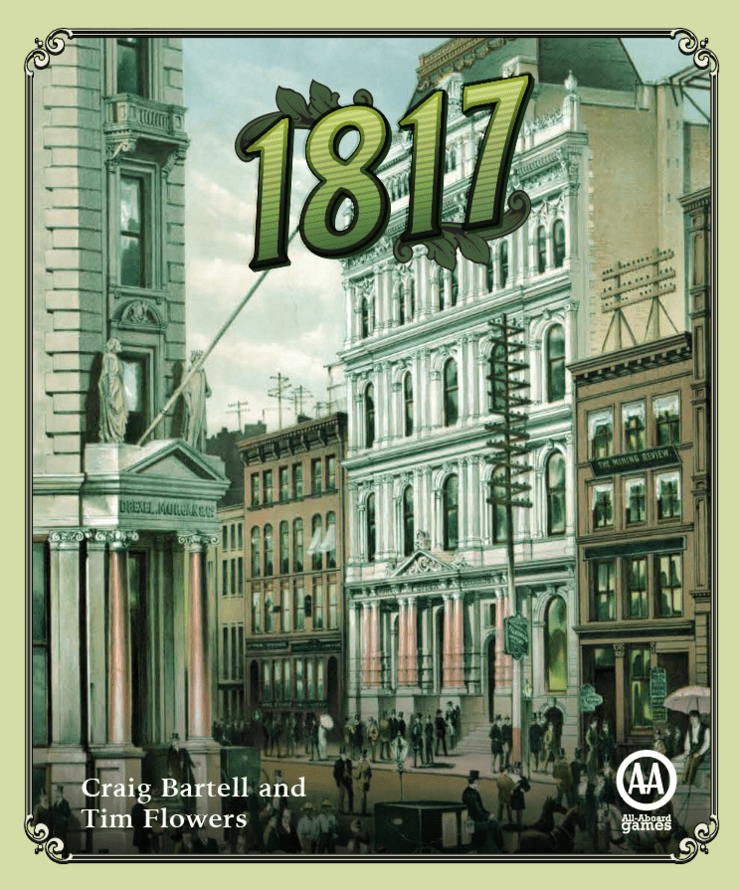
1817
All-Aboard Games, Deep Thought Games, LLC, Game Harbor · Board game · 2010
3–7 · best 5
360–540 min
Weight 4.8/5
Buy
100.0
rating
Ludopedia
8.6
rating
BGG
Our Verdict
RECOMMENDED
If you love financial challenges and want to test your negotiation skills, 1817 is your next destination.
Highlights
- Advanced financial mechanics
- Deep strategic gameplay
- Immersive market experience
- Challenge for experienced players
Keep in mind
- Long game time
- Requires attention to detail
- High complexity
Rules manual not indexed yet
Upload the PDF rulebook to ask questions about this game with AI.
About the game
What you do in a play session
1817 is a railroad operation game that goes beyond simple track building. It blends the classic mechanics of the 18xx series with a robust set of financial tools that make you feel the weight of the 19th‑century economy. The game starts with a pulsating share market, where each share represents a transportation company you can buy, sell, or, more audaciously, short sell. Short selling means you sell shares you don’t yet own, betting that the price will drop so you can repurchase them cheaper. If the market moves against you, the loss can be significant, and you still have to pay dividends while holding the short position.
The game offers a train auction, where you compete for the fastest and cheapest trains to expand your empire. Loans let you finance new routes without sacrificing immediate cash flow, but remember: interest can erode your profits if you don’t plan well. Route building involves strategically placing track tiles; each new connection opens new revenue routes and can block competitors.
The complexity of 1817 lies in balancing investment decisions, debt management, and route expansion while watching share prices fluctuate. Game time can reach six hours, so be ready for long sessions and heated debates about who should buy, sell, or take loans. If you enjoy deep strategic games focused on finance and negotiation, 1817 is a classic that will test your planning skills and patience. Get ready for a deep dive into the 19th‑century economy, where every decision can cost or earn millions in shares and trains.
For those unfamiliar with the world of stocks, the game offers clear rules and a tutorial that helps understand the share market and the nuances of short selling. The learning curve can be steep, but the payoff is a game that offers almost endless replayability, as each session can unfold uniquely depending on players’ choices.
The game offers a train auction, where you compete for the fastest and cheapest trains to expand your empire. Loans let you finance new routes without sacrificing immediate cash flow, but remember: interest can erode your profits if you don’t plan well. Route building involves strategically placing track tiles; each new connection opens new revenue routes and can block competitors.
The complexity of 1817 lies in balancing investment decisions, debt management, and route expansion while watching share prices fluctuate. Game time can reach six hours, so be ready for long sessions and heated debates about who should buy, sell, or take loans. If you enjoy deep strategic games focused on finance and negotiation, 1817 is a classic that will test your planning skills and patience. Get ready for a deep dive into the 19th‑century economy, where every decision can cost or earn millions in shares and trains.
For those unfamiliar with the world of stocks, the game offers clear rules and a tutorial that helps understand the share market and the nuances of short selling. The learning curve can be steep, but the payoff is a game that offers almost endless replayability, as each session can unfold uniquely depending on players’ choices.
Gallery
Box and component photos
Tap any photo to open fullscreen. Photos submitted by the community or publisher.
Rules videos
Learn by watching before you open the box
In English


Best player count
BGG community vote
3
REC
4
BEST
5
BEST
6
BEST
7
REC
Soundtrack
Ambience suggested by Melodice
Loading playlist...
Where to Buy
Prices monitored daily
Finding best prices...
Prices unavailable at this time.
Price history — last 6 months (lowest new offer)
As an Amazon Associate I earn from qualifying purchases. Prices and availability subject to change.
Alert enabled!
Join the BoardGamesBot deals group
Get the best board game deals every day — without message spam.
Join the WhatsApp groupGame details
Mechanics, categories, families and credits
Mechanics
Categories
Families
Publisher
All-Aboard Games, Deep Thought Games, LLC, Game Harbor
Designer
Craig Bartell, Tim Flowers
Artist
(Uncredited)
Community
Data from BoardGameGeek
1,323owners
612wishlist
167want to play
Frequently Asked Questions
Quick answers before you buy
What is the typical game duration for 1817?
A game usually lasts between 6 and 8 hours, depending on the number of players and decision speed.
How many players can participate?
3 to 7 players, though the experience is richer with 4 to 6 participants.
How complex is the game?
It is considered complex, with deep financial mechanics and a steep learning curve.
What are the game components?
Board, track tiles, train pieces, share cards, money tokens, loan tokens, and a detailed rulebook.
Who is the game best suited for?
Players who enjoy economic simulation, negotiation, and long‑term strategy.
Does the game have digital versions?
Yes, there is a digital implementation available on the 18xx.games site, facilitating online play and tutorials.
Other Games You'll Like
Based on mechanics and theme