1862: Railway Mania in the Eastern Counties — Prices
GMT Games, Korea Boardgames, LMN+B, Ltd · Board game · 2013
1–8 · best 4
Solo
120–300 min
Weight 4.6/5
Buy · from US$ 64.47
—
rating
Ludopedia
8.1
rating
BGG
Our Verdict
FOR GENRE FANS
A railway madness simulator for those who love stock market chaos.
Highlights
- Deep economic simulation
- High replayability
- Intense market mechanics
- Amazing historical immersion
Keep in mind
- Very long playtimes
- Steep learning curve
Rules manual not indexed yet
Upload the PDF rulebook to ask questions about this game with AI.
About the game
What you do in a play session
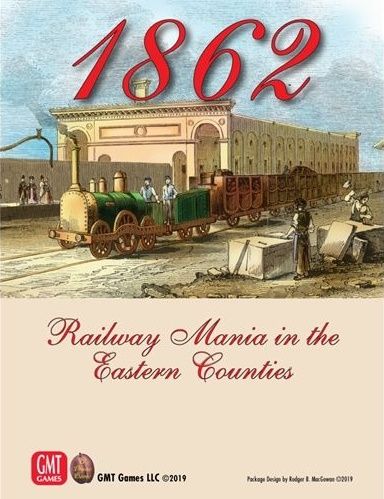
If you think stock investing is exciting, get ready for the railway chaos of 1862 England! 1862: Railway Mania in the Eastern Counties is not for the faint of heart; it's a dense entry in the 18xx series that transports you straight to the era of railway mania in East Anglia. The board is a crowded battlefield of hexagons where strategy meets pure speculation. The game features a vibrant, packed board where 16 out of 20 companies are randomly selected, ensuring every session offers a unique economic flavor.
The core of the experience lies in the complexity of capital management. You won't just be laying tracks; you'll be petitioning Parliament to secure full or partial capitalization for your companies. The market system is inspired by the semi-linear 1860 style, featuring multiple stock jumps that can turn you from a tycoon to a pauper in an instant. Furthermore, you'll manage three distinct train types, each with its own specific construction requirements and objectives. The mechanics of company mergers and re-floatations add layers of depth that will make you second-guess every investment decision.
Get ready for a network and route-building challenge where tile placement and stock holding are vital. This is a high-stakes game for those who love heavy economic simulations, where winning isn't just about having the longest tracks, but about navigating the 19th-century financial turbulence most effectively. If you are looking for a heavy 4.5-weight challenge with sessions that can last hours of pure strategic tension, this is it.
The core of the experience lies in the complexity of capital management. You won't just be laying tracks; you'll be petitioning Parliament to secure full or partial capitalization for your companies. The market system is inspired by the semi-linear 1860 style, featuring multiple stock jumps that can turn you from a tycoon to a pauper in an instant. Furthermore, you'll manage three distinct train types, each with its own specific construction requirements and objectives. The mechanics of company mergers and re-floatations add layers of depth that will make you second-guess every investment decision.
Get ready for a network and route-building challenge where tile placement and stock holding are vital. This is a high-stakes game for those who love heavy economic simulations, where winning isn't just about having the longest tracks, but about navigating the 19th-century financial turbulence most effectively. If you are looking for a heavy 4.5-weight challenge with sessions that can last hours of pure strategic tension, this is it.
Gallery
Box and component photos
Tap any photo to open fullscreen. Photos submitted by the community or publisher.
Rules videos
Learn by watching before you open the box
In English
-
 Live Teach and Play-through of 1862 with Board Game Informant
-
 1862 Parliamentary and Stock rounds
-
 1862 Solo - Full Teach Play-through with Board Game Informant
-
 1862 Set up for 2-6 players
-
 1862 Operating Round (Part 1)
-
 1862 Operating Round (part 2)
-
 1862 Solo Game Set up.
-
 1862 Solo Play Stock Round 1
-
 1862 solo play through
-
 1862 - intro
Best player count
BGG community vote
1
REC
2
REC
3
REC
4
BEST
5
REC
6
REC
7
OK
8
OK
Soundtrack
Ambience suggested by Melodice
Loading playlist...
Where to Buy
Prices monitored daily
Finding best prices...
Prices unavailable at this time.
Price history — last 6 months (lowest new offer)
Alert enabled!
Join the BoardGamesBot deals group
Get the best board game deals every day — without message spam.
Join the WhatsApp groupGame details
Mechanics, categories, families and credits
Mechanics
Categories
Families
Publisher
GMT Games, Korea Boardgames, LMN+B, Ltd
Designer
Mike Hutton
Artist
Mark Simonitch, Mike Hutton, Rodger B. MacGowan
Community
Data from BoardGameGeek
3,283owners
599wishlist
102want to play
Frequently Asked Questions
Quick answers before you buy
How long does a game take?
Get the coffee ready! Games can last anywhere from 2 to 5 hours, depending on player count.
Is the game very difficult?
Yes, it's a heavy game (4.5/5). If you've never played 18xx, prepare for a steep learning curve.
Can I play solo?
Absolutely! It includes rules for solo/solitaire play.
What is the ideal player count?
While it supports 1-8 players, the fun peaks with a large group of competitive investors.
Is it pure strategy or is there luck?
It's predominantly strategy, but the random company selection and market jumps add a dose of unpredictability.
Other Games You'll Like
Based on mechanics and theme