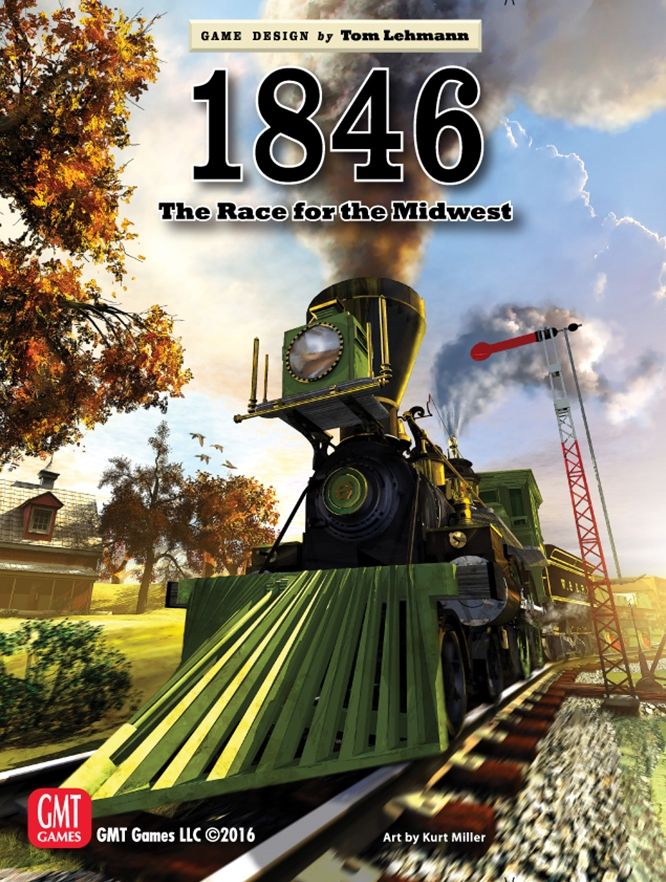
1846: The Race for the Midwest — Price & soundtrack
Deep Thought Games, LLC, GMT Games, Golden Spike Games · Board game · 2005
3–5 · best 4
120–240 min
Weight 4.0/5
Buy · from US$ 46.99
100.0
rating
Ludopedia
7.9
rating
BGG
Our Verdict
FOR GENRE FANS
Perfect for those who want 18xx depth with a slightly faster, more modern pace. The highlight is the tense financial management.
Highlights
- Initial draft adds dynamism
- Excellent player scalability
- Less punishing bankruptcies
- Incredible strategic depth
Keep in mind
- Very steep learning curve
- Long playtime for beginners
Rules manual not indexed yet
Upload the PDF rulebook to ask questions about this game with AI.
About the game
What you do in a play session
If you enjoy the financial complexity of the 18xx series, 1846 is your ticket to the railway expansion of the American Midwest. The goal is straightforward in theory but brutal in practice: end the game as the wealthiest player, summing up your cash on hand, the value of your stocks, and your private companies. The game alternates between stock rounds (where you buy and sell shares like a market shark) and operating rounds (where companies lay track, buy trains, and generate revenue).
The core dynamic is that the majority shareholder becomes the company president, making all the calls during the operational phase. However, be warned: in 1846, track building incurs costs, bringing corporate capitalization and long-term financing to the forefront of your strategy. Unlike other titles in the series, private companies are distributed via a draft rather than an auction, introducing hidden information and a degree of randomness right from the start.
Another highlight is the game's scalability. The number of corporations, private companies, and even the bank's size are adjusted based on the player count. The game ends when the bank goes bankrupt (the most common scenario) or when successive bankruptcies leave only one survivor. For those worried about total collapse, bankruptcies are less frequent here, as obsolete trains can usually be used one last time before being scrapped. It's a heavy strategy game with refined mechanics that reward those who can master cash flow and territorial expansion.
The core dynamic is that the majority shareholder becomes the company president, making all the calls during the operational phase. However, be warned: in 1846, track building incurs costs, bringing corporate capitalization and long-term financing to the forefront of your strategy. Unlike other titles in the series, private companies are distributed via a draft rather than an auction, introducing hidden information and a degree of randomness right from the start.
Another highlight is the game's scalability. The number of corporations, private companies, and even the bank's size are adjusted based on the player count. The game ends when the bank goes bankrupt (the most common scenario) or when successive bankruptcies leave only one survivor. For those worried about total collapse, bankruptcies are less frequent here, as obsolete trains can usually be used one last time before being scrapped. It's a heavy strategy game with refined mechanics that reward those who can master cash flow and territorial expansion.
Gallery
Box and component photos
Tap any photo to open fullscreen. Photos submitted by the community or publisher.
Rules videos
Learn by watching before you open the box
In English
-
 Learn 1846 Episode 1 of 5
-
 Intro to Dividend Tracking Spreadsheets
-
 Learn 1846 Episode 5 of 5
-
 Learn 1846 Episode 2 of 5
-
 Learn 1846 Episode 3 of 5
-
 Learn 1846 Episode 4 of 5
-
 How to update a Google Docs spreadsheet for 18xx
-
 1846 - intro
-
 1846 Teach and playthrough 1 of 5
-
 How To Play "1846: The Race for the Midwest"
-
 1846 Teach and playthrough 2 of 5
-
 Graphite moderator demo using GMT 1846 example of play
Best player count
BGG community vote
3
REC
4
BEST
5
REC
Soundtrack
Ambience suggested by Melodice
Loading playlist...
Where to Buy
Prices monitored daily
Finding best prices...
Prices unavailable at this time.
Price history — last 6 months (lowest new offer)
Alert enabled!
Join the BoardGamesBot deals group
Get the best board game deals every day — without message spam.
Join the WhatsApp groupGame details
Mechanics, categories, families and credits
Mechanics
Categories
Families
Publisher
Deep Thought Games, LLC, GMT Games, Golden Spike Games, Rawstone
Designer
Thomas Lehmann
Artist
Chris Lawson, John Tamplin, Kurt Miller, Mark Simonitch, Rodger B. MacGowan
Community
Data from BoardGameGeek
4,922owners
865wishlist
215want to play
Frequently Asked Questions
Quick answers before you buy
Is the game too long?
For veterans, it can take just over 2 hours. For beginners, set aside at least 4 hours to absorb the complexity.
Is it hard to learn?
Yes, it's an 'expert' game. If you've never played an 18xx, be prepared to study the rules or have an experienced player teach you.
How many people can play?
3 to 5 players, though there is an unofficial 2-player variant available in the designer's files.
Do I need to know English to play?
Hardly. The game has very little text, making it easy to memorize or adapt.
What makes 1846 different from other 18xx games?
The private company draft, the cost of track building, and the automatic scaling of components based on player count.
Other Games You'll Like
Based on mechanics and theme