4 Gods — Price & soundtrack
Ludically, Conclave Editora · Board game · 2016
2–4 · best 4
15–30 min
Weight 2.2/5
Buy · from US$ 21.79
4.0
rating
Ludopedia
5.9
rating
BGG
Our Verdict
RECOMMENDED
Perfect for those who love fast-paced, chaotic games with a touch of spatial strategy.
Highlights
- Frantic real-time dynamics
- Direct and competitive interaction
- Organic map building
- Simple and intuitive rules
Keep in mind
- Can be stressful for some
- Heavily reliant on quick reflexes
Rules manual not indexed yet
Upload the PDF rulebook to ask questions about this game with AI.
About the game
What you do in a play session
Imagine a game where everyone works together to build a map, while simultaneously trying to sabotage each other to ensure their god becomes the most powerful. In Four Gods, the adrenaline is high because everything happens in real-time. You start with tiles in hand and must fit them within a frame, matching the landscape colors. The catch is that, at the start, you can only begin in the corners and expand inward.
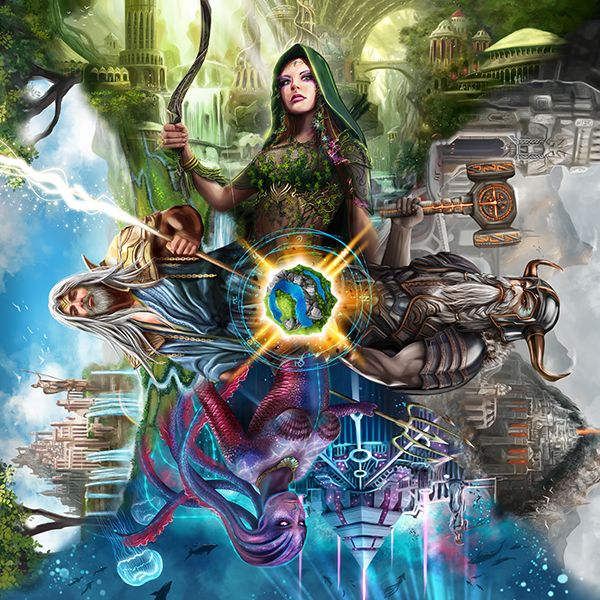
If you draw a tile that doesn't fit right now, you can toss it into your personal discard pile (up to 10 pieces), but be careful: any other player can steal a tile from your discard if they have a free hand! Strategy kicks in when you decide which of the four gods to represent. Each god is linked to a specific terrain type. Once you claim your patron, you can place prophets on the tiles you've just positioned, attempting to dominate the largest landscape areas.
There's also the clever 'city' move: if you notice a space that has become impossible to fill with any tile, you can place a city marker and claim it with your prophet. However, stay alert, because if someone finds a matching tile later, they can 'smash' the city and steal the points. The game ends when the world is full or when players agree that no more tiles can be placed. Scoring is based on occupied cities, the size of the terrain masses, and the number of distinct groups of each landscape. It's an organized chaos where you need quick reflexes to place pieces and strategic vision to dominate the land. The god with the most influence wins!
If you draw a tile that doesn't fit right now, you can toss it into your personal discard pile (up to 10 pieces), but be careful: any other player can steal a tile from your discard if they have a free hand! Strategy kicks in when you decide which of the four gods to represent. Each god is linked to a specific terrain type. Once you claim your patron, you can place prophets on the tiles you've just positioned, attempting to dominate the largest landscape areas.
There's also the clever 'city' move: if you notice a space that has become impossible to fill with any tile, you can place a city marker and claim it with your prophet. However, stay alert, because if someone finds a matching tile later, they can 'smash' the city and steal the points. The game ends when the world is full or when players agree that no more tiles can be placed. Scoring is based on occupied cities, the size of the terrain masses, and the number of distinct groups of each landscape. It's an organized chaos where you need quick reflexes to place pieces and strategic vision to dominate the land. The god with the most influence wins!
Gallery
Box and component photos
Tap any photo to open fullscreen. Photos submitted by the community or publisher.
Rules videos
Learn by watching before you open the box

Best player count
BGG community vote
2
REC
3
REC
4
BEST
Soundtrack
Ambience suggested by Melodice
Loading playlist...
Where to Buy
Prices monitored daily
Finding best prices...
Prices unavailable at this time.
Price history — last 6 months (lowest new offer)
Alert enabled!
Join the BoardGamesBot deals group
Get the best board game deals every day — without message spam.
Join the WhatsApp groupGame details
Mechanics, categories, families and credits
Mechanics
Categories
Publisher
Ludically, Conclave Editora
Designer
Christophe Boelinger
Artist
Ismaël Pommaz
Community
Data from BoardGameGeek
1,903owners
196wishlist
25want to play
Frequently Asked Questions
Quick answers before you buy
Is the game very complex?
Not at all! The rules are simple and quick to learn; the challenge lies more in agility and spatial awareness than in long manuals.
How long does a game last?
It's very quick, usually between 15 and 30 minutes, making it great for multiple rounds.
Does it work well with any number of players?
Yes, it scales well from 2 to 4 players, maintaining the real-time tension.
Do I need a lot of manual dexterity?
Yes, since it's real-time, players who are faster at fitting pieces and grabbing tiles from discards have an advantage.
Who would you recommend this game to?
Groups who enjoy high-energy party games or tile-placement fans looking for something less contemplative and more frantic.
Other Games You'll Like
Based on mechanics and theme