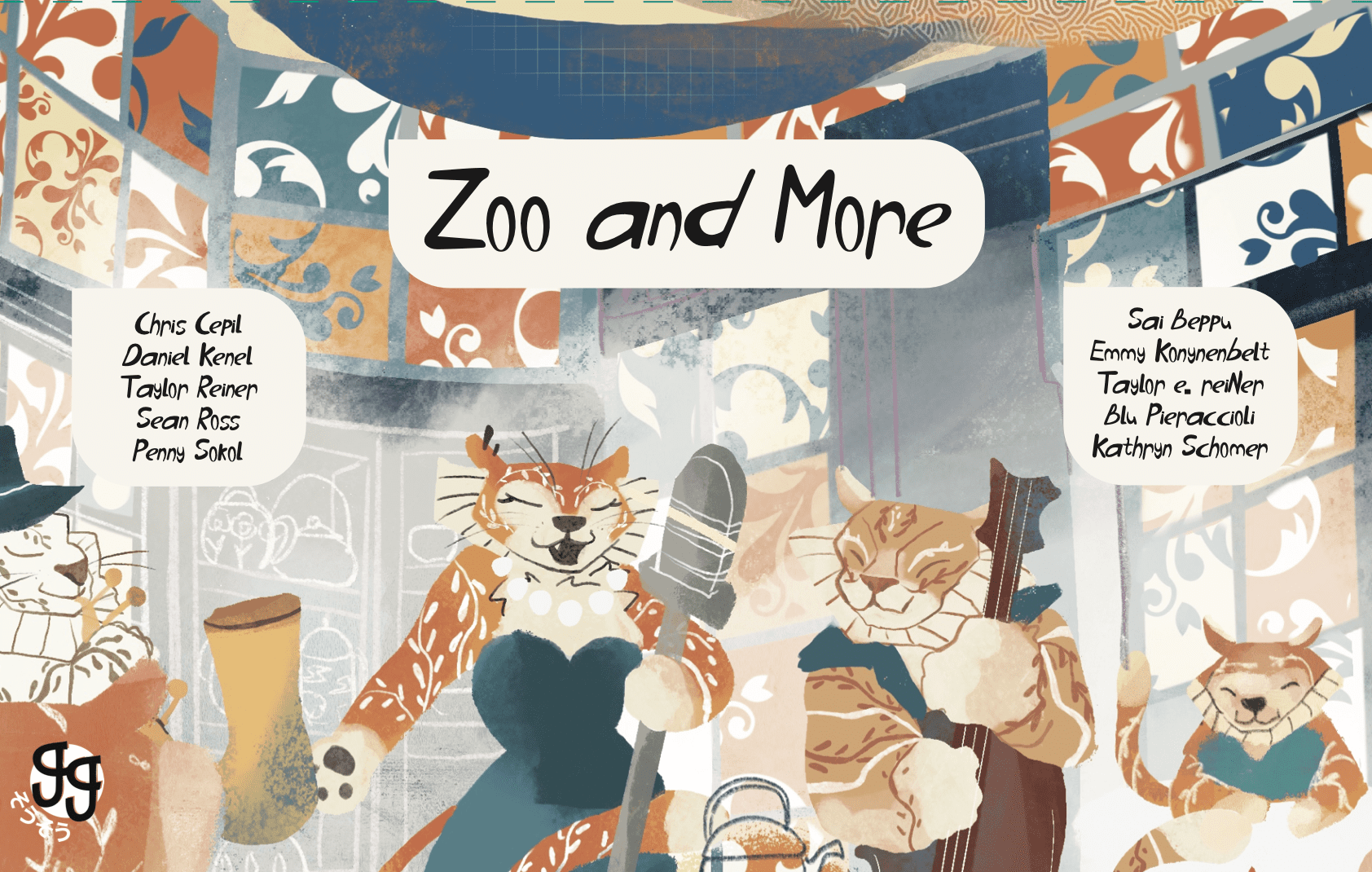
What is your question about Zoo and More?
Ask before downloading the manual: the assistant was trained on this file and answers instantly, citing the exact page.
Ask questions about the game
Ask anything about Zoo and More: rules, setup, components, complexity, price, or whether it fits your group.
Write your question first. You will create your free account to see the answer — it takes 20 seconds.
Full rulebook
Browse the manual or download the original PDFFull manual text available to read Open text
4. Chai Tea Jazz (2-4, 6 Players, 55-125 Minutes)
20. Short Zoot Suit (2-4 Players, 15-25 Minutes)
26. Bug House Millionaire (4 Players, 5 Minutes)
32. Hodge Podge Dodgeball (2, 4 Players, 15-25 Minutes)
44. Through the Zoo (2-4 Players, 25 Minutes)
51. Thanks and Credits
Contents
1
Zoo and More
A Compendium
---
2
Zoo and More is a compendium of card games from
a variety of designers and artists.
Each deck of cards is its own game that uses a
standard deck of cards, with various additions to
make it unique.
For the uninitiated: A standard deck is what you may
see in a poker game, bar, while camping, etc. It’s just
a deck of cards that has 4 suits [Clubs, Diamonds,
Hearts, and Spades] and the card ranks range from
Ace to King.
All 4 standard decks of cards in Zoo and More can
be combined to play a 5th meta game using rules
from a variety of other standard deck games.
In truth, this project is a celebration of the standard
deck and all it has done, is doing, and will do!
What is this?
You may be familiar with terms
like ‘Trick’ or ‘Meld’, but if you aren’t,
the next page is for you!
Feel free to skip it if you’re
already a card shark.
---
Trick-taking is a mechanism used in many card games. A trick is formed when each player, in turn, plays a card from their hand to the middle of the play area. The trick is then won by one of the players. The first player in any trick (or lead player) may play any card from their hand. The suit of this led card is the trick’s led suit. The remaining players in turn order must then add to the trick with a card of the same suit, or follow suit, if they are able to. If a player cannot follow suit, they are considered short-suited, and may play any other card from their hand. The highest card in the suit led will win the trick. Trump suit is a suit that is stronger than the others, and will beat the lead suit. May trump involves being able to play cards of the trump suit, even if you could follow suit. In must-not-follow games, the players in turn order must add to the trick with a card not matching the suit of any previously played card, if they are able to. The highest card will win the trick, usually (see other possible cases). The winner of a trick will lead the next trick.
3
A Shedding/Climbing game is where players take turns playing melds, or combinations/sets of cards. The goal of Shedding games is to play out all of your cards first, or to shed out. The Climbing aspect refers to the card play, where players must play stronger or higher melds in order to play at all. The first player, or Start Player, will play a certain meld and the following players can either play a stronger set of cards of that same meld type or pass. Passing is declaring that the player is out of the card play until a new trick (Hard Pass). A new Start Player is determined when all but one player passes. That remaining player will start play again by playing any valid meld. Play continues until someone has shed out. Partnership is when two players are on a team.
---
By Chris Cepil,
Taylor Reiner,
Sean Ross,
and Blu Pieraccioli
3 Players,
with variants for
2, 4, and 6 players,
55-125 Minutes
Chai Tea Jazz
4
•52 Playing Cards (A-K in 4 suits)
•2 Joker Cards
•2 Current Direction/Bid Cards
•2 Barrel/Bet Debt Cards
•2 Trump Suit Cards
•3 Player Aids
•1 Paper Pad
A trick-taking game where players
must all accomplish the same tasks
and compare feats.
Video Rules
Hook
Components
---
It’s the annual battle of the bands at Claude’s Chai Cafe, Chaipour’s #1 jazz cafe!
Your band is tasked with covering the greatest hits better than the rest.
You've just trimmed your claws and you're ready to tickle the ivories, the brasseries, and the silveries.
So grab the song menu, pick just the right song at just the right time, and blow away all those cool cats!
*A note on the game name:
Did you know that ‘chai’ means ‘tea’ in both Russian and Hindi?
At the risk of sounding like we’re saying ‘ATM machine’, the title actually is a nod to the fact that Chai Tea refers to the specific tea drink.
Chai Tea is different from a Chai Latte, which has a milk base. Ordering just a ‘Chai’ can lead to confusion between the two drinks, so this jazz cafe decided to specify. ;)
5
Video Rules
Theme
---
These rules are for 3 players. See the section “Rules for 2, 4, and 6 Players” for rules for other player counts.
1. The deck is 36 cards consisting of ranks 1-9 in four suits.
2. Shuffle the deck and deal all cards equally, 12 to each.
3. The start player for the first round is the last player to drink a chai. Give that player the 5-point Barrel card (0 side up). Set the Current Bid/Bidder cards nearby.
4. Players agree on the amount of contracts (and which contracts) they will play in the game. The standard game is on one side of the Paper Pad (with room for additional contracts, if desired), while the opposite side has a fully blank contract list for full customization. For your first play, it is recommended to play the standard side without additional contracts. (4 base: Trump, Under, Slalom, and Joker)
Setup 5
The standard game lasts 12 rounds:
4 contracts, each played by the three players.
Each round consists of two phases:
a Picking phase and a Trick-Taking phase.
In the Picking phase, players decide what type of game they are playing, through a mix of picking a contract, passing, and/or betting.
After a contract is determined, the Trick-Taking phase involves one player trying to score points, while the other two players try to hinder that sole player. After the trick-taking, players count the points won by the sole player and track that on the Paper Pad.
At the end of the game, players compare scores for all of the contracts and the player who did the best comparatively wins.
6
Gameplay Flow
---
To begin, the player with the Barrel card first looks at their hand, then either picks a contract for the round or passes.
Pass
If they pass, the next player clockwise is in the same position where they must either pass or pick a contract.
If everyone passes, that original player with the Barrel card is forced to pick a contract.
7
Pick a Contract
If the player with the Barrel card did not pass, but rather picked a contract, then the next player clockwise may now either pass or incur Bet Debt to pick a different contract.
Overall, if a contract has been picked and the next player has not yet passed, that next player may either pass or pick a new contract and increase the Bet Debt to any amount on the Barrel card, up to 35.
The game is Hard Pass, meaning if a player passes then they are out for the remainder of that Picking phase.
Players may not pick a contract they have already completed. Therefore, once a player has completed all contracts, they must pass for the rest of the game; they may not take on Bet Debt.
When a player picks a contract, they take the Current Bidder card, not the Barrel card. They also put the Current Bid card near the contract board pointing to their current bid. If any Bet Debt is declared, the Barrel card is rotated and/or flipped to have that Bet Debt number at the top, to keep track of the current Bet Debt.
The player who finally picked the contract is the declarer.
The declarer plays alone against the other two players.
Picking Phase
---
Contracts
The types of contracts are: Trump, Under, Slalom, Joker.
They are worth different game points, listed in the middle
of the Paper Pad.
8
Trump (1 Game Point): The picking player
decides which of the four suits is trump for
the round. The trump suit is declared when
the player picks the contract. No trump suit
is not allowed in this contract. The ranking
would then be the 9 in the trump suit is the
strongest down to the 1 in the trump suit,
then the 9>1 in the lead suit. In this setup,
this contract has the only trump.
Under (2 Game Points): The ranking is
changed to where the lowest card is now
the strongest: 1>2>3..>9.
Slalom (2 Game Points): The ranking
alternates every trick between 9>1 and 1<9,
repeating until the end of the round.
Before the round starts, the picking player
chooses whether the round starts with the
highest being the strongest or the lowest.
Joker (3 Game Points): This contract is
whichever of the above contracts the player
wants, declared when picked. It may be any
contract, even one the player has previously
completed.
---
Example (Forced Pick):
Aslan has the Barrel card and decides to pass.
All the other players pass.
Aslan is forced to pick a contract.
He chooses Under and takes the Current Bidder card.
He sets the Current Bid card on Under.
Under is the contract and players move to the
Trick-Taking phase
9
Trump (1 Game Point): The picking player
decides which of the four suits is trump for
the round. The trump suit is declared when
the player picks the contract. No trump suit
is not allowed in this contract. The ranking
would then be the 9 in the trump suit is the
strongest down to the 1 in the trump suit,
then the 9>1 in the lead suit. In this setup,
this contract has the only trump.
Under (2 Game Points): The ranking is
changed to where the lowest card is now
the strongest: 1>2>3..>9.
Slalom (2 Game Points): The ranking
alternates every trick between 9>1 and 1<9,
repeating until the end of the round.
Before the round starts, the picking player
chooses whether the round starts with the
highest being the strongest or the lowest.
Joker (3 Game Points): This contract is
whichever of the above contracts the player
wants, declared when picked. It may be any
contract, even one the player has previously
completed.
Example (Simple Pick):
Aslan has the Barrel card and decides to pick Trump as
the contract, with Diamonds as the trump suit.
Aslan takes the Current Bidder card and puts it
in front of himself.
He also puts the Current Bid card pointing to the
Diamonds Trump contract. (He may, if desired,
use the included Trump reminder cards and
set them to Diamonds).
The other players all pass.
Trump (Diamonds) is the contract and players move
to the Trick-Taking phase.
Current
Bid
->
Current
Bid
->
---
Example (Multiple Picks):
Aslan has the Barrel card and decides to pick Joker (Under) as the contract. Aslan takes the Current Bidder card and sets the Current Bid.
Leo passes.
Mufasa takes on 5 Bet Debt to pick Slalom as the contract, taking the Current Bidder card and setting the Current Bid. The Bet Debt card is rotated to 5.
Aslan takes on 10 Bet Debt to pick Under as the contract, taking the Current Bidder card and setting the Current Bid. The Bet Debt card is rotated to 10. Notice Aslan changed their contract, which is allowed.
Mufasa passes.
Under is the contract and players move to the trick-taking phase.
10
Example (Multiple Picks):
Aslan has the Barrel card and decides to pass.
Leo is next clockwise and picks Under as the contract, taking the Current Bidder card and setting the Current Bid.
Mufasa picks Trump (Hearts) as the contract. He increases the Bet Debt to 5 points and takes the Current Bidder card and sets the Current Bid. The Bet Debt card is rotated to 5.
Aslan passed, so he is skipped.
Leo takes on 10 Bet Debt to pick Under as the contract. Leo takes the Current Bidder card and sets the Current Bid. The Bet Debt card is rotated to 10.
Mufasa takes on 20 Bet Debt to pick Trump (Hearts) as the contract, taking the Current Bidder card and setting the Current Bid. The Bet Debt card is flipped and rotated to 20.
Aslan passed, so he is skipped.
Leo passes.
With everyone passed, Trump (Hearts) is the contract and players move to the trick-taking phase.
---
With the contract picked, the Current Bidder will lead to the first trick. The trick-taking is must-follow, may-trump (if trump was declared). If the contract has a trump suit, may-trump allows players to play a trump card, even if they could follow suit. If the trump suit is led, the following players must play a trump card, if they have one.
The Current Bidder’s goal in the trick-taking phase is to capture the cards with the points on them; all of the odd cards have points. The number of points an odd card has is equal to the card’s rank.
Example (May Trump):
The contract is Trump (Hearts) and Aslan leads a 9 of Clubs.
Leo has both Clubs and Hearts, and decides to play a 2 of Hearts instead of following suit.
Mufasa has Clubs and no Hearts, so he plays a 7 of Clubs.
Leo wins the trick, capturing 16 points on the 9 and 7 cards
The strongest card wins the trick (which may be the highest, lowest, trump, or something else, depending on the contract). The winner of the trick leads to the next trick. Play out all of the tricks, taking note of who wins the last trick as it’s worth points.
11
Trick-Taking Phase
---
After all of the tricks have been played, the Current Bidder counts the points on the cards that they won. (Sometimes it’s easier for the other team to count their points and do the math to find out how many points the declarer won, as there are 100 total points on the cards). If the Current Bidder won the last trick, they add 10 points to their total. If the Current Bidder took on a Bet Debt, the Bet Debt amount is subtracted from their total.
They put this total onto their spot for the contract that was just played. They also mark whether they were the first, second, or third to complete that specific contract.
If a row on the scoreboard is completed, players award game points. Depending on the value of the contract, the player who scored the most points gets game points equal to the positive value of the contract. The player who did the worst gets game points equal to the negative value of the contract. The middle player gets zero points. If there is a tie in any way, the tied player who finished the contract earliest gets the higher position in the scoring.
12
Scoring
---
The contract of Under was just completed by Leo, who got 75 points.
All three players have now completed the Under contract, and it can be scored.
Aslan got 59 points and Mufasa got 33 points.
The Under contract was worth 2 game points, so Leo wins +2 game points, Aslan gets 0 game points, and Mufasa gets -2 game points.
If Leo got 59 points and he and Aslan tied, Aslan would get the +2 game points because Aslan finished the Under contract before Leo.
1213
---
If a player finishes their last contract, mark their Final Score box with which position they finished the game (similar to the contract position).
If there are more contracts to complete, shuffle and redeal the cards. Flip the barrel card to the 0 side face-up and pass both it and the Current Bet card to the next player in turn order who has contracts to complete.
Note: If it’s impossible for a player to lose the overall game, players may end the game early if they don’t wish to determine second or third place.
The standard game ends after 12 rounds.
Players total their game points from the contracts and the player with the most game points wins!!
If tied, the player who finished all their contracts first wins.
Congrats on playing the sweetest licks in the spiciest chai club!!
End of Game
14
End of Round
---
The 2 player game is similar to the 3 player game, except for a few things.
The game is one versus one. Players sit across the table from each other. Each contract is only played twice, once for each player.
The deck is the same. Each player is dealt 17 cards each as follows:
Set aside 2 cards facedown.
Deal 5 cards facedown in front of each player
Deal 5 cards face-up on top of the facedown cards to create each player’s straw-pile. A straw-pile is a group of cards that is part of the player’s hand.
Deal 7 cards to each player.
During the Trick-Taking phase, players may play any card from either their hand or any face-up card from their straw-pile. When a card from their straw-pile is played, the card below it (if there is one) is flipped face up, but only after the trick is complete.
Before Scoring begins, the 2 set-aside cards are split between the players, with the winner of the final trick taking the higher card. Everything else is the same as the 3 player game.
2 Players
2
2
2
2
8
8
8
8
7
7
7
7
3
3
3
3
6
.
6
.
6
.
6
.
15
Rules for 2, 4, and 6 Players
---
The 4 player game is similar to the 3 player game, except for a few things.
The game is now two versus two. Players sit alternating from their teammate, so the teams are A,B,A,B.
Each contract is only played twice, once for each team.
The deck is the same, with the players dealt 9 cards each.
The Barrel/Bet Debt card is now the 3 point increment card.
Players may not discuss their hands or intentions with their teammates. Everything else is the same as the 3 player game.
4 Players (Teams)
The 6 player game is similar to the 3 player game, except for a few things.
The game is now three versus three. Players sit alternating from their teammate, so the teams are A,B,A,B,A,B.
Each contract is only played twice, once for each team.
The Barrel/Bet Debt card is now the 3 point increment card.
The final trick is now worth 20 points.
The deck is different: 1-13, in four suits, plus 2 Jokers. Players are dealt 9 cards each.
There are now 200 total points in the deck.
The Jokers are the strongest cards in the game, beating any trump or other card. The later-played Joker wins if both are played in the same trick.
If a more balanced deck is desired, players can make a double deck with 2 copies of 1-9 each, in the four suits. This would keep the 200 points in the deck. This can be done using 2 decks combined from the box. The only rule needed is that the earlier played card wins, if there is a tie.
Players may not discuss their hands or intentions with their teammates. Everything else is the same as the 3 player game.
6 Players (Teams)
16
---
When everybody passes and the player with the Barrel card is forced to pick a contract, they may instead reverse the Bet Debt by offering any amount out to other players to take the barrel instead. If accepted by another player, that player adds those offered points to the total that they get after picking a contract for themselves and playing that picked contract. The offer may keep growing, in the allotted increments, until either an opponent takes the offer, the max of the Bet Debt is offered, or the player with the Barrel card gives up, rescinds the offer, and picks a contract themselves.
Passing the Barrel
To play Chai Tea Jazz more like the traditional game it’s founded on, play with these three rules tweaks:
Match Points: If a player wins all the tricks in a round, they get 1 additional game point.
Jass Deck: Included in the box are 12 cards to be able to play the original game Coi eur-Jass. You simply use the deck makeup of 6,7,8,9,10,U,O,K,A. Rules for playing the full game of Coi eur-Jass are found online.
Jass
Custom Contracts Setups
1st Tier (Worth 1 Game Point):
Any Suit Trump
2nd Tier (Worth 2 Game Points):
Slalom/Pyramid
Short
17
Variants
---
1st Tier (Worth 1 Game Point):
Black Suit Trump
Red Suit Trump
2nd Tier (Worth 2 Game Points):
Under
Over
Slalom
Pyramid (See Below)
3rd Tier (Worth 3 Game Points):
Joker
Joker
Joker
Long
Additional Contracts
Pyramid: This contract is like Slalom, except that it involves 6 tricks either Up or Down, then 6 tricks the other way. So instead of oscillating between High and Low, it is 6 tricks one way, then 6 the other. The declarer decides whether to start the round High or Low.
Over: This is like Under, except the highest card wins. This could be thought of as standard trick-tacking without a trump suit.
Trump Under: This is a combination of the Trump contracts and the Under contract. It also leans toward there being other trump combination contracts like Trump Slalom, Trump Pyramid, etc.
18
---
Additional Contracts
Trump Specific Suit: You could have 4 separate contracts where a specific suit is trump.
Middle: This is similar to Over and Under, except that the middle cards are the strongest, with the order being (from strongest to weakest): 5, 4, 6, 3, 7, 2, 8, 1, 9.
Avoidance: Score as few points as possible. First place goes to the player with the lowest score, second place to second lowest, etc.
Meta Contracts
The below contracts work with any other contract, as they turn things on their head in a meta way:
Get second place within the row: Lowest score gets 0 game points, first gets negative game points.
(Only works in a 3 player game)
Cumulative: At the very end, add all scores over the whole board from each contract. Most (or least) wins.
(Note: interesting combo with an avoidance contract)
19
---
By Taylor Reiner
and Sai Beppu 2-4 Players,
15-25 Minutes
Short Zoot Suit
• 52 Playing Cards (A-K in 4 suits)
• 5 Additional Scoring Cards
• 4 Player Aids/Draw Deck Markers
• 1 Blank Additional Scoring Card
A trick-taking game
where playing
no-suit is rewarded.
20
Video Rules
Hook
Components
---
Welcome to 1935 Bollywoods!
It’s Oscar night and the stars have come to walk the red
carpet, or rather crawl.
See this is Bollywoods, Bear Hollywood, and these osos
are oh so stylish. Thankfully, Goldilocks has agreed to put
the past in the past and make you just the right fit for your
zoot suit–not too long and not too short. Now try your
darndest to be the Bear of the Ball and win beast dressed!
Build the deck and deal based
on player count:
2p: 2-9, 4 suits
Shuffle and deal all but 2
3p: 2-13, 4 suits
Shuffle and deal all but 3
4p: 1-13, 4 suits
Shuffle and deal all
Give each player a player aid/Draw Deck card.
If playing with Intermediate Scoring (see section below),
choose an Intermediate Scoring card.
The start player for the first round is the last player to
watch a short film.
21
Theme
Setup
---
At the start of a round, players pick any 5 cards from the cards they were dealt. Players then flip these 5 cards facedown, shuffle them, and place them into a pile in front of themselves. This is the draw pile for the player.
Before every trick begins, anyone may draw 1 card from their personal draw deck.
If, after this, anyone has 0 cards left in their hand (not draw deck), the round is over.
The trick-taking is must-follow, with no trump.
The highest card of the lead suit wins.
The winner takes the trick, except for any non-lead-suit cards. Those cards go back to the player who played them, face-up into that player’s shorts pile.
Example:
Bearilyn Monroe starts the trick with a 5 hearts.
Bearyl Streep follows suit with a 7 hearts.
Audrey Hepbearn is out of hearts, so she plays a 3 of clubs.
Bearyl Streep played the highest of the led suit, and will win the trick, taking all cards in suit.
Audrey will take her 3 and put it into her shorts pile, face-up.
22
Gameplay Flow
The standard game lasts 12 rounds:
4 contracts, each played by the three players.
Each round consists of two phases:
a Picking phase and a Trick-Taking phase.
In the Picking phase, players decide what type of game they are playing, through a mix of picking a contract, passing, and/or betting.
After a contract is determined, the Trick-Taking phase involves one player trying to score points, while the other two players try to hinder that sole player. After the trick-taking, players count the points won by the sole player and track that on the Paper Pad.
At the end of the game, players compare scores for all of the contracts and the player who did the best comparatively wins.
---
Number of Points
1
2
3
4
1
5
10
20
1*
Unique Suits
Players earn 1 point per trick won and 3 points for each pair of won trick and card in their shorts pile. If the number of tricks they won equals the number of shorts, the player earns 5 points per pair rather than just 3 points.
Example:
Brother Berenstain won 1 trick and has 1 short: 1 point for 1 won trick and 5 points for the 1 equal pair: 6 total points.
Sister Berenstain won 3 tricks and has 3 shorts: 3 points for 3 won tricks and 15 points for the 3 equal pairs: 18 total.
Ditka won 3 tricks and has 2 shorts: 3 points for 3 won tricks and 6 points for the 2 unequal pairs: 9 total.
Smokey won 1 trick and shorted 6 times: 1 point for 1 won trick and 3 points for the 1 pair: 4 total.
Baron won 4 tricks and didn’t short: 4 points for 4 won tricks.
Winnie won no tricks and shorted 2 times: 0 points
Intermediate Scoring
In addition to the above scoring, players shuffle the ‘Additional Scoring’ cards and draw 1 to be used in the game (or a different one each round, if desired).
For the first game with Intermediate Scoring, it is recommended to play with the Stared Additional Scoring card where players count the number of different suits in their shorts pile and get points based on that number:
23
Scoring
---
Players play rounds per player, where the next round’s start player is the person to the left of the previous round’s start player.
Most points wins!! Congrats on being best dressed!!
If tied, the tied players email their favourite movie to me, Taylor, at taylorereiner@gmail.com, and I’ll crown the winner!!
Example:
Paddington shorted 2 spades and 1 heart, they get 3 bonus points for 2 different suits.
Baloo shorted 1 spade, 1 diamond, 1 heart, and 3 clubs, they get 20 bonus points.
Grills didn’t short at all and got 0 bonus points.
24
End of Round
End of Game
---
Players skip making a personal deck at the start. Instead, at the start of every trick, players may either place a card facedown from their hand onto their draw deck or draw a card from their draw deck. Neither is required. This variant builds the draw decks during play.
Sean’s Short Shorts
25
Variant
---
By Taylor Reiner
and Kathryn Schomer
4 Players, 5 Minutes
• 64 Playing Cards (0-15 in 4 Suits)
• 2 “May Lead Singles” Variant Cards
• 4 Player Aids
• 2 Chess Clock Timers (Not Provided, scan QR code for apps)
A climbing/shedding game where you can pass cards to your partner in real-time.
26
Video Rules
App Clock Timer
Hook
Components
---
The backyard housing market in Johannesbug was ne
until the lawn was laid. Now every bug needs a six- gure
down payment to wrangle even the most humble abode.
Add to that, a competing couple seems to be making bids
faster than you and yours, so hurry and make an o er!
1.Shu e and evenly deal all the playing cards.
2.Players sit next to their partner, side by side, and across
from their opponent.
3.Set up 2 chess timers, 1 between each of the pairs of
opponents. The clock facing the player is their
personal clock.
4.Players set the chess timers to 1:55 minutes each, no
increment.
(Note: the timer in the game is meant as a means of
pressure, but not stress. If real-time games are abhorred
or a beginner game is desired, add more time to the
timers to balance out the pressure.)
5.There will be two start players. One of the start players
for the rst round is the person who last contemplated
the crushing stress of buying a house. The other start
player is the opponent diagonal to the rst start player.
27
App Clock Timer
Setup
Theme
---
Players are competing in two simultaneous, real-time, 2 player shedding/climbing games, where both games stop when either any player is out of cards or any player’s timer runs out.
To begin, start the timers.
Now, the start players will play to the table any valid meld.
Valid Melds
Singles
Pairs
Suited Runs
The following player must either play or pass.
Anytime after leading, playing or passing, a player must hit their clock before the other player’s turn.
A player does not need to take their turn until their opponent hits the clock.
To play over the lead meld, a higher combination of the lead meld must be played.
If either player passes, the trick ends.
28
Gameplay Flow
---
Flik leads a 1. Hits his clock.
Zorak thinks a bit, then plays a 3. Hits his clock.
Flik passes. Hits his clock.
Zorak wins the trick.
The winner of the trick now picks any 1 card from the trick
they just won and gives it over to their partner.
They must give a card to their partner before they lead into
their next trick.
Open communication is allowed; players may say
anything. A player may ask their partner what they need,
may talk about their hands, may discuss strategy, etc.
The only rule is players cannot show either their hand or
the contents of the collected trick to their partner. A player
may watch over their partner’s trick as they play, but once
the trick is collected and players are in the process of
passing a card, players may not show those collected cards
to their partner openly.
29
00:01
A A
AA
A A
AA
A A
AA
3 3
33
3 3
33
Pass!
00:00
00:01
00:05
00:02
00:05
---
When passed a card, the partner takes the passed card immediately into their hand. Players may pass a card after some discussion, or may just give their partner a card if they wish to forgo communicating.
The winner of a trick may delay passing a card to their partner, if desired. Though the winner is still using up their clock, it may be the better move to wait.
Example:
Jiminy leads a suited 4,5,6. Hits his clock.
Barry plays a suited 6,7,8. Hits his clock.
Jiminy plays a suited 11,12,13. Hits his clock.
Barry passes. Hits his clock.
Jiminy wins the trick.
After some chatting with his partner, Jiminy gives over the 5 card from this trick to his partner.
Jiminy leads the next trick and hits his clock.
Play like this continues until either: any player on either team is out of cards or any player’s clock runs out.
30
End of Round
---
Ease of Timing
As mentioned before, the game is meant to have pressure, but not be stressful. The time of 1:55 on each timer was arrived at after playing with experienced players. A time of 2:55 or 3:55 is fine, and can lead to different vibes.
Delayed Singles
This variant involves more risk to the cardplay. Each team puts a Singles Allowed card in between them on the table. The game plays the same, except no player can lead singles. That is, until they take their team’s Singles Allowed card in front of themselves. Then they may lead singles. Either player on the team may take the card at any time, but once the card is taken, it cannot leave from in front of that player, blocking their partner from playing singles for the rest of the game. So players must time when/if they think they can take the card to be able to go out. Players may always follow/play on singles; when an opponent takes the Singles Allowed card and leads a single, the other player may play onto that lead single with a higher single.
Check how the game ended:
if a player is out of cards, their team wins!!
if a clock runs out on a player, the other team wins!!
31
End of Game
Variants
---
By Daniel Kenel, Taylor Reiner, and Kathryn Schomer
4 Players, with a variant for 2 players, 15-25 Minutes
Hodge Podge Dodgeball
• 52 Playing Cards (A-K in 4 suits)
• 4 Ringer Variant Cards (0/14 in 4 suits)
• 2 All-Stars (Jokers)
• 4 Player Aides
• 2 Timeout/Bench Cards
• 1 Match Point/Variant Card
A trick-taking game with trick-avoidance, must-not-follow, and partnerships, oh my!
32 Video Rules
Hook
Components
---
Welcome to the village of Longcoat – England’s hub for the Raccoon Dodgeball League! We’re not that fancy-pants dodgeball that you’ve seen in the city; this is the real country stuff. You won’t be finding pristine courts or any ‘regulation-sized’ dodgeballs round here. Instead, we just use whatever we can scrounge up. A tennis ball? Yep! A rolled-up sock? Clever, why not! A rock? Ok, maybe not a rock, but anything else non-life-threatening will do. So grab whatever you can because we’re playing in the championship in 5 minutes and I still need to stock-up on balls from that garbage can over there.
33
Video Rules
Theme
---
1. Players sit diagonally opposite of their partner.
2. Place the Team Bench cards next to each other nearby, with their ‘1 Timeout Left’ side up.
3. Keep the Match Point card in the box, but give each player a Player Aide and a Team Marker card for their team in front of themselves as a reminder of which team they’re on.
4. Shuffle and evenly deal all the playing cards.
5. Place an All-Star card (Joker) on each team’s bench.
6. Players simultaneously add 1 card from their hand to their respective benches, face-up.
7. Teammates simultaneously pass each other a card from their hand.
8. The start player for the first round is the last player to throw something (tosses count).
34
JOKER
JOKER
JOKER
JOKER
JOKER
JOKER
JOKER
JOKER
10
10
10
10 Q
Q
Q
12
12
12
12
2
2
2
2
3
3
3
3
BLUE TEAM
TIMEOUT
LEFT
1 RED TEAM
TIMEOUT
LEFT
1
Setup
---
The trick-taking is must-not-follow suit. The highest card played usually wins the trick, regardless of suit. However, certain situations arise when multiple players play the highest card.
Tricks continue until any player cannot make a valid play. When that happens, the round ends immediately.
A trick resolves in one of four ways:
When a player:
Gets hit by a ball.
Blocks a ball for their partner.
Catches a ball thrown by their opponent.
Can’t play a card.
Resolve a trick at the end after every player has played a card, never during the trick. The only exception is when a player can’t play a card, which ends the round immediately.
Getting Hit
If a player plays the highest card, without any ties, they get hit with a ball and must send a card to their team’s bench. Cards in the game represent your team’s raccoon athletes.
The hit player must put a card from their hand to their team’s bench face-up. This card must be the player’s lowest rank in that suit (lowest does not count All-Stars, which are explained later). Your weakest raccoons get hit first.
After doing this, the hit player leads the next trick.
35
Gameplay Flow
---
Getting Hit Example:
Peter leads a 5 of Spades.
White plays a 6 of Clubs.
Kate plays a 3 of Diamonds.
Blazer, who must play a Heart, plays a 7 of Hearts and thus gets hit because they played the highest number.
Blazer must now put one of their cards on the bench.
Blazer’s hand:
3, 5, 7 of Clubs
9, 10 of Spades
8 of Hearts
4, 9 of Diamonds
Since Blazer must place a card that has the lowest rank within the suit, Blazer can put on the bench any of the following: 3 of Clubs, 9 of Spades, 8 of Hearts, or the 4 of Diamonds.
Blazer puts the 3 of Clubs on the bench, then leads the next trick.
36
5
55
5 6.
6.6.
6. 3
33
3 7
77
7
TIMEOUT
LEFT
1
J
O
K
E
R
J
O
K
E
R
J
O
K
E
R
J
O
K
E
R
2
22
2 3
33
33
33
3
---
Blocked
If a player is going to get hit by playing the highest number, but their teammate plays the same highest number, then the teammate blocked the incoming ball and saved their teammate from being hit. This means that no player has to send a card to the bench. The team of the player that blocked the ball now decides which player on their team leads the next trick.
Blocked Example:
Blade leads a 3 of Clubs.
Justin plays a 7 of Hearts.
Laser plays an 5 of Spades.
Gordon plays a 7 of Diamonds, blocking the ball from hitting Justin.
Neither Justin nor Gordon loses a card to their team's bench.
Gordon and Justin decide that Justin will lead the next trick.
3
33
3 7
77
7 5
55
5 7
77
7
Blocked!
37
---
Catching
If players on opposite teams play the same highest number, there is a catch. Among those who played the highest number, the latest player (P1) catches the ball from the other team’s latest player (P2). P2 has to send a card to the bench as per usual–P2 must put a card from their hand to their team’s bench face-up. The card must be your lowest rank in the suit (lowest does not count All-Stars, which are explained later).
In addition, the opposing team (P1’s team) gets to bring any card back in from their bench to either of their player’s hands. Players may discuss which player takes which card.
P2 then leads the next trick.
Catching Example:
Fran leads a 5 of Spades.
Steve plays a 3 of Diamonds.
Laser plays an 2 of Hearts.
Dwight plays a 5 of Clubs, catching the ball from Fran.
Fran loses a card to their bench.
Dwight and Laser decide that Lazer takes any card from his team's bench to his hand.
Fran leads the next trick.
5
55
5
3
33
3
TIMEOUT
LEFT
1
JOKER
JOKER
JOKER
JOKER
3
33
3
5
55
5
2
22
2
TIMEOUT
LEFT
1
JOKER
JOKER
JOKER
JOKER
7
77
7
Fran
Laser
38
---
Catching Example:
Patches leads a 5 of Spades.
Cotton plays a 5 of Diamonds, attempting to catch the ball from Patches.
Me'Shell plays a 5 of Hearts, attempting to catch the ball from Cotton.
Pepper plays a 5 of Clubs, catching the missed catch from Me'Shell.
Me'Shell is the latest player on the team that got caught (P2) and loses a card to their bench.
Pepper and Cotton decide that Pepper takes any card from his team bench to his hand.
Me'Shell leads the next trick.
39
Laser
5
55
5
TIMEOUT
LEFT
1
JOKER
JOKER
JOKER
JOKER
3
33
3
5
55
5
TIMEOUT
LEFT
1
JOKER
JOKER
JOKER
JOKER
7
77
7
Me’Shell
Pepper
5
55
5 5
55
5
---
Timeouts
If any player cannot play a card because of either the must-not-follow rule or not having any cards left in hand when it is their turn, their team loses the round immediately.
Can’t Play Example:
Meeko leads a 7 of Hearts.
Sly plays a 5 of Diamonds.
Rocket has only Diamonds and Hearts in his hand, thus cannot make a valid play. His team loses the round.
Each team starts the round with 1 timeout.
Before any trick begins, anyone may call a timeout, if their team still has 1 left.
During a timeout, each player on both teams may exchange any one of their hand cards with any card from their bench.
If a player decides to exchange, they must first take any card from their hand and place it face down on their bench. Note this card may be any card, not just the lowest of any suit.
Once all players have either placed a card facedown or decided not to do an exchange, then players may openly discuss which card they want to take into their hand from their bench. The players may not take any facedown card from the bench into their hand. Communication is also limited such that teammates may not discuss any cards in their hand or any facedown cards on the bench.
After taking cards, all facedown cards are flipped and placed on the bench face-up.
Can’t Play a Card
Pepper
40
---
Timeouts Example:
Owen calls a timeout.
Owen places a J of Hearts facedown.
Owen’s partner places a card facedown.
Owen exchanges with their team bench to take the All-Star.
Owen’s partner takes a 5 of Clubs that was on the bench.
One player on the other team passes on the exchange, while the other takes advantage and exchanges with a 2 of Hearts.
The J of Hearts, the partner facedown card, and the opponent facedown card are all flipped and added to their respective benches.
Play continues.
All-Stars
Jokers are all-star raccoons for each team. These cards can be taken from the bench as normal during a timeout or a catch. They act as any number in any suit, both aspects declared when played.
All-Stars Example:
Rosco leads a 7 of Spades.
David plays a J of Diamonds.
Chuck has the All-Star and decides to play it as a J of Hearts.
William plays a 5 of Clubs.
41
JOKER
JOKER
JOKER
JOKER
---
Play continues until any player cannot make a valid play, due to either the must-not-follow rule or they no longer have any cards left to play when it’s their turn. When either situation happens, the team with that player loses and the other team wins a match point.
If the Match Point card is in the game box, the winning team takes the Match Point card, ‘1 Point’ side up. If the other team has the Match Point card, flip the Match Point card to the ‘Sudden Death’ side.
Repeat the Setup steps starting at 1, noting that the start player for the next round is the player that triggered the end of the prior round.
If the winning team had the Match Point card already or the card was flipped to ‘Sudden Death’, then the winning team has won the 2 match points needed to win the championship!!
Congrats on winning the Raccoon Dodgeball League tournament!!
During setup, shuffle the 4 Ringer cards and deal 1 to each player.
These can be either rank 0 or 14, decided when played.
Ringer
42
End of Round
End of Game
Variants
---
2 Player Variant
The 2 player game plays similar to the 4 player game, but with a few tweaks.
Each player will be controlling their own dummy-hand partner made of cards on the table.
To set up the 2 dummy hands, deal each player 6 cards face-down in a line and then cover those with a face-up card on top, as seen here:
Deal each player 12 cards, and each bench 1 card face-up, along with an All-Star on each bench. The remaining 2 cards are left facedown and are out for the round. Players now put 1 card from their hand onto their bench, face-up, but the dummy hands do not (this makes the dummy players have 12 cards, while the actual players have 11 each). Finally, players may exchange 1 card from their hand with 1 face-up card from their dummy-hand partner.
Players will play cards to the trick in between opponents:
Player 1
Player 2
Player 1’s dummy partner
Player 2’s dummy partner
Whenever a facedown card is uncovered by the card on top of it being played, flip the facedown card face-up immediately. This includes during the setup exchange.
If a card is added to the dummy player through a catch, exchange, or timeout, it just goes to the side of the piles, face-up. Everything else is the same as the 4 player game.
43
3
33
3 2
22
2 3
33
3 7
77
7 5
55
5 7
77
7
---
By Penny Sokol
with Dev by
Taylor Reiner
2-4 Players,
25 Minutes
Through The Zoo
• 1 Standard Deck of Cards per Player
(52 Cards, A-K in 4 Suits)
• 24 Exhibit Cards
• 5 Zoo Cards
• 1 Blank Exhibit Card
• 1 Blank Zoo Variant Card
A game system where players play
a variety of standard deck games.
44
Video Rules
Hook
Components
---
Hey, the name’s Purr Lhett and I hope this email finds you all well. I’m the chief event organizer over at Zü, Zooklyn’s hot new zoo that’s all the rage. I’ve BCC’d all of you, Zoo York’s premium exhibit curators, because tonight is our big showcase event. As I’m sure you all already know, our zoo has every exhibit you’re ever heard of, and even some you haven’t. Well, we’d love for you all to swing by and show off all the animals you represent at our zoo. So shuffle your animals around, plan which exhibit they fit best in, and win the next residency at Zü.
Cheers, Purr
Sent from an iPawd
Note
It is strongly recommended that players have played the original games they are using in the system first.
For example, playing an actual game of Hearts before including that exhibit card in a game of Through the Zoo.
A familiarity with the included set of exhibits for a given Through the Zoo game will make choosing how to prepare much easier and more impactful. Also, playing a game for the first time within this system can be a bit much.
45
Video Rules
Theme
---
1. Players each get their own standard deck of cards that they shuffle and set in front of themselves.
2. Place the Zoo card (pick Zooklyn for your first game).
3. Get all of the Exhibit cards for the player count, shuffle them, and deal 4 Exhibit cards to the spots below the Zoo card.
4. Every player draws 13 cards from their personal deck.
5. Start player for the 1st round is the player whose favourite animal is the smallest. They get the Start Player Card.
64
Zooklyn
• None
• Mulligan up to 13.
Shuffle your deck afterward.
Hearts
2 / 3 /4 Uncredited
• It is a Hold hand
• Shooting the Moon is capturing
all of the point cards in the hand
mf/nt/Ah
Hodge Podge Dodgeball
T
Daniel Kenel
Taylor Reiner
mnf/nt/Al
• Use 2 Jokers still for the bench
Big Two
2 / 3 /4 Uncredited CS/2Ah
• There are no Jokers
Numberwang
4Cardner Babakitismf/Dt/Ah
• 4 papers are needed for each
player to track the bids they make
Setup
---
The game will last 4 rounds where players will play a different standard deck game each round. The games that will be played are in order under the Zoo Setup card. If any player is not sure on the rules for a game, the list of games and their rules can be found here:
Exhibit Cards have an organization:
47
Hearts
2 /3 /4Uncredited
• It is a Hold hand
• Shooting the Moon is capturing all of the point cards in the hand
mf/nt/Ah
Game Name
Possible Rule Exceptions or Notes
Designer Name
Player Count (T means 4-player Teams)
Reminders of gameplay rules:
mf: must follow, mnf: must not follow, Mf: May follow
nt: no trump, lt: later determined trump, (DHSC)t: (Diamonds, Hearts, Spades, Clubs) trump
Ah: Aces high, Al: Aces low, 2Ah: 2’s high then Aces high
CS: Climbing/Shedding
-: does not apply
Gameplay Flow
---
Players now play the current round’s standard deck game. Through the Zoo is built on the knowledge of various standard deck games, so the rules for the current round’s game are not on the Exhibit card, but will be either easy to find online or linked from the QR on the previous page. Play for a round of that Exhibit’s game uses all the same rules of that game, with any changes or exceptions noted on the Exhibit card itself. The start player for the game is the player with the Start Player card.
Play
Every round starts with players activating the Prepare action of the zoo. In Zooklyn, players prepare by discarding up to 13 cards from their hand, drawing that many from their deck into their hand, then shuffling those discarded cards back into their deck. (Mulliganing up to 13)
Prepare
48
Zooklyn
• None
• Mulligan up to 13.
Shuffle your deck afterward
Prepare
Action
Meta
Scoring
---
Players compare how they did according to the standard deck game’s rules. Rank players by their round score and give out Game points accordingly to the chart below. If players tie, they share the rank and do not bump the next ranking player(s) at all. For example, a 2-person tie for 1st place does not knock the next player to 3rd place, but rather that next player stays at 2nd place. Tied players ranked last all get 0 points.
After scoring, if there are more rounds to play, pass the Start Player card to the next player clockwise. Players draw 13 cards from their personal deck and repeat the round flow from above.
Example:
A game of Hearts was played, where players don’t want points.
Parlett scored 5, Pagat scored 15, David scored 5, and McLeod scored 3.
McLeod did best and gets 3 Game points.
David and Parlett tied at second, so they get 2 Game points each.
Pagat did the worst and gets 0 Game points, and not 1 Game point as he got last place.
49
4 Players | 3 Players | 2 Players
------- | -------- | --------
1st: 3 points | 1st: 2 points | 1st: 1 point
2nd: 2 points | 2nd: 1 point | 2nd: 0 points
3rd: 1 point | 3rd: 0 points |
4th: 0 points | |
End of Round
---
The player with the most Game points at the end of the 4 rounds is the winner!
If tied, the player who did the best in the last round wins.
If still tied, the tied players share the victory… unless the
tied players hate that! Then, instead, start a decades-long
rivalry that only ends when one of you breaks down in
tears one day and apologizes for caring so much about a
card game. The player who didn’t cry the most wins.
Congrats to the winner!! As per my previous email, enjoy
your residency at Zü, the hippest zoo in the hippest part
of the hippest town!!
Fran
Laser
50
During setup, use a different zoo city instead of Zooklyn.
These have meta scoring and different mulligan rules.
To score these, rank players just like the previous rounds
and they score Game points similarly.
New Zoos
Johannesburg
• Fewest Diamonds total
• Mulligan up to 7, put mulliganed
cards on top of your deck,
never shuffle your deck
Meta
Scoring
End of Game
Variant
---
Thanks
Truly, truly, truly, truly, thanks!!!!!
Thanks to all of you backers and supporters
for all your help with this wild idea!
Thanks to all the amazing designers who let
us include their games in Through The Zoo:
Thanks to Panda and all the proofreaders!
Thanks to Doris Matthäus and Frank Nestel
for making Mü & More, the inspiration!
Thanks to all the playtesters and folks who
took the time to play these goofy games!
Y’all truly are so kind!
CHEEEEERS!!!!!
51
Cardner Babakitis
Shreesh Bhat
Chris Cepil
Daniel Kenel
David Parlett
Sean Ross
Uncredited <3
Harold Vanderbilt
---
It is strongly recommended that players have played the original games they are using in the system first. For example, playing an actual game of Hearts before including that exhibit card in a game of Through the Zoo. A familiarity with the included set of exhibits for a given Through the Zoo game will make choosing how to prepare much easier and more impactful. Also, playing a game for the first time within this system can be a bit much.
Credits
Game Design and Dev:
Chris Cepil
Daniel Kenel
Taylor Reiner
Sean Ross
Penny Sokol
Art, Graphics, and Logo:
Sai Beppu
Emmy Konynenbelt
Taylor E. Reiner
Blu Pieraccioli
Kathryn Schomer
Special Thanks:
Fools and Nibs--Tea Reps
Shreesh Bhat--Cultural Help
Julie Freels <3
Aunty Phedremene, LLC
Cloud Cap Folks <5
Rosco--PE Teacher
Steve + Ramona <7
52
Cardner Babakitis
Shreesh Bhat
Chris Cepil
Daniel Kenel
David Parlett
Sean Ross
Uncredited <3
Harold Vanderbilt
---
Why ask BoardGamesBot
Instead of flipping through the whole manual- Accurate answers Based exactly on this manual, with the source page.
- Save time Find the rule in seconds, without flipping 52 pages.
- Anytime Settle rules mid-game, straight from your phone.
- 100% free Create your free account and start using it now.
How it works
Three steps to the answer- 1 Ask your question Type your question about this game's rules.
- 2 Create your free account Takes 20 seconds — it only saves your history.
- 3 Get the answer The AI finds the exact rule and cites the manual page.
Other Games You'll Like
Based on mechanics and theme




Manual published by the publisher · for rules reference only. More about the game on BoardGameGeek and Ludopedia .