Bazaar
3M, Discovery Toys, Eagle-Gryphon Games · Board game · 1967
2–6 · best 3
45 min
Weight 2.0/5
Buy · from US$ 32.19
—
rating
Ludopedia
6.5
rating
BGG
Our Verdict
FOR GENRE FANS
Perfect for those who love quick mathematical puzzles and want a game that's easy to explain. The highlight is the resource optimization.
Highlights
- Simple and intuitive rules
- Rewarding efficiency calculations
- Fast and dynamic gameplay
- Great intro to abstract strategy
Keep in mind
- Reliance on dice luck
- Can feel repetitive for hardcore gamers
Rules manual not indexed yet
Upload the PDF rulebook to ask questions about this game with AI.
About the game
What you do in a play session
Imagine you're in a vibrant marketplace where the currency isn't money, but colored chips. In Bazaar, your goal is straightforward yet challenging: gather the exact combination of colors to 'purchase' the target cards laid out on the table. However, it's not just about reaching the goal; efficiency is everything! The fewer chips you have left over after purchasing a target card, the more points you secure. It's the kind of game that blends the luck of the dice with the cold precision of mathematics.
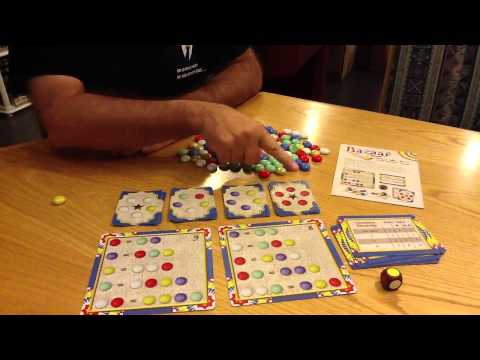
At the start of the match, the 'market rules' are set using equation cards. These dictate the possible exchanges—for instance, you might find that three green chips and one yellow are equivalent to two blues and one red. On your turn, you have two choices: either roll the colored die to gain a random chip, or use the equations to trade what you already have for something more useful.
The game becomes a strategic race. You look at the four available target cards and decide which one is the most viable. Is it worth chasing the harder card for more points, or should you secure the easy ones quickly? The tension rises as the card piles dwindle, and the game ends when two of these piles are exhausted. It's a constant exercise in optimization: you're always calculating the shortest path between the chips you hold and the required combination. If you enjoy abstract strategy games that don't require reading massive manuals but still make your brain work, Bazaar is a classic that proves simplicity can be quite addictive.
At the start of the match, the 'market rules' are set using equation cards. These dictate the possible exchanges—for instance, you might find that three green chips and one yellow are equivalent to two blues and one red. On your turn, you have two choices: either roll the colored die to gain a random chip, or use the equations to trade what you already have for something more useful.
The game becomes a strategic race. You look at the four available target cards and decide which one is the most viable. Is it worth chasing the harder card for more points, or should you secure the easy ones quickly? The tension rises as the card piles dwindle, and the game ends when two of these piles are exhausted. It's a constant exercise in optimization: you're always calculating the shortest path between the chips you hold and the required combination. If you enjoy abstract strategy games that don't require reading massive manuals but still make your brain work, Bazaar is a classic that proves simplicity can be quite addictive.
Gallery
Box and component photos
Tap any photo to open fullscreen. Photos submitted by the community or publisher.
Rules videos
Learn by watching before you open the box

Best player count
BGG community vote
2
REC
3
BEST
4
REC
5
REC
6
OK
Soundtrack
Ambience suggested by Melodice
Loading playlist...
Where to Buy
Prices monitored daily
Finding best prices...
Prices unavailable at this time.
Price history — last 6 months (lowest new offer)
As an Amazon Associate I earn from qualifying purchases. Prices and availability subject to change.
Alert enabled!
Join the BoardGamesBot deals group
Get the best board game deals every day — without message spam.
Join the WhatsApp groupGame details
Mechanics, categories, families and credits
Mechanics
Categories
Families
Publisher
3M, Discovery Toys, Eagle-Gryphon Games, Estrela, Klee, Parker Spiele, Schmidt International, Schmidt Spiele
Designer
Sid Sackson
Artist
Pixel Productions Inc.
Community
Data from BoardGameGeek
3,110owners
271wishlist
81want to play
Frequently Asked Questions
Quick answers before you buy
Is the game hard to learn?
Not at all! The rules are super simple and you'll learn by playing the first few turns. It's ideal for those who hate long manuals.
How long does a game last?
Usually around 45 minutes, depending on how quickly players can complete the objectives.
Do I need to be good at math to play?
You don't need to be a genius, but since the game involves simple exchanges and equations, those who enjoy logic and basic arithmetic will feel right at home.
How many people can play?
The game supports 2 to 6 players, making it very versatile for different group sizes.
What's in the box?
You'll find chips in five colors, colored dice, equation cards, and target cards.
Other Games You'll Like
Based on mechanics and theme