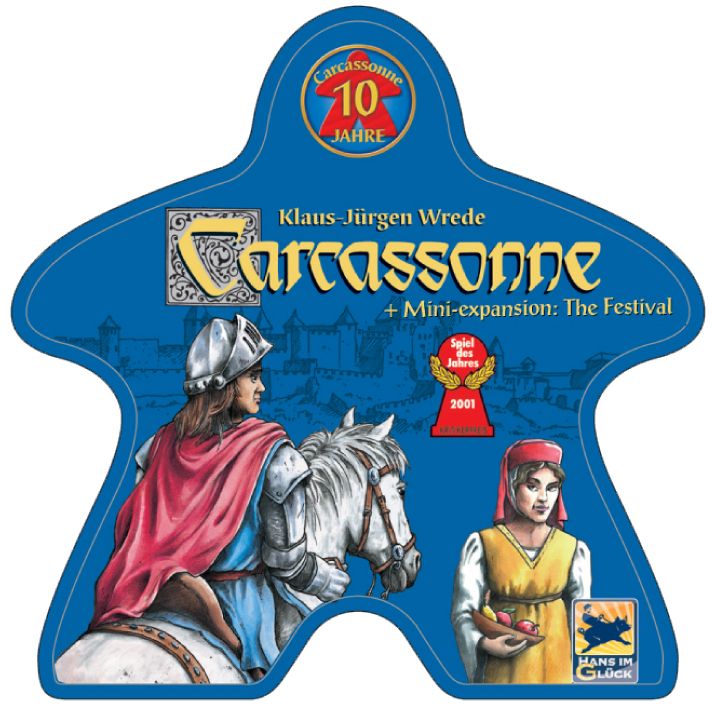
How to Play Carcassonne: 10 Year Special Edition
999 Games, Devir, Enigma (Bergsala Enigma) · Board game · 2011What do you want to do now
Ask anything about Carcassonne: 10 Year Special Edition: rules, setup, components, complexity, price, or whether it fits your group.
Step by step
Game Objective
In Carcassonne, players develop the area around the city of Carcassonne, famous for its Roman and medieval fortifications. They place their followers on roads, cities, monasteries, and fields that emerge and grow as land tiles are placed. The goal is to use the abilities of their thieves, knights, farmers, and monks to earn points. The player with the most points after the final scoring is the winner.
Preparation (Setup)
- Place the starting tile (with the different back) face up in the middle of the table.
- Shuffle the remaining land tiles face down and stack them in several face-down piles, so that all players have easy access to them.
- Place the scoring track near one of the edges of the table to leave space for players to place the land tiles in the middle of the table.
- Each player takes the 8 followers of their color.
- Each player places one of their followers as their scoring marker on the large space in the bottom left corner of the scoring track.
- Each player places their 7 remaining followers in front of them on the table as their supply.
- Players decide among themselves who will be the starting player, using any method they choose.
Game Flow
Players take turns in clockwise order, starting with the starting player. On a player's turn, they perform the following actions in the order shown:
- The player must draw and place a new land tile.
- The player may position one of their followers from their supply on the land tile they just placed.
- If, by placing the land tile, monasteries, roads, and/or cities are completed, they are scored now.
The player's turn ends and the next player, in clockwise order, takes their turn in the same way.
Actions and How to Play
Drawing and Placing Land Tiles
First, a player must draw a land tile from one of the face-down piles. They look at it, show it to the other players (so they can advise them on the "best" placement of the tile) and place it on the table, using the following rules:
- The new tile must be placed with at least one edge adjacent to and touching a previously placed tile. The new tile cannot be placed only corner-to-corner with a previous tile.
- The new tile must be placed so that all field, city, and road segments on the new tile continue into field, city, and road segments, respectively, on all adjacent tiles (monasteries are always complete within single tiles).
In rare circumstances where a drawn tile has no legal placement (and all players agree), the player discards the tile from the game (to the box) and draws another tile to place.
Positioning Followers
After the player places a land tile, they may position one of their followers, using the following rules:
- The player may only play 1 follower per turn.
- The player must take it from their supply.
- The player may only position it on the tile they just placed.
- The player must choose where to position the follower on the tile, either as:
- a knight on a city segment
- a farmer on a field segment (place farmers on their side)
- a thief on a monastery
- a monk on a road segment
- The player cannot position a follower on a field, city, or road segment if that segment connects to a segment on another tile (no matter how far) that already has a follower (of any player, including themselves) on it.
When a player has positioned all their followers, they continue to play land tiles each turn. Although a follower cannot be picked up, followers are returned to players when monasteries, roads, and cities are scored.
Scoring Completed Monasteries, Roads, and Cities
If, through the placement of the tile, cities, roads, and/or monasteries are completed, these are scored before moving on to the next player.
Completed Road
A road is complete when the road segments at both ends connect to a crossroads, a city segment, or a monastery, or when the road forms a complete loop. There can be many road segments between the ends.
The player who has a thief on a completed road scores one point for each tile in the completed road (count the number of tiles; separate segments on a tile count only once).
Completed City
A city is complete when the city is surrounded by a city wall with no gaps in the wall and no holes in the city. A city can have many city segments. The player who has a knight in a completed city scores two points for each tile in the city (count the tiles, not the segments). Each pennant in segments in the city earns the player 2 points.
If a completed city or road has more than one follower: The player with the most thieves (on a road) or most knights (in a city) earns all the points. When two or more players tie with the most thieves or knights, each earns the total points for the road or city.
Completed Monastery
A monastery is complete when the tile it is on is completely surrounded by land tiles. The player with a monk in the monastery earns 9 points (1 for the monastery tile and 1 for each of the other tiles).
Returning Scored Followers
After a road, a city, or a monastery is scored (and only then), the involved followers are returned to the appropriate players' supplies. Returned followers can be used by players as any of the possible followers (thief, farmer, knight, or monk) in subsequent turns.
It is possible for a player to position a follower, score a road, city, or monastery, and have the follower returned in the same turn (always in this order):
- Complete a road, monastery, or city with the new tile.
- Position a knight, thief, or monk.
- Score the completed city, road, or monastery.
- Return the knight, thief, or monk.
The Farms
Connected field segments are called farms. Farms are not scored when completed during the game. Players can position farmers on field segments, but they only score at the end of the game. A farmer remains on the field segment where it is positioned throughout the game and is never returned to the player's supply! To emphasize this, place the farmer on its side on the field segment. Farms are delimited by roads, cities, and the edge of the area where land tiles are played.
The Expansion: The Festival
When a player draws a land tile with the festival symbol, they first place it normally. Then, they must choose between:
- they place 1 of their followers according to the normal rules on this land tile or
- they return 1 of their followers from anywhere on the map back to their supply.
The player can also choose not to do either option.
End of Game and Scoring
End of Game
At the end of the player's turn during which the last land tile is placed, the game ends. Then, the final scoring follows.
Final Scoring
Scoring Incomplete Roads, Cities, and Monasteries
For each incomplete road, monastery, and city, the player who has a thief on the road, a monk in the monastery, or a knight in the city, earns one point for each road or city segment. Pennants are worth 1 point each. After scoring each feature, remove the follower(s) from the scored feature.
Scoring Farmers (to supply completed cities)
Only completed cities are used to score farmers. The farmer must be in a farm that borders a city to supply it. The distance from the farmer to the city is irrelevant.
For each city that a farm supplies, the player who positioned the most farmer(s) on the farm earns 3 points, regardless of the size of the city. If players tie with the most farmers, each scores 3 points. A farm can supply (score) multiple cities if they border the farm. Multiple farms can supply a single city. In this case, each farm is scored separately, as described above. Thus, for each field, the adjacent completed cities are scored.
When all completed cities are scored in this way, scoring and the game end. The player with the most points is the winner. If players tie with the most points, they rejoice in their shared victory.
Scoring Summary
- Farm to Completed Cities at the end of the game: 3 points for the player who has the most farmers in each farm that supplies each completed city.
- Completed Features DURING the game:
- Road: 1 point per tile (thief)
- City: 2 points per tile + (knight) 2 points per pennant
- Monastery: 9 points (monk)
- Incomplete Features at the END of the game:
- Road: 1 point per tile (thief)
- City: 1 point per tile + (knight) 1 point per pennant
- Monastery: 1 point for each tile (monastery tile and each surrounding tile) (monk)
Tips for Winning
Refer to the manual for details on this section.
Rules manual
Official PDF file
Frequently Asked Questions
Quick answers about the rules
What is the objective of Carcassonne: 10 Year Special Edition?
How do you set up Carcassonne: 10 Year Special Edition?
How do you play Carcassonne: 10 Year Special Edition?
How does Carcassonne: 10 Year Special Edition end, and how do you score?
What are some tips for winning Carcassonne: 10 Year Special Edition?
Other Games You'll Like
Based on mechanics and theme