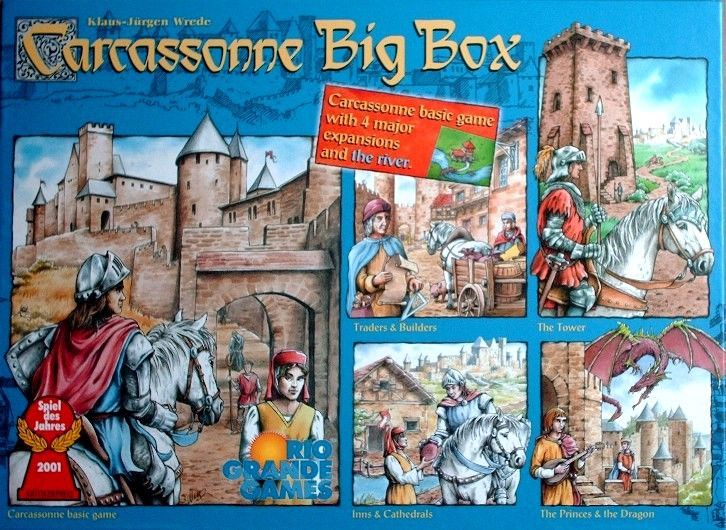
How to Play Carcassonne Big Box
Hans im Glück, Rio Grande Games · Board game · 2006What do you want to do now
Ask anything about Carcassonne Big Box: rules, setup, components, complexity, price, or whether it fits your group.
Step by step
Game Objective
In Carcassonne, players take turns placing land tiles to create a continuously expanding region with roads, cities, monasteries, and fields. The goal is to strategically place your followers (who can be thieves, knights, monks, or farmers) in these areas to earn victory points during the game and in the final tally. The player with the most victory points at the end of the game is declared the winner.
Setup
- Separate the 72 land tiles. The starting tile (with the darker back) should be distinguished from the others.
- Place the starting tile in the center of the table.
- Shuffle the remaining land tiles and form several face-down stacks, so that all players can easily reach them.
- Keep the 8 50/100 point tokens ready, as they will be needed later.
- Place the score track in the corner of the table.
- Each player chooses a color and receives 7 follower figures of that color, which will constitute their supply.
- Each player's eighth follower figure is placed on space 0 of the score track.
- The River Expansion: If using The River expansion, do not use the basic game's starting tile. Instead, find the "Source" and "Lake" river tiles. Shuffle the remaining river tiles face down and form a stack. Place the "Lake" at the bottom of the stack and the "Source" as the starting tile.
- The Abbot Expansion: Each player receives the abbot of their color and keeps it in their supply.
- Inns & Cathedrals Expansion: Mix the 18 land tiles (indicated with a specific symbol) with the other land tiles. Each player should start the game with the large follower figure of their color in their supply.
- Traders & Builders Expansion: Mix the 24 land tiles (indicated with a specific symbol) with the other land tiles. Keep the goods tokens (9 wine, 6 grain, and 5 cloth) ready next to the box. The 6 pigs and 6 builders of each color will be in the players' supply.
- The Flying Machines Expansion: Mix the 8 land tiles with flying machines (indicated with a specific symbol) with the other land tiles. Keep the die (with values 1, 1, 2, 2, 3, 3) next to the playing area.
- The Messengers Expansion: Shuffle the 8 messenger tokens face down and form a stack. Each player should place their messenger figure next to their follower on the score track, on space "0".
- The Ferries Expansion: Mix the 8 land tiles with a lake (indicated with a specific symbol) with the other land tiles. Keep the 8 ferries next to the playing area.
- The Goldmines Expansion: Mix the 8 gold tiles (indicated with a specific symbol) with the other land tiles. Keep the 16 gold bars and the scoring table ready next to the playing area.
- The Mage & Witch Expansion: Mix the 8 tiles with the magic symbol (indicated with a specific symbol) with the other land tiles. Keep the mage and witch figures next to the playing area.
- The Robbers Expansion: Mix the 8 tiles with the robber symbol (indicated with a specific symbol) with the other land tiles. Distribute the 6 robber figures to each player, matching their color.
- The Crop Circles Expansion: Mix the 6 tiles with crop circles (indicated with a specific symbol) with the other land tiles.
Game Flow
Carcassonne is played clockwise, starting with the youngest player. On their turn, each player performs the following actions, always in the order indicated:
- Place a land tile
- Place a follower (optional)
- Score points (if applicable)
After a player's turn is complete, the turn passes to the player on their left, and so on.
Actions and How to Play
1. Place a land tile
- The player must always draw a new land tile from a stack and place it so that it touches at least one side of another tile already in play.
- The edges of the newly placed tile must continue the existing terrain (roads with roads, cities with cities, fields with fields).
- In the rare case that a tile cannot be placed, the player must return it to the box and draw a new tile.
- The River Expansion: When playing with the river, players draw and place river tiles in turns. It is not allowed to place two consecutive river tiles that turn in the same direction. When all river tiles have been placed, the game continues with the normal tiles.
- The Goldmines Expansion: If you draw a tile with a gold symbol, after placing it, you must place a gold bar on that tile and one on an adjacent tile (including diagonally). It is allowed to place a gold bar on a tile that already has other gold bars from previous turns.
- The Mage & Witch Expansion: If you draw a tile with magic, after placing it, you must place the mage or witch figure into play, or move it (before placing a follower). The figure must be placed on any road or city that has not been completed. The mage and witch figures cannot be in the same city or road. If you cannot place the mage or witch, you must remove them from the terrain. If, when placing a tile, the mage and witch end up in the same city or road, you must immediately remove one of the two figures.
- The Crop Circles Expansion: Crop circles separate two roads and the fields from each other.
2. Place a follower
- After placing the land tile, the player may place one of their followers from their supply onto the tile they just placed.
- The follower can only be placed on the same tile that was just played.
- There cannot be any other follower in the same area (road, city, monastery, or field) where the player wishes to place theirs.
- Thief: A follower placed on a road acts as a thief.
- Knight: A follower placed in a city acts as a knight.
- Monk: A follower placed in a monastery acts as a monk.
- Farmer: A follower placed in a field acts as a farmer. Farmers are placed lying down in the field and remain there until the end of the game. Fields are delimited by cities and roads.
- The River Expansion: Followers cannot be placed directly on the river.
- The Abbot Expansion: If you placed a tile with a monastery or a garden, instead of placing a normal follower, you may place your abbot. The abbot must be placed in a monastery or a garden. Normal followers cannot be placed on a garden.
- Inns & Cathedrals Expansion: Instead of placing a normal follower, you may place a large follower, following the same placement rules as other followers.
- Traders & Builders Expansion - The Builder: Instead of placing a follower, you can place your builder on the tile just placed, but only on a road or city. You must have at least one follower in the area where you want to place the builder. The builder returns to your supply if none of your followers remain in the area where it was.
- Traders & Builders Expansion - The Pig: Instead of placing a follower, you can place your pig in a field on the tile just placed. You can only place a pig in a field that already has one of your farmers. You can also place a pig in a field that already has another player's pig. If your pig is in a field that does not have any of your farmers, you must return it to your supply.
- The Flying Machines Expansion: If you draw a land tile with a flying machine, after placing it, you may place a follower on top of the flying machine. The flying machine will indicate the direction (horizontal, vertical, or diagonal) the follower must follow when flying. Roll the die to determine the distance (1 to 3 tiles in a straight line). The follower must be placed on the landing tile, in an uncompleted area (road, city, or monastery) or in an area already occupied by more than one follower. It cannot be placed in a field. If you cannot place the follower, you immediately retrieve it and cannot place any other follower or figure this turn.
- The Ferries Expansion: If you wish to place a follower on one of the roads that exist on a tile with a lake, you must place it on one of the three or four road segments on the tile. Then, you will take a ferry from the supply and place it on the lake, so that it crosses from one side of the lake to the other, connecting two road segments. The segments without the ferry remain closed.
- The Crop Circles Expansion: It is not allowed to place a follower directly on a crop circle.
3. Score points
- Scoring occurs whenever an area (road, city, or monastery) is completed.
- Roads: A road is completed when both ends terminate in a crossroads, a city, a monastery, or when the road closes on itself. Each road tile gives 1 point.
- Cities: A city is completed when it is completely surrounded by walls and there are no empty spaces on its edges. Each city tile, as well as each coat of arms, gives 2 points.
- Monasteries: A monastery is completed when it is completely surrounded by 8 tiles. Each monastery gives 9 points (1 point for the monastery tile and 1 point for each of the 8 adjacent tiles).
- After all scoring is done, the player retrieves the follower that earned them the points and returns it to their supply.
- The score track is used to record points. If a follower completes a full lap (reaching or exceeding 50 points), take a scoring token and place it in front of you, with the "50" side face up. If it completes a second lap, flip the token to "100".
- Majority: If there is more than one player in the same area, the player with the most followers on the road or in the city receives the points. If several players are tied with the highest number of followers, all of them earn points.
- It is possible to place a follower, score points immediately, and then retrieve the follower in the same turn if the placed tile completes an area and the follower is placed in that newly completed area.
- The Abbot Expansion: If a monastery or a garden is surrounded by 8 tiles, you receive 7 points for the abbot. Additionally, if you did not place any follower in your second action, you may retrieve your abbot from the board and receive the points for the monastery or garden (the same points you would receive in the final scoring).
- Inns & Cathedrals Expansion - Roads with Inns: If a road with a thief and one or more inns is completed, the player receives 2 points for each road segment (instead of 1).
- Inns & Cathedrals Expansion - Cities with Cathedrals: If a city with a knight and one or more cathedrals is completed, the player receives 3 points for each city tile and for each coat of arms (instead of 2).
- Inns & Cathedrals Expansion - Large Follower: If you are scoring an area that contains your large follower, it counts as two normal followers (value of 2). After scoring, the large follower returns to your supply.
- Traders & Builders Expansion - Goods Tokens: If a player completes a city that has one or more goods icons, the city's points are scored normally. The player who completes the city obtains the corresponding goods tokens (1 token for each goods icon in the city), regardless of whether they have a knight in it. The goods tokens are placed face up in front of them.
- Traders & Builders Expansion - The Builder: The builder does not affect normal scoring rules and is not counted for determining majorities. However, if you place a tile on a road or city where your builder is already located, you complete your turn as usual and, after it is finished, you may take another turn (draw and place a new tile, place a follower, and score points).
- The Ferries Expansion: If after placing a ferry
Rules manual
Official PDF file
Frequently Asked Questions
Quick answers about the rules
What is the objective of Carcassonne Big Box?
How do you set up Carcassonne Big Box?
How do you play Carcassonne Big Box?
Other Games You'll Like
Based on mechanics and theme