Cascadero — Price & soundtrack
Bitewing Games, White Goblin Games · Board game · 2024
2–4 · best 3
45–60 min
Weight 2.6/5
Buy · from US$ 39.94
7.6
rating
Ludopedia
7.3
rating
BGG
Our Verdict
If you love deep strategy games, Cascadero will hook you with its chaining, connections, and timing challenges.
Highlights
- Powerful envoy chains
- Cascading bonuses
- Strategic hex grid
Keep in mind
- Requires careful planning
- Gradual point growth
Rules manual not indexed yet
Upload the PDF rulebook to ask questions about this game with AI.
About the game
What you do in a play session
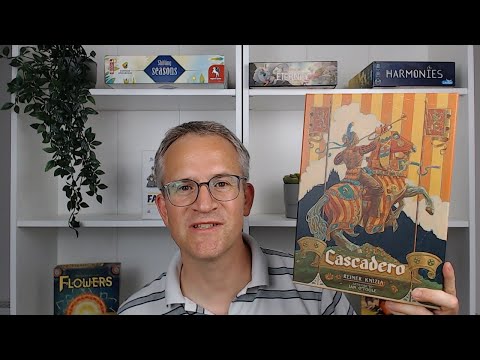
Cascadero places you at the heart of a shattered kingdom where the newly crowned king, El Cascadero, must unite the chaotic cities. To do this, he relies on four ministers, each responsible for Agriculture, Crafting, Mining, and Markets. The goal is simple: place envoys adjacent to cities, but cities are wary and only recognize envoys that are part of a chain or carry the king’s official seal. When you achieve this, the city scores and you advance along its success column, earning bonuses such as victory points, envoy repositioning, or even an extra turn. The trick lies in deciding whether to build long chains of envoys to maximize synergies or create smaller groups to score sooner. Each choice has consequences, and perfect timing can trigger a cascade of bonuses that changes the game’s trajectory. The board is hexagonal, allowing multiple expansion directions, and the network and route mechanic makes every move strategic. The game ends when someone reaches 50 victory points or can no longer place tiles, but those who reach the end of their designated success column have a chance to win. Cascadero blends abstract strategy with a Renaissance setting, offering replayability thanks to player interaction, variable board setup, and an advanced mode with traveling heralds. If you enjoy games that require careful planning, resource exchanges, and a bit of luck, Cascadero is a solid bet.
Gallery
Box and component photos
Tap any photo to open fullscreen. Photos submitted by the community or publisher.
Rules videos
Learn by watching before you open the box


Best player count
BGG community vote
2
REC
3
BEST
4
BEST
Soundtrack
Ambience suggested by Melodice
Loading playlist...
Where to Buy
Prices monitored daily
Finding best prices...
Prices unavailable at this time.
Price history — last 6 months (lowest new offer)
As an Amazon Associate I earn from qualifying purchases. Prices and availability subject to change.
Alert enabled!
Join the BoardGamesBot deals group
Get the best board game deals every day — without message spam.
Join the WhatsApp groupGame details
Mechanics, categories, families and credits
Mechanics
Categories
Families
Publisher
Bitewing Games, White Goblin Games
Designer
Reiner Knizia
Artist
Ian O'Toole
Community
Data from BoardGameGeek
3,266owners
1,220wishlist
194want to play
Frequently Asked Questions
Quick answers before you buy
How many players can play?
2 to 4 players.
What is the typical game length?
45 to 60 minutes.
What is the game’s complexity?
Medium to high, requiring planning and timing.
What are the main components?
Hexagonal board, envoy pieces, seal tokens, success column tracks, and bonus cards.
Is there an advanced mode?
Yes, there is an advanced mode with traveling heralds that ups the strategy.
Who is the ideal audience?
Players who enjoy abstract strategy, network building, and chaining mechanics.
How does the game end?
When someone reaches 50 points or cannot place a tile, and whoever reaches the end of the success column has a chance to win.
Other Games You'll Like
Based on mechanics and theme