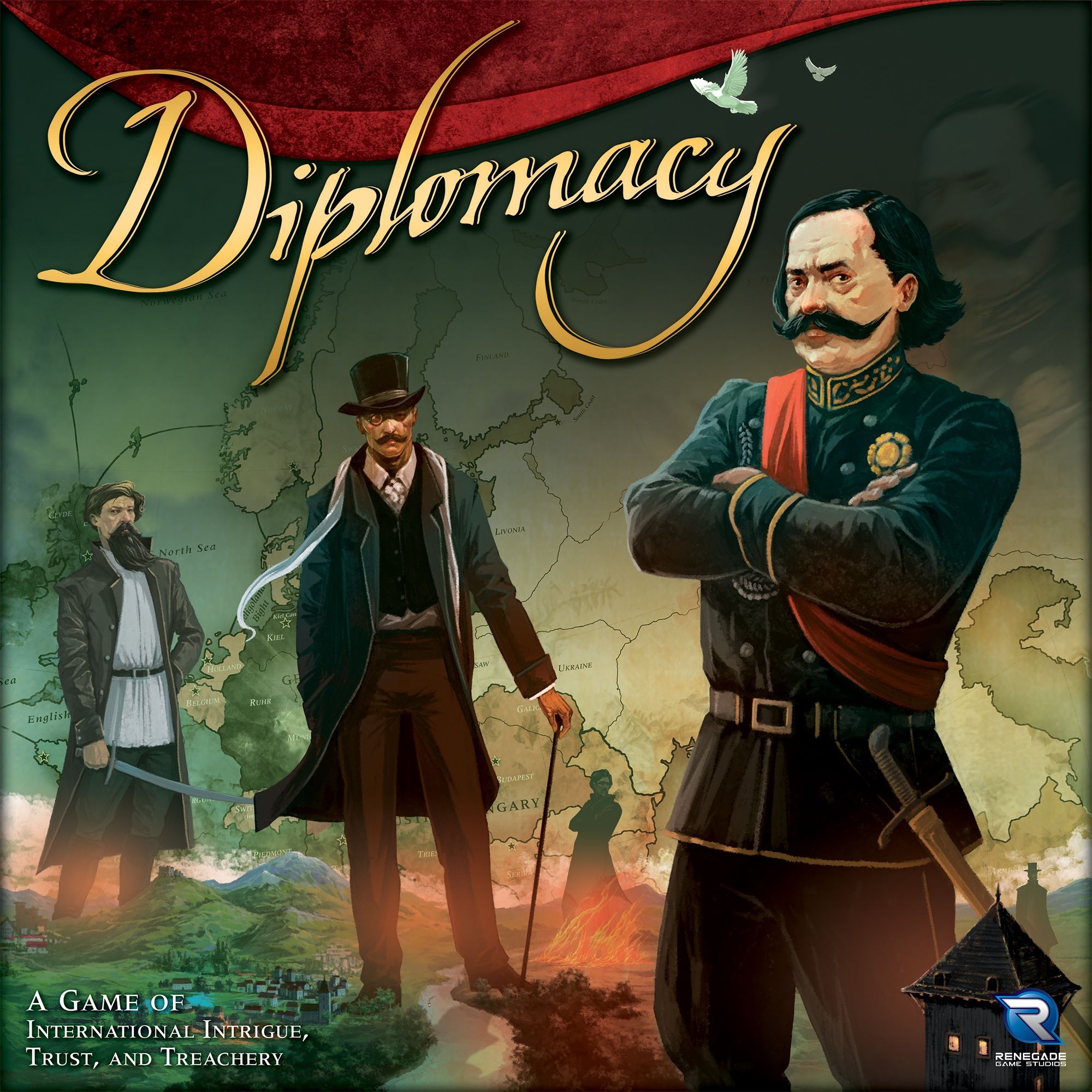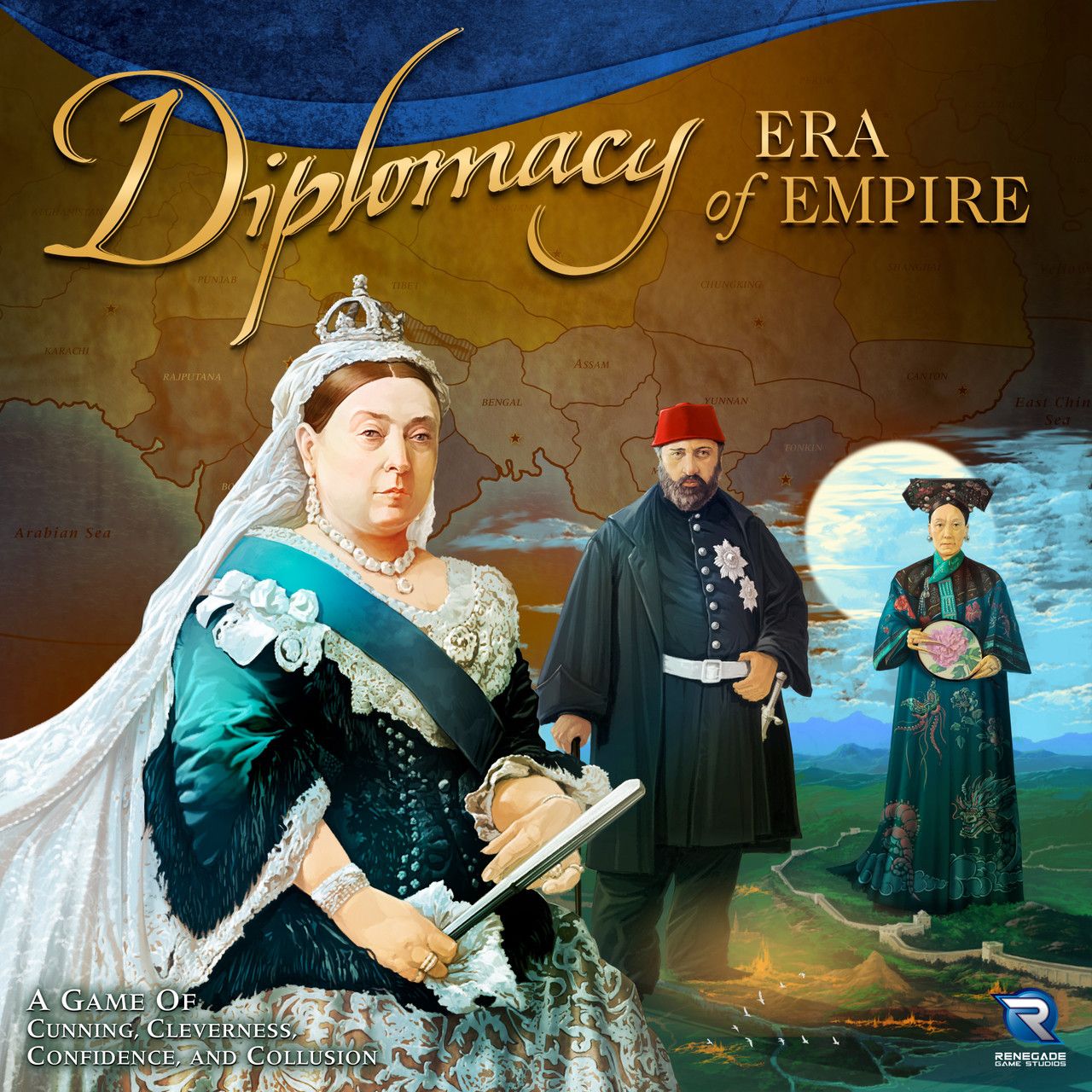
How to Play Diplomacy: Era of Empire
Renegade Game Studios · Board game · 2025What do you want to do now
Ask anything about Diplomacy: Era of Empire: rules, setup, components, complexity, price, or whether it fits your group.
Video: How to Play
Start here, then follow the written guide
Step by step
Game Objective
In Diplomacy: Era of Empire, players recreate the turbulent years of the 19th century, when vast areas of the Ottoman Empire, the Indian subcontinent, China, Indochina, and the East Indies were contested by rival empires. Each player takes on the role of one of the seven Great Powers of the era: Great Britain, France, Russia, Turkey, China, Japan, and the Netherlands.
The main objective is to control the largest number of Supply Centers, which are provinces of strategic, economic, or military importance, marked with stars on the map. Victory can be achieved in several ways, defined by the players before the start of the game:
- Control of 22 Supply Centers: A player who controls 22 or more Supply Centers at the end of any Fall turn achieves a solo victory. If two players reach 22 or more and are tied in the number of Supply Centers, they share the victory.
- Draw Including All Survivors (DIAS): All players who still possess at least one Supply Center agree to equally share a draw. This can be agreed upon at any time during the game.
- Turn Limit: The game ends after a predetermined number of turns (e.g., after Fall 1877). The winner is the player with the most Supply Centers. Tied players share the victory.
- Time Limit: The game ends after a predetermined number of hours (e.g., 4 or 8 hours). The winner is the player with the most Supply Centers. Tied players share the victory.
While military strategy is important, skillful diplomacy, alliance negotiation, crucial timing, and good judgment of character (observing the inevitable betrayal) are essential for victory.
Setup
The standard game is designed for seven players. If there are fewer players, the initial settings for two to six players are described in the "Alternate Ways to Play" section.
- Power Selection: Players choose their Powers by preference or by drawing lots, if there is no agreement. The seven Powers are: Great Britain (Dark Blue), China (Yellow), France (Light Blue), Japan (White), Netherlands (Orange), Russia (Black), and Turkey (Red).
- Game Board: Place the assembled mapboard in the center of the table. The map represents the world in the second half of the 19th century, with named provinces (land and sea) that can be occupied.
- Starting Units: Each player positions their initial units (Armies and Fleets) in the designated Supply Centers, according to the table below. The units are wooden pieces in the shape of cavalry (Army) or a ship (Fleet), with colors corresponding to their Power.
- Great Britain: A Delhi, F Madras, A Bombay, F Aden
- China: A Peking, F Shanghai, A Sinkiang
- France: A Tonkin, F Annam, A Cochin
- Japan: A Tokyo, F Kyushu, F Kyoto
- Netherlands: A Borneo, F Java, F Sumatra
- Russia: A Moscow, A Irkutsk, F Vladivostok, F Odessa
- Turkey: A Angora, F Baghdad, F Constantinople
- Supply Center Control Markers: Each player receives a set of Supply Center control markers. Use them to identify which Supply Centers you control on the board. It is recommended to use the markers on the initial Supply Centers for the starting units.
- Remaining Components: Keep the rulebook, the Quick Start Rules sheet, and the conference map pad handy for reference.
Remember that all units have the same strength and only one unit can occupy a province at a time.
Game Flow
The game progresses in a series of turns, each representing six months. The first turn is a Spring turn and the next is a Fall turn. After each Fall turn, Powers adjust the number of their units based on the Supply Centers they control. A full year of play consists of a Spring turn and a Fall turn.
Each turn has a series of phases:
Spring four-phase turn
- Diplomatic Phase:
- Duration: 30 minutes before the first turn, and 15 minutes before each subsequent turn (may end earlier if all players agree).
- Players openly or secretly discuss their plans, negotiate alliances, plan joint actions, spread rumors, and try to destabilize alliances.
- Nothing discussed in this phase is binding. Trust is a key element.
- Agreements can be made between any number of players and may include support for military units or transport of units by sea.
- Order Writing Phase:
- Each player secretly writes the orders for each of their units on a piece of paper.
- All orders are revealed simultaneously. Each player reads their orders, or a gamemaster can collect and read them.
- A legal order must be followed. Orders written by mistake, if legal, must be followed.
- Units without orders or with illegal orders (miswritten or impossible) simply remain in their current location (Hold).
- Orders must be dated (e.g., "Spring 1870", "Fall 1870").
- Order format: Unit type (A for Army, F for Fleet), current province, and the order (e.g., "A Moscow Holds").
- Order Resolution Phase:
- After the orders are revealed, players (or the gamemaster) resolve all conflicts.
- This results in successful movements, failed movements, standoffs, retreats, and disbands.
- The units on the board are moved or removed as described in the following phases.
- Important rules: Only one unit per province; impossible orders are ignored; all units have strength 1; forces can be one unit plus its supports; equal forces attacking the same space result in standoff; unequal forces, the larger wins.
- Retreat And Disbanding Phase:
- Any dislodged units must retreat.
- Retreats are written secretly and revealed immediately, without diplomacy.
- A dislodged unit must retreat to an adjacent province it could normally move to, if unopposed.
- It is not allowed to retreat to: an occupied province; the province from which the attacker came; or a province that became vacant due to a standoff in the same turn.
- If no province is available to retreat to, the dislodged unit is immediately disbanded.
- If two or more units retreat to the same province, all are disbanded.
- A unit can be voluntarily disbanded instead of retreating.
Fall five-phase turn
The first four phases are identical to those of the Spring turn.
- Gaining And Losing Units Phase (Winter Phase, After Fall Turn):
- After each Fall turn (including retreats), players adjust their units to match the number of Supply Centers they control.
- A Power gains control of a Supply Center when one of its units occupies it after a complete Fall turn. Control is maintained as long as the Supply Center is vacant or occupied by its own unit at the end of each Fall turn.
- Disbanding: If a Power has fewer Supply Centers than units, it must disband the excess number of units (player's choice).
- Building (Conscription): If a Power has more Supply Centers than units, it can place new units in unoccupied Supply Centers it controls. Unlike the base game, you can build in any controlled and unoccupied Supply Center.
- Building (Conversion): If a unit ends a Fall turn in a Supply Center, the player can convert that Army into a Fleet or vice versa. This does not use an available build. An Army can only be built in land provinces; in coastal provinces, it can be an Army or a Fleet.
- Build and disband orders are written and revealed simultaneously, without diplomacy.
The game ends at the end of any Fall turn if a Great Power controls 22 or more Supply Centers.
Actions and How to Play
Each turn, each Power can order all, some, or none of its units to perform the following actions:
Hold Order
- A unit attempts to remain in its current province.
- Not giving an order to a unit is interpreted as a Hold order.
- Example: F Constantinople Holds (or F Con Holds).
Move Order
- A unit moves to an adjacent province. Moving to an occupied province is considered "attacking."
- Format: Unit location - Destination (e.g., A Tabriz-Baghdad or A Tab–Bag).
- Army Movement: Can move to an adjacent land or coastal province. Cannot move to water provinces.
- Fleet Movement: Can move to an adjacent water or coastal province. Cannot move to land provinces. A Fleet cannot move from one coastal province to another adjacent one if the movement is not along the coast.
- Straits: Land movement is allowed between certain provinces separated by a narrow strip of water, indicated by an arrow (e.g., Kyushu to Kyoto). No Fleet is needed to transport an Army across a strait.
- Impassable Areas: Unnamed areas or areas with obstacles (e.g., between Nepal and Tibet) are impassable.
- Standoffs: Occurs when forces of equal strength attempt to occupy the same province simultaneously. All units involved remain in their original provinces. A standoff does not dislodge a unit already present in the province. Units cannot swap places without a convoy.
Support Order
- A unit does not move and instead gives support to an adjacent space.
- Format: Support or S.
- You can support your own units or those of another Power. Each unit can support only one other unit per turn.
- Both Armies and Fleets can provide support.
- Support can be offensive (supporting an attacking move) or defensive (supporting a Hold, Support, or Convoy).
- Attacking or defending units gain increased strength with support. E.g., a unit with two supports has strength 3.
- Support can be given without consent and cannot be refused.
- To support a unit that is not moving and wants to hold position: S A Luc (support an Army in Lucknow).
- To support a unit that is moving: A Kar S A Per – Afg (an Army in Karachi supports an Army in Persia attacking Afghanistan).
- A unit must be adjacent to the space it intends to support. Armies cannot support in water provinces, and Fleets cannot support in land provinces (both can support in coastal provinces).
- Cutting Support: Support is cut if the unit giving support is attacked from any province, except the one to which support is being given. Support is cut regardless of the success of the attack. Support is also cut if the unit giving support is dislodged.
Convoy Order
- Instructs a Fleet unit in a water province to transport an Army unit from an adjacent coastal (or island) province to that water to another adjacent coastal (or island) province to that water.
- Format: C. The Army unit and its initial and final destinations must follow the convoy order (e.g., F RS C A Egy – Ade, A Egy – Ade).
- A Fleet can convoy only one Army per turn. A Fleet in a coastal province cannot convoy an Army.
- A Fleet that is convoying cannot perform other orders that turn; it remains in its position.
- The convoyed Army must end its movement in a land space.
- An Army can be convoyed by multiple Fleets across multiple adjacent water provinces, provided each water province contains a Fleet with orders to transport that Army.
- The dislodgement of a Fleet in a convoy causes the convoy to fail. The convoyed Army remains in its original province.
- A
More videos
More rules explanations from the community

Rules manual
Official PDF file
Frequently Asked Questions
Quick answers about the rules
What is the objective of Diplomacy: Era of Empire?
How do you set up Diplomacy: Era of Empire?
How do you play Diplomacy: Era of Empire?
Other Games You'll Like
Based on mechanics and theme