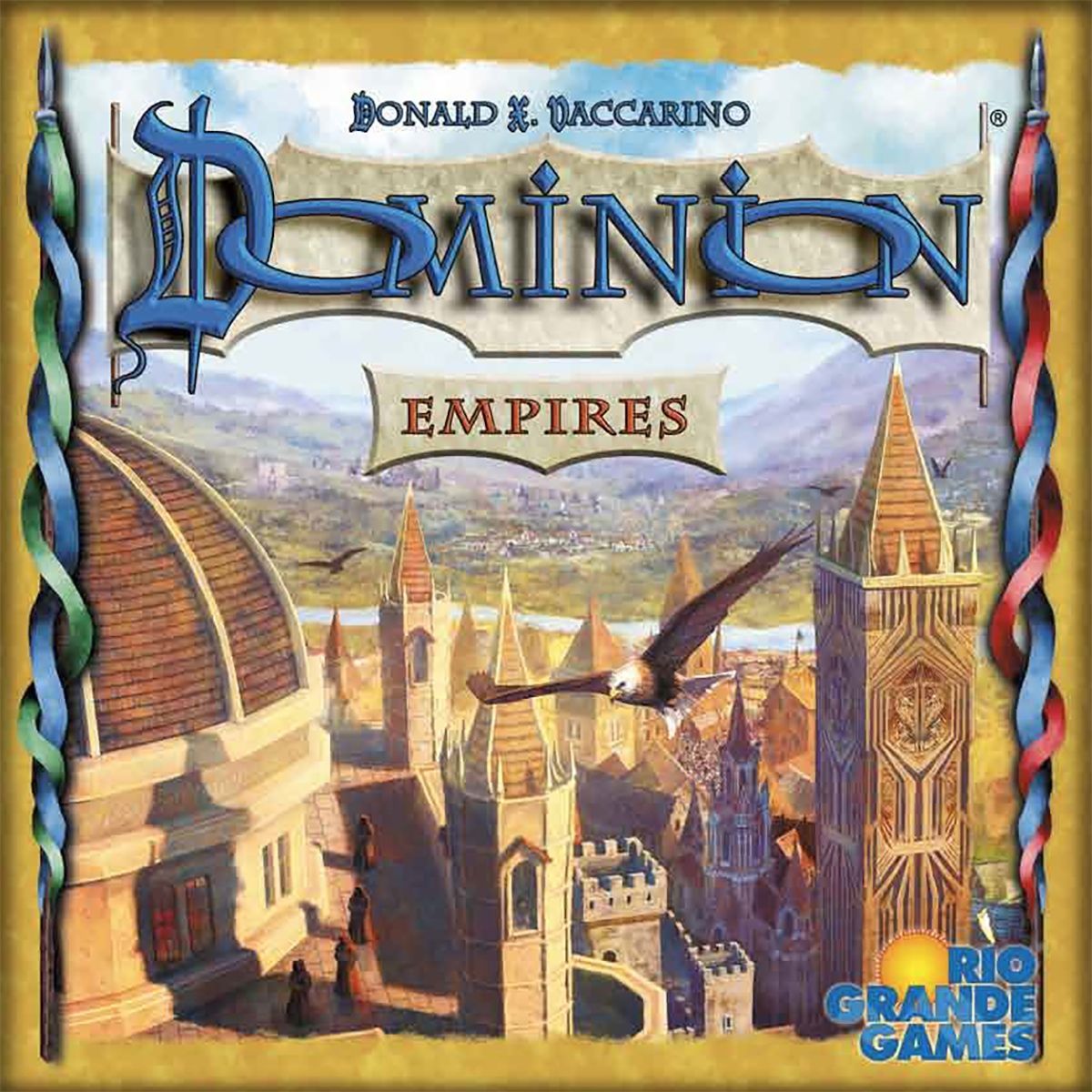
How to Play Dominion: Empires
Rio Grande Games, 999 Games, ASS Altenburger Spielkarten · Board game · 2016
2–4 · best 2
30 min
Weight 2.8/5
9.3
rating
Ludopedia
8.3
rating
BGG
What do you want to do now
Ask questions about the game
Ask anything about Dominion: Empires: rules, setup, components, complexity, price, or whether it fits your group.
Example questions
Continue this chat in the Assistant
Game page
Prices, ratings and our review
Rules manual
Official PDF file
Step by step
Objective of the Game
The objective of Dominion: Empires is to gain the most Victory Points by the end of the game. Players do this by building their decks with various cards, including Victory cards, and utilizing different strategies to acquire more powerful cards and score points.
Preparation (Setup)
Here's how to set up a game of Dominion: Empires:
- For 2 players, use 8 of all VP cards, including split VP cards.
- For 3-4 players, use all VP cards.
- For 5 players, use 15 Provinces and all other cards.
- For 6 players, use 18 Provinces and all other cards.
- Curses: 10 for 2 players, 20 for 3 players, 30 for 4 players, 40 for 5 players, and 50 for 6 players.
- If using Dark Ages ONLY: Use Shelters instead of Estates (one of each).
- Spoils, Madmen, Mercenary, and Shelters are not part of the Supply but are kept handy as needed. They do not affect end game conditions.
- If using LOOTER cards: Use Ruins, shuffle all together and put out amounts like Curses, place face down with the top card face up.
- If using Knights: Shuffle Knights cards, place face down with the top card face up. Do not get Trade Route tokens.
- If using Page or Peasant cards: Also need the (Upgrade) cards which are not part of the Supply but kept handy as needed.
- If using SPLIT CARDS: Place the cheaper card on top.
- If using EVENTS/LANDMARKS: It is recommended to use only 2 per game. EVENTS/LANDMARKS cannot be Young Witch’s bane.
- In games using the Baker card, each player starts the game with a Coin token.
- For Distant Lands: Use 8 for games with 2 players, or 12 for games with 3 or more players.
- For Duke: Place 12 Dukes in the Supply for a 3- or 4-player game and 8 in the Supply for a 2-player game.
- For Fairgrounds: Use 8 Fairgrounds in a game with 2 players, and 12 for a game with 3 or more players.
- Colony is not a Kingdom card and is not used every game.
Fluxo do Jogo
Consulte o manual para detalhes sobre esta seção.
Ações e Como Jogar
Card Types and General Rules
- Action - Victory cards are Actions.
- Cards with multiple types that include Action, such as Crown, are Actions.
- Cards with two types, one of which is Treasure (such as Harem), are Treasures and can be played via Counterfeit.
- Cards with two types, one of which is Victory, are Victory cards.
- Costs never go below 0 coins.
- The number of cards left in a player's hand is public information; you can ask whenever you want to know it.
Specific Card Abilities
- Abandoned Mine: When you play this, you just get 1 Coin. This is a Ruins.
- Advance (Event): If you do not trash an Action, nothing else happens.
- Adventurer: If you have to shuffle in the middle, shuffle. Don't shuffle in the revealed cards as these cards do not go to the Discard pile until you have finished revealing cards. If you run out of cards after shuffling and still only have one Treasure, you get just that one Treasure.
- Advisor: If there are not three cards in your deck, reveal what you can, then shuffle your discard pile into your deck to get the other cards. If there still are not enough, just reveal what you can. No matter how many you revealed, the player to your left chooses one for you to discard, and the remaining cards go into your hand.
- Alchemist: When you play this, you draw two cards and may play an additional Action card this turn. In the Clean-up Phase, when you discard this, if you have at least one Potion card in play, you may put Alchemist on top of your deck. This is optional and happens before drawing your new hand. If you have no cards in your deck when you do this, Alchemist becomes the only card in your deck. If you have multiple Alchemists and a Potion, you can put any or all of the Alchemists on top of your deck. You don't have to have used the Potion to buy anything, you only need to have played it.
- Alms (Event): You can only buy this once per turn. When you do, if you have no Treasures in play, you gain a card costing up to 4 Coin. The gained card comes from the Supply and is put into your discard pile.
- Altar: You trash a card from your hand if you can, and then gain a card whether or not you trashed one. The gained card comes from the Supply and is put into your discard pile.
- Ambassador: First you choose and reveal a card from your hand. You may place up to 2 copies of that card from your hand back in the Supply. You may choose not to put any of them back in the Supply. Then the other players each gain a copy of it from the Supply. If the pile for the chosen card runs out, some players may not get one; cards are given out in turn order starting with the next player. If you have no other cards in hand when you play this, it does nothing.
- Amulet: You choose something when you play it, and again at the start of your next turn; the choices may be the same or different.
- Annex (Event): You can do this even if the Duchy pile is empty. The chosen cards stay in your discard pile when the other cards are shuffled into your deck.
- Aqueduct (Landmark): If you gain a card that is both a Treasure and a Victory card, such as Humble Castle, you can resolve the abilities in either order.
- Apothecary: You draw a card first. Then reveal the top four cards, put the Coppers and Potions into your hand, and put the rest back on top of your deck. If there aren't four cards left in your deck, reveal what you can and shuffle to get the rest. If there still aren't enough cards, just reveal what there is. Any cards that are not Copper and are not Potion go back on top of your deck in an order you choose. You cannot choose not to take all of the Coppers and Potions. If after revealing four cards there are no cards left in your deck, the cards you put back will become the only cards in your deck.
- Apprentice: If you do not have any cards left in hand to trash, you do not draw any cards. If you trash a card costing 0, such as Curse or Copper, you do not draw any cards. Otherwise you draw a card per cost of the card you trashed, and another two cards if it had a potion in its cost. For example, if you trash a Golem, which costs one potion and four gold, you draw 6 cards.
- Archive: You look at three cards, and get one now, one next turn, and one the turn after that. Put the set-aside cards under Archive. If you play two Archives, they get separate sets of cards. If you Throne Room an Archive, keep the sets of cards separate; you get one from each each turn. If there are fewer than three cards, just set aside what you can, and Archive will run out of cards faster and still be discarded the turn it has no cards left.
- Arena (Landmark): With Villa it is possible for your Buy phase to start twice or more in a turn; you can make use of Arena each time.
- Armory: The card you gain comes from the Supply and is put on top of your deck.
- Artificer: First you get 1 Card, 1 Action, and 1 Coin. Then you discard any number of cards. You may choose not to discard any cards. Then you may gain a card costing exactly 1 Coin per card discarded. For example if you discarded two cards; you may gain a card costing 2 Coins; if you discard no cards, you may gain a card costing 0 Coin. The gained card comes from the Supply and is put on top of your deck. You may choose not to gain a card, even if you discard cards.
- Bag of Gold: The Gold you gain comes from the Supply and is put on top of your deck. If your deck has no cards in it, it becomes the only card in your deck. If there are no Golds left in the Supply, you do not gain one. This is a Prize.
- Baker: When you play this, you draw a card, get 1 Action, and take a Coin token. In games using this card, each player starts the game with a Coin token. This includes games using the promo card Black Market in which Baker is in the Black Market deck.
- Ball (Event): When you buy this, you take your -1 Coin token, which will cause you to get 1 Coin less the next time you get Coin. Then you gain 2 cards, each costing up to 4 Coin. They can be 2 copies of the same card, or 2 different cards.
- Band of Misfits: When you play this, you pick an Action card from the Supply that costs less than it, and treat this card as if it were the card you chose. Normally this will just mean that you follow the instructions on the card you picked. Band of Misfits also gets the chosen card's cost, name, and types. If you use Band of Misfits as a card that trashes itself, you will trash the Band of Misfits. If you use Band of Misfits as a duration card, Band of Misfits will stay in play until next turn. If you use Band of Misfits as a Throne Room, King's Court, or Procession, and use that effect to play a duration card, Band of Misfits will similarly stay in play. If you use Throne Room, King's Court, or Procession to play a Band of Misfits card multiple times, you only pick what to play it as the first time; the other times it is still copying the same card. If you use Band of Misfits as a card that does something during Clean-up, it will do that thing during Clean-up. When you play Horn of Plenty, it counts Band of Misfits as whatever Band of Misfits was played as. Band of Misfits can only be played as a card that is visible in the Supply; it cannot be played as a card after its pile runs out, and cannot be played as a non-Supply card like Mercenary; it can be played as the top card of the Ruins pile, but no other Ruins, and can only be played as Sir Martin when that is the top card of the Knights pile.
- Bandit Camp: Draw a card before gaining a Spoils. The Spoils comes from the Spoils pile, which is not part of the Supply, and is put into your discard pile. If there are no Spoils cards left, you do not get one.
- Bandit Fort (Landmark): Scores can go negative.
- Bank: This is a Treasure worth a variable amount. When you play Bank, it is worth 1 gold per Treasure you have in play, counting itself. Remember, you choose what order to play Treasure cards. If you play Bank with no other Treasures in play, it is worth 1 gold. If you play two copies of Bank in a row, the one you play second will be worth 1 gold more than the first one. Bank produces money right when you play it; things that happen later in the turn will not change how much money you got from it.
- Banquet (Event): You can do this even if the Copper pile is empty.
- Baron: You are never obligated to discard an Estate, even if you have one in your hand. However, if you do not discard an Estate, you must gain an Estate (if there are any left); you cannot choose to just get 1 Buy from this card.
- Basilica (Landmark): This happens each time you buy a card.
- Baths (Landmark): Any way you gain a card will stop you from getting VP from this that turn.
- Battlefield (Landmark): You take the VP whether you bought the Victory card or gained it another way.
- Bazaar: You draw a card, get 2 more Actions to use, and get 1 more coin to spend this turn.
- Beggar: When you play this, you gain three Coppers from the Supply, putting them into your hand. If there are not three Coppers left, just gain as many as you can. When another player plays an Attack card, you may discard this from your hand. If you do, you gain two Silvers from the Supply, putting one on your deck and the other into your discard pile. If there is only one Silver left, put it on your deck; if there are no Silvers left, you do not gain any.
- Black Market: Allows you to Buy a card during the Action phase. You can use coins provided by other Action cards played earlier in the Action phase and you can also play Treasure cards from your hand to pay the cost of the bought card. The Treasure cards are played to the table in your play area, just as you would during the Buy phase. You may play more Treasure cards than are required for the purchase; the extra coins from Action cards and Treasure cards are available to use during your Buy phase. You may even play Treasure cards without Buying a card. You may not reuse coins already spent during a turn. A card bought during the Action phase does not count as a card bought in your Buy phase, so you do not need an action card giving you 1 Buy to still buy a card during your normal Buy phase. If you play Black Market and the Black Market deck is empty, you cannot buy a card but you still get 2 Coins. If you play Black Market and choose not to buy one of the three cards from the Black Market deck, you still get 2 Coins.
- Bishop: Trashing a card is optional for the other players but mandatory for you. If players care about the order things happen for this, you trash a card first, then each other player may trash a card, in turn order. Only the player who played Bishop can get VP tokens from
Rules manual
Official PDF file
Prefer the Official PDF?
Download the official Dominion: Empires rulebook or browse it online with our AI rules assistant.
View Rulebook PDF
Frequently Asked Questions
Quick answers about the rules
What is the objective of Dominion: Empires?
The objective of Dominion: Empires is to gain the most Victory Points by the end of the game. Players do this by building their decks with various cards, including Victory cards, and utilizing different strategies to acquire more powerful cards and score points.
How do you set up Dominion: Empires?
Here's how to set up a game of Dominion: Empires: For 2 players, use 8 of all VP cards, including split VP cards. For 3-4 players, use all VP cards. For 5 players, use 15 Provinces and all other cards. For 6 players, use 18 Provinces and all other cards. Curses: 10 for 2 players, 20 for 3 players, 30 for 4 players, 40 for 5 players, and 50 for 6 players. If using Dark Ages ONLY: Use Shelters instead of Estates (one of each). Spoils, Madmen, Mercenary, and Shelters are not part of the Supply…
How do you play Dominion: Empires?
Consulte o manual para detalhes sobre esta seção. Card Types and General Rules Action - Victory cards are Actions. Cards with multiple types that include Action, such as Crown, are Actions. Cards with two types, one of which is Treasure (such as Harem), are Treasures and can be played via Counterfeit. Cards with two types, one of which is Victory, are Victory cards. Costs never go below 0 coins. The number of cards left in a player's hand is public information; you can ask whenever you want to…
Want to compare prices and check reviews?
Find where to buy at the lowest price, price history, and our full game review.
View Dominion: Empires
Expansion for
Published additional content