How to Play Fresco: Big Box
Queen Games · Board game · 2014What do you want to do now
Ask anything about Fresco: Big Box: rules, setup, components, complexity, price, or whether it fits your group.
Step by step
Game Objective
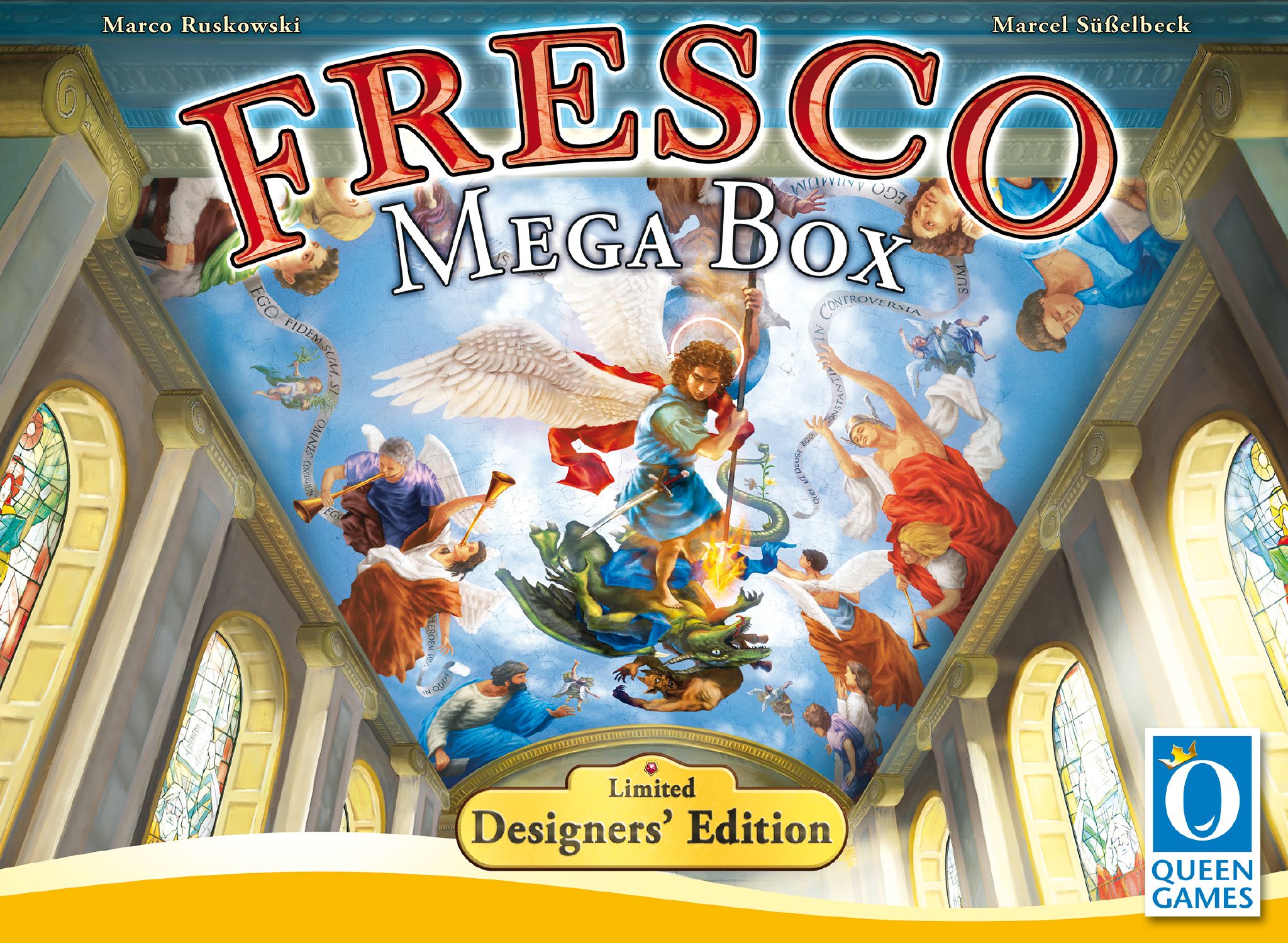
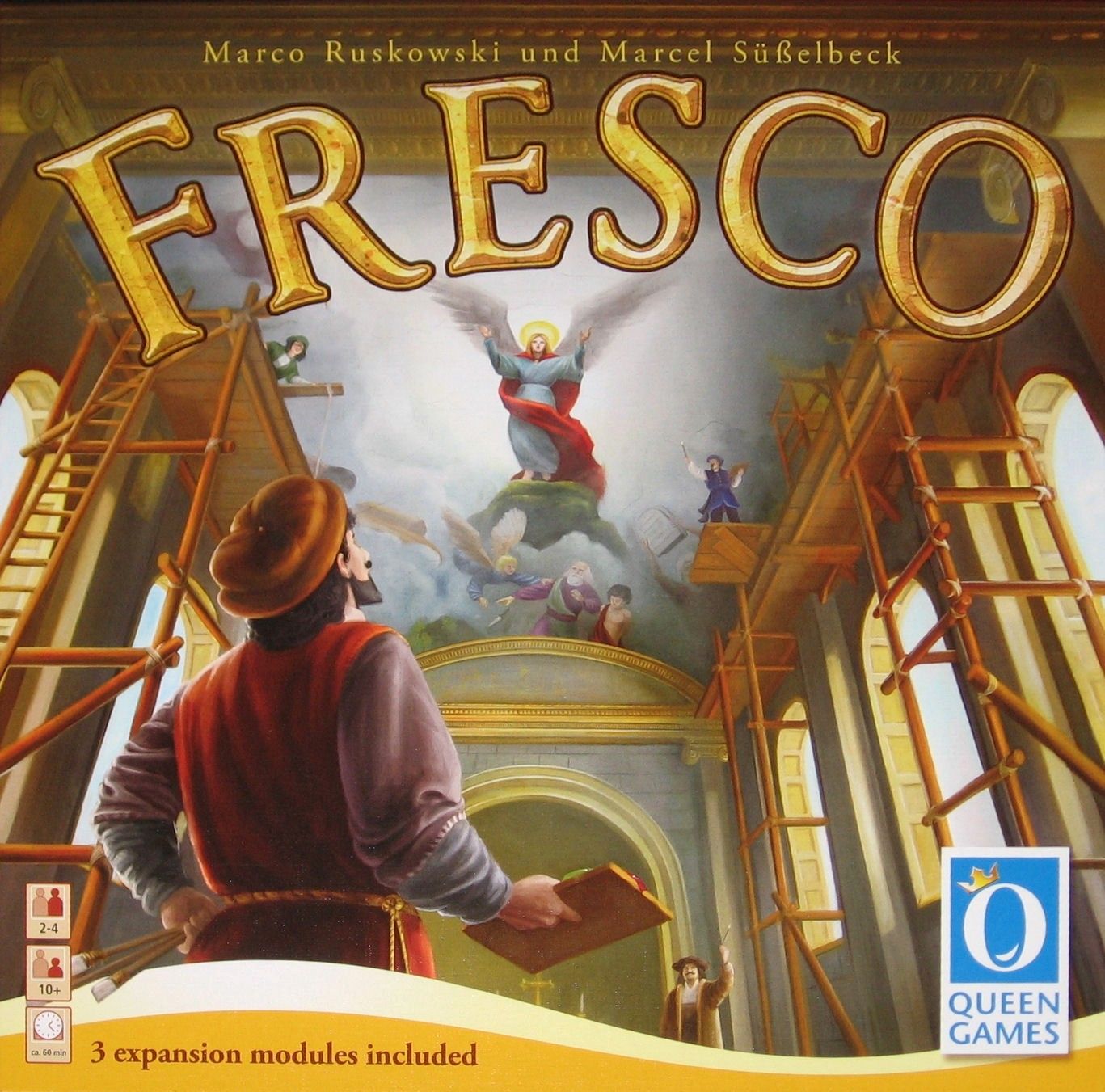
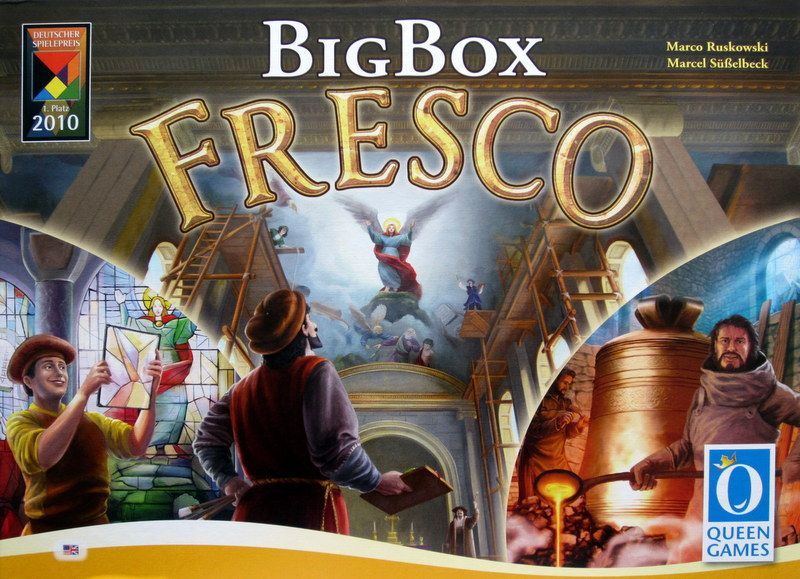
In "Fresco", players take on the role of renowned fresco painters, tasked with restoring the magnificent ceiling painting in the cathedral at the bishop's request. To do this, they must carefully plan their workday, which includes waking up early, buying and mixing paints, and working impeccably in the cathedral. If earnings are not sufficient, painters may have to fulfill requests in their own studios, which can affect the mood of their apprentices. Bad moods can be recovered by attending the evening performance at the theater.
The ultimate goal is to accumulate the most victory points through good planning and become the most glorious fresco painter.
Preparation (Setup)
Follow these steps to set up the game:
- Game Board: Place the double-sided game board in the center of the table. For 4 players, use the side with starting spaces S1-S4. For 3 players, flip the board and use the side with starting spaces S1-S3.
- Player Components: Each player chooses a color and takes:
- 1 small screen and 1 action guide (placed behind the screen, with side 1 showing).
- 1 large screen, and behind it, 1 yellow paint tile, 1 red, 1 blue, and 12 Thalers.
- 1 card with basic paint mixtures.
- 3 master painters.
- 5 apprentices.
- Starting Spaces (S1-S4): Place 1 master painter from each player inside the cloth bag. Draw them one by one from the bag and place them on starting spaces S1 to S4 (or S1 to S3 for 3 players) in the order they were drawn.
- Inn: Each player places one of their master painters on one of the spaces above the inn.
- Market: Place all 14 market tiles inside the cloth bag and mix well. Take the appropriate number of tiles for each stall (four stalls for 4 players, three stalls for 3 players) and place them face up. For 3 players, remove specific game tiles (consult the manual for details on which tiles to remove).
- Cathedral with Fresco and Altar: From the 25 fresco tiles, take the one with value 11 and place it face up in the middle space of the fresco. Shuffle the remaining tiles and place them randomly in the fresco segments.
- Studio: Place all coins (Thalers) in the three empty spaces of the studio, separated by value. This is a reserve.
- Workshop: All paint tiles are placed in the 6 spaces of the workshop, separated by color. This is a reserve.
- Theater: All players place one of their master painters in the corresponding space of their color. A neutral-colored apprentice is placed in the space above each column.
- Bishop: The bishop takes his place in the center of the fresco.
Game Flow
"Fresco" is played over several rounds, and each round is divided into 2 phases:
- Choosing wake-up time and adjusting mood
- Planning and taking actions
1. Choosing wake-up time and adjusting mood
The player in last place on the victory point track is the first to play. At the start of the game, with master painters on starting spaces S1-S4, S1 is considered the last position.
- The current player takes their master painter from the space above the inn and places it on their chosen wake-up time (left column).
- Other players do the same, from last position to first on the victory point track, placing their master painters on any free wake-up time. Each wake-up time can only be occupied by one player.
- The chosen wake-up time has the following effects:
- It can change the player's own mood.
- It affects the market price for the player.
- It determines the player order for actions in phase 2.
- Mood change: Immediately after choosing the wake-up time, the player must adjust their mood, moving their painter up or down in their column, on the mood tracker, as indicated in the middle column of the inn. The painter never goes beyond the last space, top or bottom, of the column.
- If a master painter is occupying one of the two "+1" spaces, they take a neutral-colored apprentice from the top of their column, allowing them to take an additional action (total of 6 actions). They keep the extra apprentice until they leave the "+1" spaces.
- If a master painter is occupying one of the two "-1" spaces, they must dismiss one of their own apprentices, placing it in front of their screen (total of 4 actions in phase 2). They take their apprentice back when leaving these spaces.
- Market prices: Depending on the chosen wake-up time, the right column of the inn shows the price the player must pay for 1 market tile.
- Player order: After all players have chosen their wake-up time, the player order is fixed for phase 2. Whoever chose the earliest wake-up time will be the first player, followed by players of subsequent times.
2. Planning and taking actions
- Planning actions: All players plan their future actions simultaneously behind their small screens. They can take actions in 5 different places on the board. Players allocate their available apprentices among the 15 spaces of the action guide. Each space can only have 1 apprentice, activating that action.
- Taking actions: As soon as all players have allocated their apprentices, they remove the small screen and visit the 5 locations, one after the other. At each location, the current player takes their actions in the order of the time they chose to wake up. The current player takes all their actions at one location before the next player takes their actions at the same location.
- If a player has not placed apprentices in a certain location, they will not take any actions there and skip their turn.
- Players are not obligated to take the chosen actions. They can skip any chosen actions, especially if they do not have enough money or paint.
Preparation for the Next Round
After all players have finished their actions, the next round is prepared:
- Take the appropriate number of market tiles for each stall and place them face up.
- Each player receives their payment: 1 Thaler for each face-down fresco tile in front of them (applicable only after having restored at least 1 fresco segment).
- All players move their master painters back to sleep at the top of the inn.
- The player in the last position on the victory point track starts the next round by choosing the wake-up time.
- In case 2 or more master painters are in the starting spaces, they will swap places. The first is moved to the end of the line and the others move one space forward.
Actions and How to Play
Players can perform actions in 5 different locations on the board, allocating their apprentices to the corresponding spaces on the action guide:
Market: Buy paints or close stall
The current player chooses one of the market stalls and decides to take one of the following actions:
- Buy paints: Each apprentice allocated in the "market" column allows buying 1 market tile from the chosen stall. Each tile can only be bought once. The purchase price depends on the chosen wake-up time. The player takes the paints shown on the tile from the reserve and hides them behind their large screen. After all purchases from the stall, the tiles from this stall return to the cloth bag.
- Close the stall: If the player has allocated at least 1 apprentice in the "market" column, they can skip buying paint and, instead, close the chosen stall. All tiles from this stall return to the cloth bag. This action has no cost.
Cathedral: Restore the fresco or the altar
Each apprentice allocated in the "cathedral" column allows:
- Restore a fresco segment: To restore a segment, the player needs to have the paints illustrated on the segment tile. When restoring, the player returns the required paints to the reserve and gains the victory points shown on the tile, plus any bonus points acquired by the bishop. The player advances their master painter on the victory point track. If the movement ends alongside another player's painter, they must decide whether to stop in the empty space before or after the occupied space. No space on the victory point track can be occupied by more than 1 player. After restoring, the player removes the fresco tile from the board, places it face down in front of them, and moves the bishop to the restored segment.
- Moving the bishop: Before restoring any fresco segment, the player can move the bishop only 1 space in any direction (vertical, horizontal, or diagonal) once, paying 1 Thaler to the reserve.
- The bishop's bonus point: If the bishop is on the segment to be restored, the player gains 3 bonus points. If the bishop is in an adjacent space (vertically, horizontally, or diagonally) to the segment to be restored, the player gains 2 bonus points.
- Restore the altar: Instead of restoring a fresco segment, the player can choose to restore the altar in two ways:
- Using basic paints: The player returns 1 yellow paint tile, 1 red, and 1 blue from behind their screen to the reserve. They gain 2 victory points. The player can replace any or all of the paints with green, orange, or purple, each of these wildcard paints is worth 1 additional victory point.
- Using only 3 different mixed colors: The player returns 1 orange paint tile, 1 green, and 1 purple from behind their screen to the reserve. They gain 6 victory points.
Studio: Paint portraits
For each apprentice allocated in the "studio" column, the player gains 3 Thalers from the reserve.
Workshop: Mix paints
For each apprentice allocated in the "workshop" column, the player can mix their colors up to 2 times. The player decides which colors they want to mix, returns the mixed color tiles to the reserve, and takes the resulting color tiles. The number of paint tiles is unlimited; if there are not enough, make a note on paper.
Theater: Improve mood
For each apprentice allocated in the "theater" column, the player can move their master painter 2 spaces up on the mood tracker. Any mood change from visiting the theater will be effective in the next round, after choosing the wake-up time.
End of Game and Scoring
The game ends when one of the following conditions is met:
- If there are only 6, or fewer, fresco tiles remaining on the board at the start of the round, this is the final round of the game. All players flip their action guides to side 2. The game will end after this round, even if the fresco is not fully restored. No payment is made after the final round. In the final round, the "theater" can no longer be visited, and the cathedral can be visited twice.
- In case the fresco has been completely restored before the final round, that will be the final round and the final point count will occur immediately afterward. As it is the final round, no payment is made.
Final point count
Now, all players gain victory points for their money. Every 2 Thalers are worth 1 victory point. These final victory points are gained in player order (wake-up time) from the last round. If a master painter ends their movement in an already occupied space on the victory point track during the final point count, they are moved to the next empty space ahead.
The player with the most victory points is the winner.
Tips for Winning
- Wake-up Time Planning: The choice of wake-up time is crucial, as it affects not only turn order but also the mood of your apprentices and market prices. Evaluate your needs for the round (do you need money, cheap paints, or do you want to act first?) before deciding.
- Apprentice and Mood Management: Pay attention to the mood of your apprentices. An extra apprentice can mean a valuable action, while a dismissed apprentice can limit your options. Using the theater to improve mood can be an important strategy to maintain your workforce.
- Cathedral Strategy: Restoring the fresco is the main source of victory points. Keep an eye on the bishop's position to maximize your bonus points. Restoring the altar can be a valuable alternative, especially at the end of the game, when fresco tiles are scarce.
Rules manual
Official PDF file
Frequently Asked Questions
Quick answers about the rules
What is the objective of Fresco: Big Box?
How do you set up Fresco: Big Box?
How do you play Fresco: Big Box?
How does Fresco: Big Box end, and how do you score?
What are some tips for winning Fresco: Big Box?
Other Games You'll Like
Based on mechanics and theme