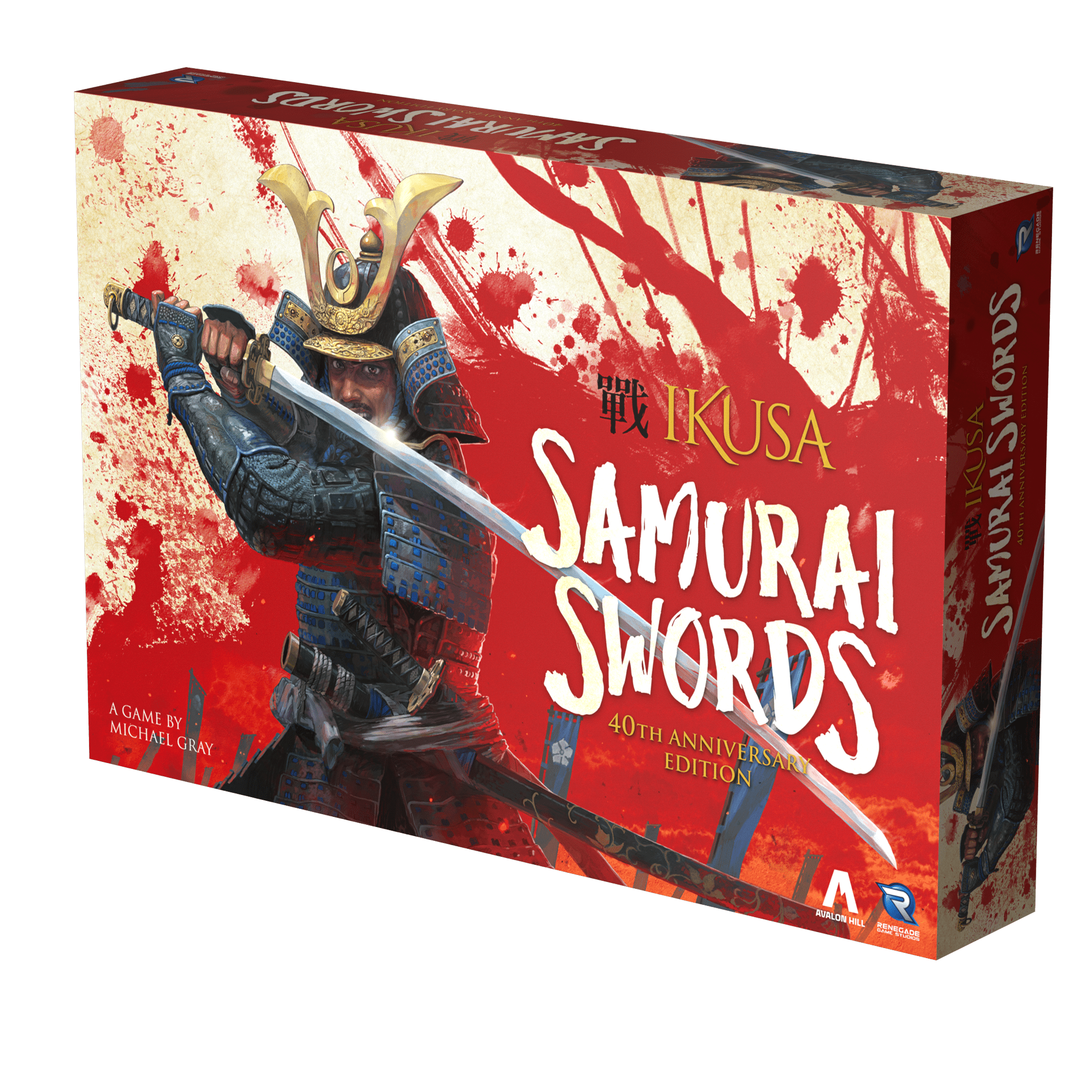
How to Play Ikusa
Milton Bradley, Renegade Game Studios, Avalon Hill · Board game · 1986Video: How to Play
Start here, then follow the written guide
Step by step
1. Objective of the Game
As Daimyo in 16th‑century Japan, you vie for Shogun status. To win, you must control the most provinces, build castles, temples, and Nô theaters, and accumulate victory points through provincial control, building construction, and regional dominance. The player with the highest victory point total after the final winter scoring round becomes the Shogun.
2. Preparation (Setup)
- Choose a board side (sun or moon). Lay the board and discard all province cards that do not match the chosen side. In a 3‑player game, 8 province cards are set aside.
- Distribute player materials:
- Individual board (front side for action planning, back side for starting provinces)
- 62 colored army cubes (player’s color)
- 1 Daimyo card
- War chest cards (0–4 chests)
- Starting chests: 18 (3 players), 15 (4 players), 12 (5 players)
- Claim Starting Provinces:
- Shuffle all province cards and place them face down near the board.
- Turn the top two cards face up.
- Starting from the oldest player, each player chooses one of the two face‑up cards or draws the top card from the pile, then transfers one of his army groups (from his individual board) to the matching province on the game board and keeps that province card.
- Replace any taken face‑up card with the next card from the pile. Continue until all army groups are on the board.
- Place any remaining province cards near the board; they can be conquered later.
- Set up the Battle Tower:
- Drop 7 armies from each player and 10 farmer armies into the tower.
- Return any cubes that fall out to the appropriate supplies.
- Keep the remaining farmer armies as a general supply.
- Prepare other components:
- Shuffle the Event cards and place them face down. Turn the top four face up next to the board.
- Place the Action cards and Special cards within easy reach.
- Set each player’s victory point marker on the “0” space of the scoring track and each rice marker at the bottom of the provision track.
3. Flow of the Game
The game lasts two years, each year divided into four rounds: Spring, Summer, Fall, and Winter. The sequence repeats once more, ending with the second winter scoring round.
- Spring, Summer, Fall (identical structure):
- Lay out the top five Action cards face up beneath fields 1–5; the remaining five remain face down beneath fields 6–10.
- Lay out the five Special cards face up in the order drawn.
- Each player secretly plans his ten actions, assigning a province card to each chosen action space on his individual board.
- Players bid for turn order by placing an unused chest card or province card face down on the auction space.
- Shuffle the face‑up Event cards (2–4 depending on the round), draw one, and place it face up on the event space.
- Reveal all bids, pay the amounts shown (province cards cost nothing), and determine turn order by selecting the special card that matches each player’s position on the board.
- Execute the ten actions in the order of the action cards. All players perform the same action in turn order before moving to the next action.
- After all ten actions, return the Daimyo card and discard the used Special card. Remove the round’s Event card from play.
- Winter:
- Apply the fourth Event card to determine rice losses for each player.
- Each player must have one unit of rice for each province he controls. If not, revolts occur as described in the Revolts section.
- Score victory points for provinces, buildings, and regional building dominance.
- Remove all revolt markers, reset rice markers to 0, and reveal four new Event cards for the next year.
4. Actions and How to Play
Each player may perform each of the ten actions once per round, assigning a province card to the action space on his individual board.
- Build a Castle: Pay 3 chests to the general supply and place a castle in the chosen province (must be an unoccupied building space; no duplicate castle in the same province).
- Build a Temple: Pay 2 chests and place a temple.
- Build a Nô Theater: Pay 1 chest and place a Nô theater.
- Confiscate Rice: Move the rice amount shown on the province card to the player’s rice marker.
- Collect Taxes: Take the number of war chests shown on the province card from the general supply. The event card may limit the maximum to 5 chests; the special card may add 1 chest.
- Deploy 1 Army / Move Armies: Pay 1 chest, deploy 1 army to the chosen province, and optionally move armies from that province to an adjacent province (no battle).
- Deploy 3 Armies: Pay 2 chests, deploy 3 armies.
- Deploy 5 Armies: Pay 3 chests, deploy 5 armies (special card may allow 6).
- Battle / Move A‑B: Move armies from the chosen province into an adjacent province. If the destination is occupied or neutral, a battle ensues (see Resolving Battles). Special cards may add an extra army to the tower for attacking or defending.
If a player cannot perform an action, he may place a war chest card on the action space; the chest’s value is ignored.
5. End of Game and Scoring
The game ends after the second winter scoring round. Scoring is performed each winter as follows:
- Province Points: 1 victory point (VP) per province controlled.
- Building Points: 1 VP per castle, temple, or Nô theater built.
- Regional Dominance:
- Most castles in a region: 3 VP.
- Most temples in a region: 2 VP.
- Most Nô theaters in a region: 1 VP.
- If two or more players tie for most of a building type in a region, each tied player receives the full VP amount minus 1.
- Move each player’s victory point marker forward the number of VP earned.
- After the final winter, the player with the highest VP total wins. In case of a tie, the player with the greatest number of war chests wins.
6. Tips for Winning
- Plan your action order early: The first five action cards are visible to all players, so choose your province assignments to maximize the benefit of the current event and your special card.
- Use special cards strategically: For example, the “+1 War Chest” special card can turn a tax collection into a larger haul, while the “+1 Army with Attack” or “+1 Army with Defense” specials can give you a decisive edge in battles.
- Control the center and build regionally: Building the most castles, temples, or theaters in a region yields bonus VP. Focus on one region to secure the regional dominance bonus.
More videos
More rules explanations from the community


Frequently Asked Questions
Quick answers about the rules
What is the objective of Ikusa?
How do you set up Ikusa?
How do you play Ikusa?
How does Ikusa end, and how do you score?
What are some tips for winning Ikusa?
Other Games You'll Like
Based on mechanics and theme