Jarmo
(Public Domain), 3Joy Games, Fratelli Fabbri Editori (Fabbri Editore) · Board game · 1227
2 · best 2
—
Weight 2.8/5
Buy
6.7
rating
Ludopedia
6.5
rating
BGG
Our Verdict
FOR GENRE FANS
Perfect for those who love tactical duels and minimalist board games with depth. The highlight is the positional tension.
Highlights
- Constant tactical tension
- Exotic tactile components
- Simple rules, high depth
- Ideal for quick sessions
Keep in mind
- Asymmetric board may confuse
- Two-player only
Rules manual not indexed yet
Upload the PDF rulebook to ask questions about this game with AI.
About the game
What you do in a play session
Ever wondered what kind of game Batu Khan, grandson of Genghis Khan, played to get into the 'warrior mood' before a battle? Meet Jarmo! Based on an old Tatarian legend, this game puts you in command of archers in a tactical duel where concentration, observation, and imagination are your primary weapons. Don't be fooled by its clean look; every move matters, and the winning strategy is far more nuanced than simply rushing toward the opponent's side.
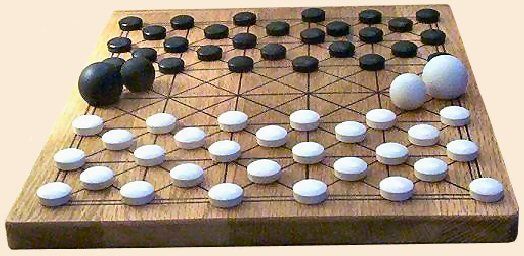
The core objective is to get as many of your archers as possible into the opponent's first row. However, the path is anything but straightforward. The board is asymmetric, meaning you and your opponent experience the game from different perspectives, creating fascinating positioning dynamics. To clear the way, you capture enemy pieces by moving your archer into a circle occupied by an opponent's archer, removing them from the board immediately.
Here is a crucial detail: an archer that captures an enemy is marked with a small black or white line. This isn't just for show! This marking is essential when applying the 'loop' rule, which adds a layer of complexity to movement and capture strategies. The game ends when one player successfully moves all their remaining archers to the opponent's first row. At that point, the final score is calculated to determine the winner. In the event of a tie, the game ends in a draw. It's a game of pure reasoning, devoid of luck, perfect for those who enjoy chess or other abstract strategy games where the mind is the only tool required.
The core objective is to get as many of your archers as possible into the opponent's first row. However, the path is anything but straightforward. The board is asymmetric, meaning you and your opponent experience the game from different perspectives, creating fascinating positioning dynamics. To clear the way, you capture enemy pieces by moving your archer into a circle occupied by an opponent's archer, removing them from the board immediately.
Here is a crucial detail: an archer that captures an enemy is marked with a small black or white line. This isn't just for show! This marking is essential when applying the 'loop' rule, which adds a layer of complexity to movement and capture strategies. The game ends when one player successfully moves all their remaining archers to the opponent's first row. At that point, the final score is calculated to determine the winner. In the event of a tie, the game ends in a draw. It's a game of pure reasoning, devoid of luck, perfect for those who enjoy chess or other abstract strategy games where the mind is the only tool required.
Gallery
Box and component photos
Tap any photo to open fullscreen. Photos submitted by the community or publisher.
Rules videos
Learn by watching before you open the box


Best player count
BGG community vote
2
BEST
Soundtrack
Ambience suggested by Melodice
Loading playlist...
Where to Buy
Prices monitored daily
Finding best prices...
Prices unavailable at this time.
Price history — last 6 months (lowest new offer)
Alert enabled!
Join the BoardGamesBot deals group
Get the best board game deals every day — without message spam.
Join the WhatsApp groupGame details
Mechanics, categories, families and credits
Mechanics
Categories
Families
Publisher
(Public Domain), 3Joy Games, Fratelli Fabbri Editori (Fabbri Editore), Lemery Games, Mitra, NewVenture Games
Designer
(Uncredited)
Artist
Lívia Varga, Tímea Kőszegi
Community
Data from BoardGameGeek
250owners
21wishlist
4want to play
Frequently Asked Questions
Quick answers before you buy
Is the game hard to learn?
The basic rules are quite simple, but the winning strategy and the 'loop' rule require a bit more study and practice.
How many people can play?
Jarmo is exclusively for 2 players, focusing entirely on the duel.
How long does a game last?
Time varies based on player skill, but since it's an abstract game, matches tend to be brisk.
Do I need to know English or another language to play?
Nope! Since it's an abstract strategy game with no text on cards or the board, there is no language dependency.
Who would you recommend this game to?
Anyone who enjoys Chess, Shogi, or any game where victory depends purely on your ability to anticipate the opponent's moves.
Other Games You'll Like
Based on mechanics and theme