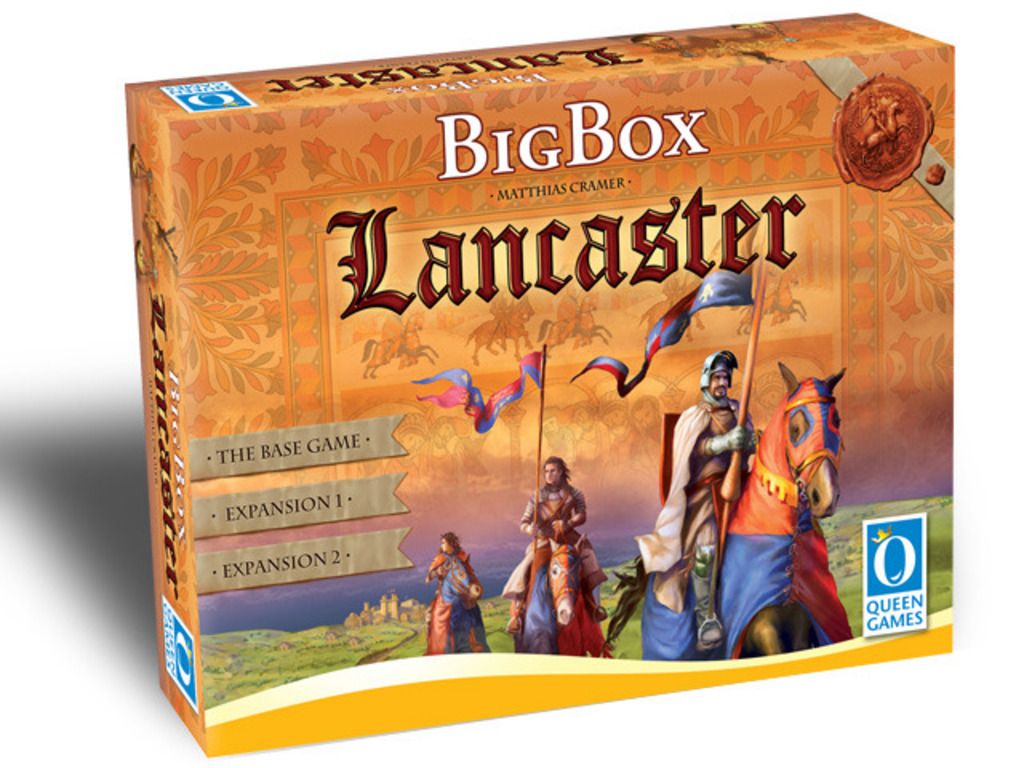
How to Play Lancaster: Big Box
Queen Games · Board game · 2015What do you want to do now
Ask anything about Lancaster: Big Box: rules, setup, components, complexity, price, or whether it fits your group.
Step by step
Game Objective
In 1413, the new King of England, Henry V of Lancaster, has ambitious plans: to unify England and conquer the French Crown! Each player leads their own rising noble family. The objective is to progress from a simple Lord to the king's most powerful ally, developing their own cavalry and intelligently using their knights in the counties of England, in their own castle, and in conflicts with France. In parliament, players will try to pass laws that benefit them most. The player with the most power points at the end of the game is the winner.
Preparation (Setup)
Before the first game, attach the stickers to the wooden pieces according to the instructions (1 (3x), 2 (2x), 3 (1x), 4 (1x) for each of the 5 player colors).
Common Components:
- 1 Game Board
- 2 Supply Boards
- 37 Squires
- 37 Gold
- 37 Vote Markers
- 36 Noble Tiles
- 1 Starting Player Marker
- 12 Conflict Cards (plus 2 extra cards)
- 6 "King's Favor" Tiles
- 1 Parliament Board
- 18 Law Cards
Individual Player Components (in 5 colors):
- 5 Player Markers
- 35 Knights
- 5 Castle Boards
- 30 Extension Tiles
- 5 Screens (each assembled in 3 parts)
- 10 Vote Tiles (5 x "yes" and 5 x "no")
- 1 Sticker sheet (including extra stickers)
Basic Setup:
- Place the Game Board, the Parliament Board, and the 2 Supply Boards in the center of the playing area.
- Disperse all vote markers, gold, and squires equally between the two Supply Boards.
- Each player chooses their color and places their player marker on the "0" space of the power point track and their 7 knights in the corresponding reserve area.
- Give each player:
- In their player color: 1 castle board, 6 extension tiles, 1 screen, 2 knights (strength 1 and strength 2) (taken from the reserve).
- From the general supply: 1 vote marker, 2 gold, 2 squires, 2 vote tiles (yes and no).
- Randomly determine the starting player and give them the starting player marker.
- Place the 6 "King's Favor" tiles face up on the Game Board.
- Remove 2 of the 12 conflict cards. Shuffle the remaining cards and place the deck in the designated space, face down. Draw the top 2 cards and place them face up in the top row. France's strength for conflict cards varies with the number of players:
- 2 & 4 players: "2" & "10"
- 3 players: "9" & "10"
- 5 players: "2" & 1 x "3"
- Parliament:
- Separate the law cards by the numbers on their backs.
- Shuffle the 3 "0" laws and place them from left to right in the top row, face up. These are the current laws.
- Form the draw pile in the center. First, shuffle the 3 "4" laws and place them face down in the central space. Repeat this procedure with the "3", "2", and "1" laws, always placing the cards on top of each other.
- Finally, draw the top 3 cards and place them, from left to right, in the bottom row, face up.
- Sort the noble tiles by the letters on their backs and place each stack randomly face up in one of the counties. The exact number of tiles depends on the number of players:
- 2 & 3 players: 2 tiles per county
- 4 players: 3 tiles per county
- 5 players: 4 tiles per county
- Each player selects one of their extension tiles and places it in their castle, covering the space that shows the same reward. The remaining 5 tiles form the player's personal supply.
- Keep gold and squires always hidden behind the screen. Place the vote markers always on the castle board, visible to all players. Place the two knights in the court.
Setup for 2 Players:
Use the rules for 4 players, with the following changes:
- Leave the screens in the box, they are not used. A player's gold and squires are visible to the opponent.
- Place 2 noble tiles in each county.
- Each player selects their ally's color and additionally receives:
- 2 ally boards (1 x "castle" front / 1 x "court" back)
- 7 knights of their ally. Place 1 knight with strength 2 in the court, the remaining 6 knights go to the reserve.
Setup for the "Henry V – The Power of the King" Expansion:
Before the first game, attach the archer and Tudor knight stickers to 3 of each of the 6 brown wooden discs. Additionally, attach a bishop sticker to each of the 9 black wooden discs, and a lord sticker of the player colors to each of the remaining 5 discs.
- Regal Board – place this board below the Parliament Board.
- 8 Privileges – place the privileges (2 shields, 3 archers, and 3 Tudor knights) in their supply spaces on the Regal Board.
- 24 Royal Seals – place them in their designated supply space.
- 3 Office Cards – place them next to the Regal Board.
- 9 Bishops – place a certain number of bishops on the Regal Board according to the number of players:
- 2/3 players: 5 bishops
- 4 players: 7 bishops
- 5 players: 9 bishops
- 5 Lord Markers – give each player 1 lord marker of their player color. Each player places their lord marker on the coat of arms icon of their castle board.
- Unlike the basic game, each player receives 2 vote markers to start.
Setup for the "The King’s Resentment" Expansion:
- Regal Board – place this board below the Parliament Board.
- 38 Dishonor Markers – place these markers on the dishonor track of the Regal Board, depending on the number of players:
- 2 players: 2 dishonor markers per space
- 3 players: 3 dishonor markers per space
- 4 & 5 players: 4 dishonor markers per space
- Place all remaining dishonor markers in the appropriate supply box on the Regal Board.
- 1 Tower – place the tower somewhere on the Game Board within reach of all players.
- Depending on the number of players, fill the tower as follows:
- 2 players: 1 knight with strength 4 of a non-player color
- 3 players: 1 knight with strength 3 of a non-player color
- 4 players: 1 knight with strength 2 of a non-player color
- 5 players: no knight
Setup for the "QUEENIE 1: REWARD TILES" Expansion:
- 9 reward tiles for use with the basic game and 3 exchange tiles for use in combination with the "Henry V – The Power of the King" expansion. On the back of the tiles, letters A-I are printed, corresponding to the counties on the game board. Place the 9 tiles for the basic game in the bag and mix them well.
- When playing with the "Henry V – The Power of the King" expansion, remove power point tiles A, D & F and use seal tiles A, D & F.
Game Flow
The game is played over five game rounds. Players take turns clockwise. Each round consists of 3 Phases:
- Phase 1: Place Knights
- Phase 2: Parliament
- Phase 3: Rewards
Phase 1: Place Knights
The active player takes one of their own knights from their court and places it in a knight space. Then, the next player does the same, and so on, until all players have placed all their knights. If a player no longer has knights in their court, their turn is skipped. If only one player remains with knights in their court, they place them successively one after the other.
There are 3 possible locations to place knights:
- County
- Castle
- Conflict
Modification for "Henry V – The Power of the King": The active player can place one of their own knights or their own lord. Then, the next player takes their turn, until all players have placed all their knights and lords.
Modification for "The King’s Resentment": There is one more location where players can place their knights: The Tower.
Phase 2: Parliament
After the last knight has been placed, the English Parliament convenes. Players must vote on the 3 new laws, one after the other. They start with the law in space 1, bottom left row.
Voting Procedure
All players vote simultaneously and secretly. They decide for or against the law and place the appropriate vote tile face down in front of them.
Then, all players can secretly reinforce their decision by using as many vote markers as they wish.
After all players have taken their reinforcements in their hands, they simultaneously place the markers on the table and reveal their vote tiles.
Voting Result
Players now count all votes for and against the law. Each vote tile and each vote marker counts as 1 vote. The majority wins. In case of a tie, the law passes.
Return all used vote markers to the general supply.
- The new law passes: Remove the previous law (top left, top row) from the Parliament display. Then, slide the other two laws one position from left to right and place the new law in the empty space on the right.
- The new law is rejected: Remove the rejected law from the game and leave the previous laws unchanged.
Use the same procedure to vote on the 2nd and 3rd new law.
Players who still have vote markers after the completion of all three votes return them to the general supply.
Implementation of the 3 Applicable Laws
After all votes, there will always be three applicable laws. They are applied from left to right and players gain rewards.
Phase 3: Rewards
Counties, castles, and conflicts are evaluated in this order.
Modification for "Henry V – The Power of the King": Offices are filled before counties, castles, and conflicts are evaluated.
Modification for "The King’s Resentment": Before evaluating the counties, the tower is cleared and the knights return to their owners' court. The non-player color knight remains inside the tower.
Preparing the Next Game Round:
Prepare the next game round after the completion of scoring all conflicts.
- Parliament: Reveal 3 new laws from the top of the draw pile, one after another, and place them in the 3 spaces for new laws, from left to right.
- Conflict: Reveal two new conflict cards and place them in the top row. All face-down "King's Favor" tiles are flipped face up.
Modification for "QUEENIE 1: REWARD TILES": Draw 1 reward tile from the bag at the beginning of each game round. The letter on its back corresponds to a county on the Game Board. Place the tile face up next to the printed reward.
Actions and How to Play
Placing Knights (Phase 1)
Players place their knights in one of three locations:
County
- A knight can be placed in an empty or occupied space. In both cases, the knight itself must equal or exceed the required minimum strength.
- Additionally, the player can place as many squires as they wish along with their knight. Each squire adds 1 strength point, which does not count towards the required minimum strength.
- If the space is occupied by another player's knight, that knight can be expelled if the active player's knight's strength or the combined strength of the knight and their
Rules manual
Official PDF file
Frequently Asked Questions
Quick answers about the rules
What is the objective of Lancaster: Big Box?
How do you set up Lancaster: Big Box?
How do you play Lancaster: Big Box?
Other Games You'll Like
Based on mechanics and theme