Lifeboats: Plank of Carneades — Prices
Broadway Toys LTD, Lanlalen, Mayday Games · Board game · 2024
3–7 · best 5
45 min
Weight 1.6/5
Buy · from US$ 35.99
8.5
rating
Ludopedia
7.0
rating
BGG
Our Verdict
RECOMMENDED
Perfect for those who love intense social interaction and don't mind betraying their friends for points.
Highlights
- Frantic and funny social interaction
- Constant tension during voting
- Simple and quick to learn rules
- Captain mechanic creates great twists
Keep in mind
- Highly dependent on the player group
- Can be cruel to new players
Rules manual not indexed yet
Upload the PDF rulebook to ask questions about this game with AI.
About the game
What you do in a play session
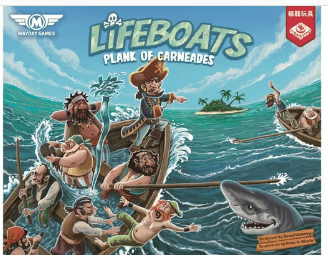
Picture this: a catastrophic shipwreck and you're fighting for a spot in a lifeboat. In Lifeboats: Plank of Carneades, the difference between reaching dry land or becoming shark bait depends on one thing: politics. The game is a social tug-of-war where cooperation is merely a tool for betrayal. You must manage your officers and sailors, trying to place them on boats with the best chance of reaching the islands, while actively sabotaging your opponents.
The dynamics revolve around simultaneous voting. Each player holds color cards (representing the boats) and Captain cards. When everyone reveals their choices, the majority wins, but there's a twist: if only one player plays a Captain card, they dictate the result entirely. If two or more play it, the cards are ignored. It's a game of 'who blinks first.'
Each round follows a tense flow: first, players vote on which boat starts leaking. If the boat is full, the passengers must vote to decide who gets tossed overboard to lighten the load. Next, players vote on which boat moves forward toward its island. Finally, the movement phase begins, where you try to pull your characters out of sinking boats and jump into others. Be careful, though: if you jump and there's no space in the new boat, you end up in the water.
This 'Plank of Carneades' version expands the original experience, allowing up to seven players, which makes the politics far more chaotic. Additionally, the pace is faster, with more frequent leaks and ships that move more quickly. The Captain has also become more powerful, now able to prevent a boat from leaking. In the end, the winner is whoever saved the most valuable crew, proving that at sea, loyalty is the first thing to sink.
The dynamics revolve around simultaneous voting. Each player holds color cards (representing the boats) and Captain cards. When everyone reveals their choices, the majority wins, but there's a twist: if only one player plays a Captain card, they dictate the result entirely. If two or more play it, the cards are ignored. It's a game of 'who blinks first.'
Each round follows a tense flow: first, players vote on which boat starts leaking. If the boat is full, the passengers must vote to decide who gets tossed overboard to lighten the load. Next, players vote on which boat moves forward toward its island. Finally, the movement phase begins, where you try to pull your characters out of sinking boats and jump into others. Be careful, though: if you jump and there's no space in the new boat, you end up in the water.
This 'Plank of Carneades' version expands the original experience, allowing up to seven players, which makes the politics far more chaotic. Additionally, the pace is faster, with more frequent leaks and ships that move more quickly. The Captain has also become more powerful, now able to prevent a boat from leaking. In the end, the winner is whoever saved the most valuable crew, proving that at sea, loyalty is the first thing to sink.
Gallery
Box and component photos
Tap any photo to open fullscreen. Photos submitted by the community or publisher.
Rules videos
Learn by watching before you open the box


Best player count
BGG community vote
3
OK
4
REC
5
BEST
6
BEST
7
BEST
Soundtrack
Ambience suggested by Melodice
Loading playlist...
Where to Buy
Prices monitored daily
Finding best prices...
Prices unavailable at this time.
Price history — last 6 months (lowest new offer)
As an Amazon Associate I earn from qualifying purchases. Prices and availability subject to change.
Alert enabled!
Join the BoardGamesBot deals group
Get the best board game deals every day — without message spam.
Join the WhatsApp groupGame details
Mechanics, categories, families and credits
Mechanics
Categories
Families
Publisher
Broadway Toys LTD, Lanlalen, Mayday Games
Designer
Ronald Wettering
Artist
Pedro A. Alberto
Community
Data from BoardGameGeek
651owners
206wishlist
42want to play
Frequently Asked Questions
Quick answers before you buy
Is the game complex?
Not at all! The rules are simple and intuitive; the real complexity lies in the 'politics' between players.
How many people can play?
From 3 to 7 players. The more people, the more chaotic and fun the game becomes.
How long does a game take?
Around 45 minutes, making it much faster than most strategy games.
Is it a cooperative game?
No, it's competitive. You might cooperate momentarily, but in the end, only one person wins.
Who do you recommend it for?
For those who enjoy Party Games, bluffing, and groups that love arguing and negotiating.
Other Games You'll Like
Based on mechanics and theme