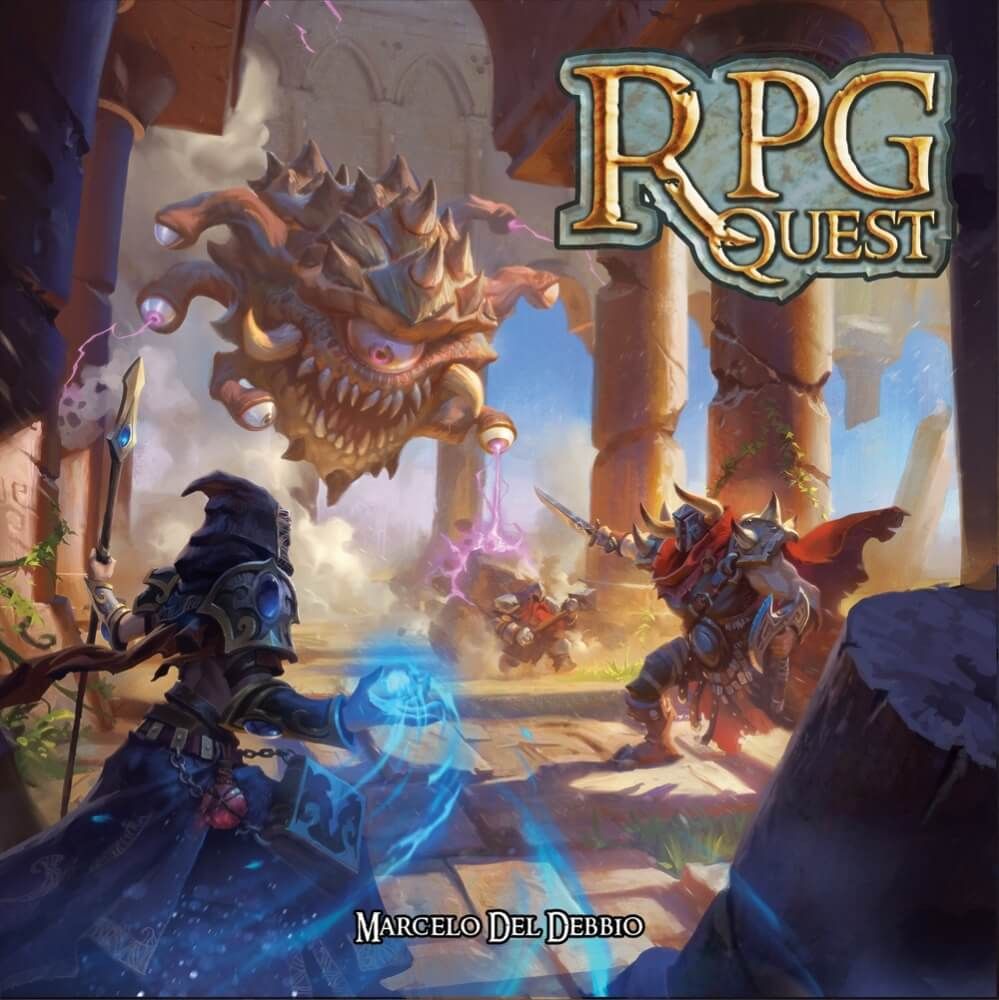
How to Play RPGQuest Dungeons
Daemon Editora · Board game · 2018What do you want to do now
Ask anything about RPGQuest Dungeons: rules, setup, components, complexity, price, or whether it fits your group.
Step by step
Game Objective
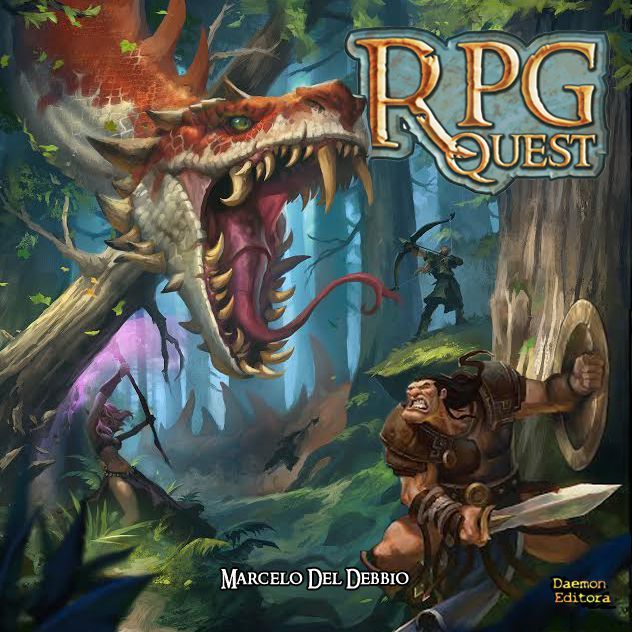
RPGQuest Dungeons is a modern RPG and board game where a group of four Heroes venture through underground labyrinths, dungeons, and secret passages known as "Dungeons" or "Seth's Tunnels" in the Kingdom of Arcadia. The main objective is for the Heroes to work together to win the Adventures, which are described in the "Adventure Book." During these Adventures, the Heroes can find treasures, valuable artifacts, weapons, armor, and magic items, as well as improve their powers and attributes to become stronger on their journey. The game is cooperative, and fun is the main objective, with or without the presence of a Narrator.
Setup
The setup for RPGQuest Dungeons can be done with or without a Narrator. It is recommended to play the first few games with a Narrator to get used to the rules.
- Choose Hero Powers: Each player creates a Character Sheet, choosing a combination of Power and Ability Cards according to their character's Levels. The sum of the Levels of the Power Cards must be equal to the number of Class Points on the Hero card. It is not allowed to choose more than one card with the same Power for the same Hero.
- Spells: Some Powers are associated with Spell Cards (Mages, Clerics, Druids, Paladins, Shamans, etc.). Separate the Spells by Level (1, 2, and 3) and type (Red - Mage and Blue - Cleric). Draw the correct number of Spells of each Level for each Hero, according to their Powers.
- Initial Room Setup: Place an 8x8 Room on the table and the token representing the Stairs in one of the corners. Add 1 or 2 Doors on any two walls.
- Select Adventure Monsters: Ready-made Adventures have a specific Monster Setup. Monsters are divided into three Card Decks: "Easy," "Medium," and "Hard." Choose the number of Monsters for each deck. The division is subjective and determines the difficulty. A "boss" Monster (BOSS) can be separated from the deck. Whenever the Monsters in a room are defeated, their cards return to their respective deck and are shuffled.
- Create a Dungeons Deck: Shuffle the Dungeon Construction Cards and place them face down, forming the "Dungeons Deck."
- Other Preparations: Place all Furniture shuffled and face down, separated by size. Place all Initiative Tokens inside the Initiative Cloth Bag. Make a pile with the Health Point Tokens and Mental Point Tokens.
- The Heroes!: Place the 4 Hero Miniatures in the positions inside the Starting Staircase.
- Adventures with a Narrator: The Narrator reads the Adventure description, the Dungeon Map, the Adventure Notes, and replayability instructions. They separate the Spiral Staircase pieces and place them on the table. The Narrator also organizes the Monsters according to the Adventure's Initial Setup, keeping the miniatures out of the players' sight. They do not reveal Monsters or Rooms that the Heroes have not yet entered.
Game Flow
The game progresses through Adventures. Inside a Dungeon, if there are no Monsters or other Characters in the Room/Corridor, the Heroes act clockwise. Each Hero can perform one of the following Actions:
- Move
- Open Doors
- Attack
- Cast a Spell
- Use a Power
Then it's the Board's turn, where traps or objects in Rooms and Corridors can be activated according to the Adventure Notes.
Combat
When Monsters are revealed in a new Room or Corridor, Combat occurs. A Combat is divided into Rounds, and each Round into Initiatives.
- Initiative Draw: In each Combat Round, draw Initiative tokens from the bag without looking and place them randomly in front of each participating Hero and Monster card. Add or subtract modifiers. These are the Initiative Values.
- Order of Actions: The order of actions follows the order of Initiatives, from HIGHEST to LOWEST numbers. Actions with the same Initiative occur simultaneously, following clockwise order. Tied Heroes act before Monsters.
- Performing Actions: Characters with the highest Initiative act first and can perform ONE Action. As actions are taken, players flip the Initiative token to its dark side.
- Damage Calculation: Damage is calculated only at the END of each Initiative number. If a Monster is killed, it is removed from the board at the end of the Initiative in which it was attacked and will not be entitled to an action in its own Initiative.
- Next Round: When everyone has taken their actions, the next Round will be based on the order resulting from the dark tokens.
Actions and How to Play
Move
- Each Hero can move a number of spaces equal to or less than their MOVEMENT (usually 7 spaces per Round).
- It is possible to move to any of the 8 adjacent free spaces, in a straight or diagonal line.
- It is not possible to cross spaces occupied by Monsters, walls, Closed Doors, or Tall Furniture.
- It is not possible to end a movement in the same space already occupied by another Hero.
- The Hero's miniature faces the direction of the last space they moved to, defining their FRONT and BACK.
- It is possible to move up to 3 spaces and Attack in the same Action without penalty.
- Move 4 spaces: HIT only on "5" and "6" values of the Die.
- Move 5 spaces: HIT only if "6" is rolled on the dice.
- Move more than 6 spaces: The Hero will not be able to Attack in this Action.
- It is possible to move up to 3 spaces and perform a Ritual or activate a Power.
- Some obstacles, such as Columns, cost an extra Movement point to bypass.
- Room corners cannot be crossed diagonally.
- Some Furniture (Tables, Chairs, Altars, Beds, Fountains) allow movement over them, costing an EXTRA movement point. Others (Columns, Statues, Bookcases, Fireplaces) DO NOT allow movement in the space they occupy.
Open Doors
- The Hero must be facing a Door or in any adjacent space to it and declare the Action.
- The Narrator flips the Closed Door token to the Open Door side.
- Locked Doors are locked and require the correct key to be opened.
- Limit Doors: If the Door is a Limit Door (it is unknown what is behind it), the player draws a card from the Dungeons Deck and draws an Initiative token to build that part of the dungeon, following the card's instructions.
- The red entrance arrow on the card indicates where the new section of the Dungeon should be assembled.
- Players add new Doors at the limits specified by the translucent arrows, being careful not to place them in blocked spaces.
- Only the first of the opened Rooms should be furnished and inhabited.
- Furnishing a Room:
- Draw Monsters: Draw a card from the Encounter Deck. Observe the Dungeons card and the red sphere to determine the quantity and type of Monsters (Easy, Medium, Hard) based on the number of Heroes. The Monsters are positioned following the order of the Encounter card.
- Draw Furniture: Draw a Furniture of the size indicated on the card from the Furniture pile and place it in the indicated position.
- All Doors start closed and, once opened, cannot be closed again.
Attack
- Each Hero/Monster can attack any Monster or Target around them.
- When declaring an Attack, the Character gains a DIRECTION (FRONT and BACK).
- Moving and Attacking: A Character can move up to 3 spaces and attack in the same Action. If they start the Action in a space adjacent to a Monster, they cannot move without attracting the Monster's ATTENTION.
- Attracting a Monster's Attention: When a Hero enters an adjacent space within a Monster's line of sight, they provoke an immediate reaction, becoming the Monster's priority.
- The Hero attacks:
- Roll the White Dice according to the Hero's Attack Attribute.
- Each SWORD rolled causes 1 Damage Point.
- Spend ONE Mental Point to re-roll a die (only once per attack), keeping the new result. This must be done BEFORE the opponent makes the Defense Test.
- If no Sword is rolled, the Hero missed the attack.
- Monster Defends:
- The target of the attack rolls the Dice according to their Monster Sheet or Character Sheet (usually White Dice, but can be Black, Brown, or combinations).
- For each SKULL rolled, one Damage Point is canceled. Extra Skulls are ignored.
- At the end of the attack, remove a heart token for each Damage Point caused.
- Fallen Monsters are replaced by a token and can be searched.
- Monsters attack: Follow the same rules, moving up to 3 spaces towards the preferred Hero (determined by their Card) and rolling the Attack Dice.
- Monsters cause 1 Damage Point for each SWORD they roll.
- Black Dice: The Spiral symbol ( ) on "6" is considered a SWORD or a special attack.
- Brown Dice: Can generate larger quantities of Swords per die.
- Heroes Defend:
- The target Hero rolls the Dice according to their Character Sheet (usually White Dice, but Rituals, Armor, and Magic Items can alter this).
- Each SHIELD rolled cancels one Damage Point. Extra Shields are ignored.
Cast a Spell
- The Hero who possesses a Spell Card can use it in their Action, and its effect is immediately put into play.
- Each Spell has its explanation on the corresponding Card, including Range, Damage, Damage Type, and whether it allows defense.
- Ranged Attack Spells (like Lightning Bolt or Magic Missile) need a Line of Sight to hit the target.
- Line of Sight: Is calculated with each movement. Closed doors, columns, barriers, tall furniture block vision. Tables, beds, sarcophagi, altars, etc., DO NOT obstruct the line of sight. Bookcases, fireplaces, statues, and columns block vision.
- Impaired Line of Sight: If an Ally is between the Hero and the Target in a Ranged Attack, any SKULL rolled will cause damage to the Ally.
- Monsters behind other Monsters are not in the line of sight for Ranged Attacks.
Use a Power
Each Hero has unique abilities that can be activated during the game or Combat. Activating an Ability or Power counts as an Action.
- Bless: Costs 1 Mental Point. On self or adjacent companion. Until the end of Combat, SKULLS are considered SHIELDS in defense rolls.
- Traps:
- Search for Traps: In Adventures with a Narrator, roll white dice corresponding to the skill's rank. A SWORD means the Trap was found and disarmed.
- Defend against Traps: When targeted by a Trap, roll white dice (according to the rank). Each SHIELD cancels one point of damage.
Rules manual
Official PDF file
Frequently Asked Questions
Quick answers about the rules
What is the objective of RPGQuest Dungeons?
How do you set up RPGQuest Dungeons?
How do you play RPGQuest Dungeons?
Other Games You'll Like
Based on mechanics and theme