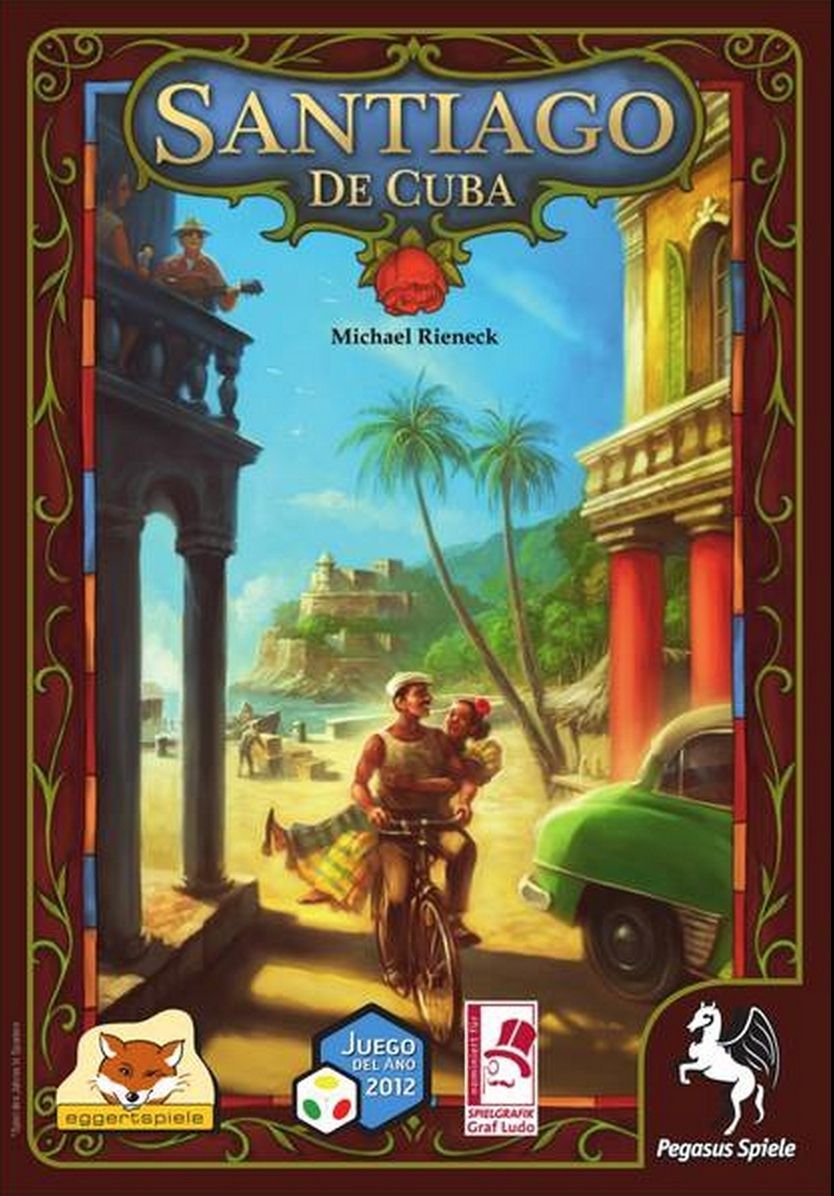
Santiago de Cuba
eggertspiele, Eagle-Gryphon Games, Filosofia Éditions · Board game · 2011
2–4 · best 2
40–75 min
Weight 2.2/5
Buy
7.8
rating
Ludopedia
6.9
rating
BGG
Our Verdict
RECOMMENDED
If you enjoy a light bargaining game with constant interaction, Santiago de Cuba offers fun and surprise every play.
Highlights
- High replayability
- Constant player interaction
- Simple ruleset
Keep in mind
- Dice luck dependency
- Best with 2‑4 players
Rules manual not indexed yet
Upload the PDF rulebook to ask questions about this game with AI.
About the game
What you do in a play session
Santiago de Cuba drops you into the bustling second‑largest Cuban city, where exotic fruit, sugar, rum, tobacco and cigars flow nonstop. At the start, nine locals are placed on a circular track that also includes the port, and twelve buildings are randomly assigned to four color groups. Each local offers a unique ability – giving you goods, cash, victory points or even hindering opponents – while the buildings grant powers such as converting tobacco to cigars or boosting delivery values. The core loop revolves around delivering to seven ships that dock at the port. Ship demand is set by rolling five dice (one per commodity) and the active player picks four results to represent the needed colors. After taking a local's action, the player moves his token to a building of matching color; if the building belongs to another player, that owner scores 1 VP. When a player reaches the port, everyone may deliver one type of good, earning 2‑4 VP per unit. Unmet demand raises the VP bounty and the ship stays, unless it has already reached the maximum of 4 VP, in which case it sails and a new ship arrives. After the seventh ship, every three goods left in hand are worth 1 VP, and the highest‑scoring player wins (ties broken by goods then money). The ever‑changing mix of locals, buildings and ship demands creates a fresh tactical puzzle each play, rewarding good connections, memory and smart spending of pesos to move the shared car. It’s a light‑weight game with simple rules but plenty of strategic depth for shrewd wheeler‑dealers.
Gallery
Box and component photos
Tap any photo to open fullscreen. Photos submitted by the community or publisher.
Rules videos
Learn by watching before you open the box
Best player count
BGG community vote
2
BEST
3
REC
4
REC
Soundtrack
Ambience suggested by Melodice
Loading playlist...
Where to Buy
Prices monitored daily
Finding best prices...
Prices unavailable at this time.
Price history — last 6 months (lowest new offer)
As an Amazon Associate I earn from qualifying purchases. Prices and availability subject to change.
Alert enabled!
Join the BoardGamesBot deals group
Get the best board game deals every day — without message spam.
Join the WhatsApp groupGame details
Mechanics, categories, families and credits
Mechanics
Categories
Families
Publisher
eggertspiele, Eagle-Gryphon Games, Filosofia Éditions, Hobby World, Kaissa Chess & Games, Lacerta, Ludonova, MYBG Co., Ltd., Pegasus Spiele, Piatnik Distribution
Designer
Michael Rieneck
Artist
Hans-Georg Schneider, Michael Menzel
Community
Data from BoardGameGeek
5,089owners
720wishlist
179want to play
Frequently Asked Questions
Quick answers before you buy
How long does a typical game take?
Usually between 40 and 75 minutes, depending on player count and familiarity.
What is the recommended number of players?
2 to 4 players, with 3 often providing the smoothest flow.
How complex is the game?
Light – about 2 out of 5 on the complexity scale, easy to learn and quick to play.
What components are included?
Modular board, five colored dice, peso tokens, Cuban cards, building pieces, ship miniatures, and victory point markers.
Is it good for fans of economic games?
Yes, though it leans more toward bargaining and memory than heavy economic calculations.
Other Games You'll Like
Based on mechanics and theme