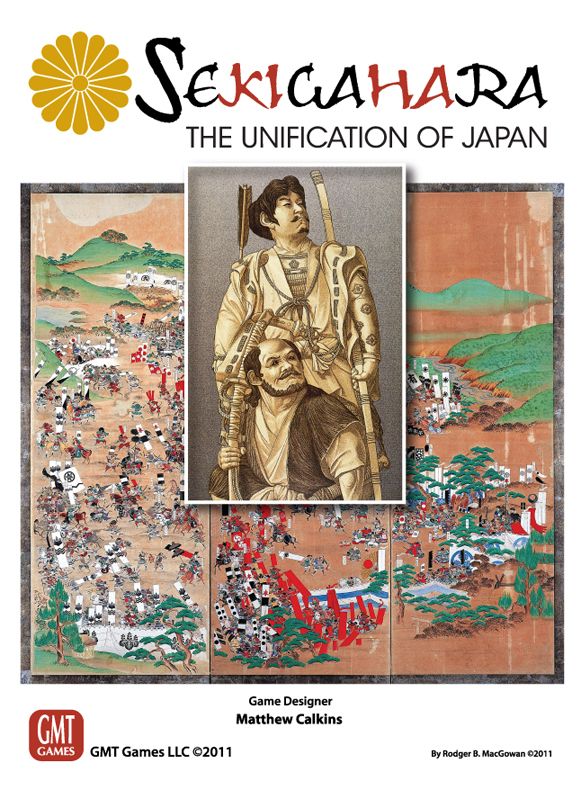
How to Play Sekigahara: The Unification of Japan
GMT Games, Devir, GaGa Games · Board game · 2011- Players
- 2 · best 2
- Play Time
- 180 min
- Weight
- Weight 2.8/5
- Year
- Year 2011
- Minimum age
- Minimum age 14+
What do you want to do now
Ask anything about Sekigahara: The Unification of Japan: rules, setup, components, complexity, price, or whether it fits your group.
Video: How to Play
Start here, then follow the written guide
Step by step
Game Objective
Sekigahara: The Unification of Japan is a two-player game set in 1600, where players represent the opposing forces of Tokugawa Ieyasu (Player A) and Ishida Mitsunari (Player B). Players lead coalitions of loyal and disloyal forces to decide the dominance of Japan.
The goal is to achieve victory either through an Immediate Victory or by accumulating the most Victory Points by the end of the 7th week.
Setup
- Place the Turn Marker on the first week.
- Shuffle the Cards separately.
- Each player draws 5 Cards.
- Separate the Blocks based on the Initial Order marker (found on the bottom corner of the block). Place the Blocks on the map in their specific locations.
- Player B's five Blocks with the Home Base marker are placed in the Home Base.
- Place any remaining Blocks in the Random Blocks areas defined on the map. When a player decides which city to place a block in, they draw a block and then decide its placement.
- Each player draws 4 Random Blocks and places them in their respective Reinforcement Base.
Game Flow
The game lasts for 7 weeks. Each week consists of 2 turns (Turn A and Turn B) and follows this sequence:
- Reinforcement Phase: Players receive new Blocks and Cards.
- Each player draws 5 Cards. If a player has 7 or more Cards, they must discard half (rounded down; e.g., 7 cards means discarding 3).
- The player controlling the most Castles receives one additional Card.
- Players draw Blocks from the Recruitment Board (2 blocks in the second week, and 1 block from the fifth to the seventh week).
- The player controlling the most Resource Areas draws one additional Block. If control is tied, both players draw one.
- Place these Blocks in the Recruitment Base.
- Note: The Reinforcement Phase is skipped in the first week.
- First Player Determination Phase: Players bid using Cards. Each player plays one Card face down. The player with the highest number on the bottom right of the Card wins the bid and becomes the first player for both turns of that week. The winning player places the Turn Marker on the Turns Board. Used Cards are discarded.
- Turns A and B: Each turn consists of the following sequence:
- First Player's Movement.
- First Player's Battle.
- Second Player's Movement.
- Second Player's Battle.
Actions and How to Play
Movement
Players move their Units (Blocks or Stacks). The number of Stacks that can move depends on the number of Cards played:
- Zero Cards: No Stacks can move.
- One Card: Limited Movement. The player can move one Stack or perform a Recruitment action.
- Two Cards: Full Movement. The player can move all their Stacks and also perform a Recruitment action.
- Three Cards: Full Movement. The player can move all their Stacks and also perform a Recruitment action.
Movement Rules: Blocks move along paths from one city to another. A Stack cannot be split during movement. Movement is blocked by enemy Blocks unless a Overrun occurs. The base movement distance is one location, which can be increased by +1 via:
- Starting Path: +1 if the Stack moves only on its starting path.
- Leadership: +1 if the Stack starts movement in a location with Leadership (obtained from a Castle or Capital).
- Force Marching: +1 by discarding a Card. This can only be done once per Stack per turn.
Stack Size: Movement speed depends on the number of Blocks in a Stack (1-4 blocks move the fastest; 17+ blocks cannot move).
Recruitment
Players move Blocks from the Recruitment Base to the map. This can only be done in Recruitment Areas (marked with a Leadership symbol). A player can either recruit all Blocks with the same symbol at that point or recruit one Block in a Recruitment Area not belonging to them (revealing the recruited Block).
Battle
Battles occur when Blocks of both players are in the same location. The active player declares the battle.
- Deployment: Players secretly assign Blocks and Cards to the battle. Cards must be paired with a Block with the same symbol.
- Combat: The attacker reveals first. The player who creates the highest Damage wins.
- Damage Calculation: Base damage is the number of symbols on the Block. A +1 bonus is added if a Block with that symbol was played previously in the same battle.
- Special Attacks: Cavalry and Weapon symbols on Cards can add +2 damage if paired with a Block with a Cavalry or Weapon symbol.
- Loyalty Check: A player can play a Loyalty Check Card to prove a Block's loyalty. If proven, the Block is transferred to the opponent's side.
- Initiative: The player with fewer Damage points has the Initiative and can continue playing Blocks.
Overrun
An Overrun occurs when a force is four times larger than the enemy force. It happens immediately and the overrun force does not suffer damage. The defeated Blocks are removed from the game.
Siege
When a battle occurs in a Castle, the defender can choose to stay inside the Castle, making the battle a Siege. The Castle can hold up to 2 Blocks. If all Blocks in the Castle are destroyed, the Castle falls to the attacker.
End of Game and Scoring
The game ends immediately if an Immediate Victory is achieved, or after the 7th week.
Immediate Victory
- Player A wins immediately if they capture the Ishida army Block (as seen in the manual image) or if the Toyotomi Hideyoshi disk is captured.
- Player B wins immediately if they capture the Ieyasu Block (the black Block in the manual image).
- If both achieve this simultaneously, Player B wins.
Victory Points
If no Immediate Victory occurs by the end of the 7th week, points are counted:
- 1 point for each Castle controlled.
- 1 point for each Resource Area controlled.
- In the event of a tie, Player B wins.
Tips for Winning
- Control the Castles: Controlling the most Castles provides a critical advantage by granting an extra Card during the Reinforcement Phase.
- Manage your Stacks: Be mindful of Stack Size, as larger Stacks move slower and can eventually become immobile (17+ Blocks).
- Utilize Force Marching: Use the Force Marching action by discarding Cards to increase movement range when a quick strike is necessary.
More videos
More rules explanations from the community
In English
-
 Sekigahara Play Through Part 1/5
-
 Sekigahara Play Through Part 2/5
-
 Sekigahara: The Unification of Japan
-
 Sekigahara Play Through Part 5/5
-
 Sekigahara Play Through Part 4/5
-
 Sekigahara Play Through Part 3/5
-
 Sekigahara Unification of Japan GMT Demo Part 1
-
 SEKIGAHARA Strategy Guide / SEKIGAHARA: The Unification of Japan Board Game
-
 Sekigahara Unification of Japan GMT Demo Part 2
-
 Seki - intro
-
 Sekigahara: Combat Rules
Rules manual
Official PDF file
Frequently Asked Questions
Quick answers about the rules
What is the objective of Sekigahara: The Unification of Japan?
How do you set up Sekigahara: The Unification of Japan?
How do you play Sekigahara: The Unification of Japan?
How does Sekigahara: The Unification of Japan end, and how do you score?
What are some tips for winning Sekigahara: The Unification of Japan?
Other Games You'll Like
Based on mechanics and theme