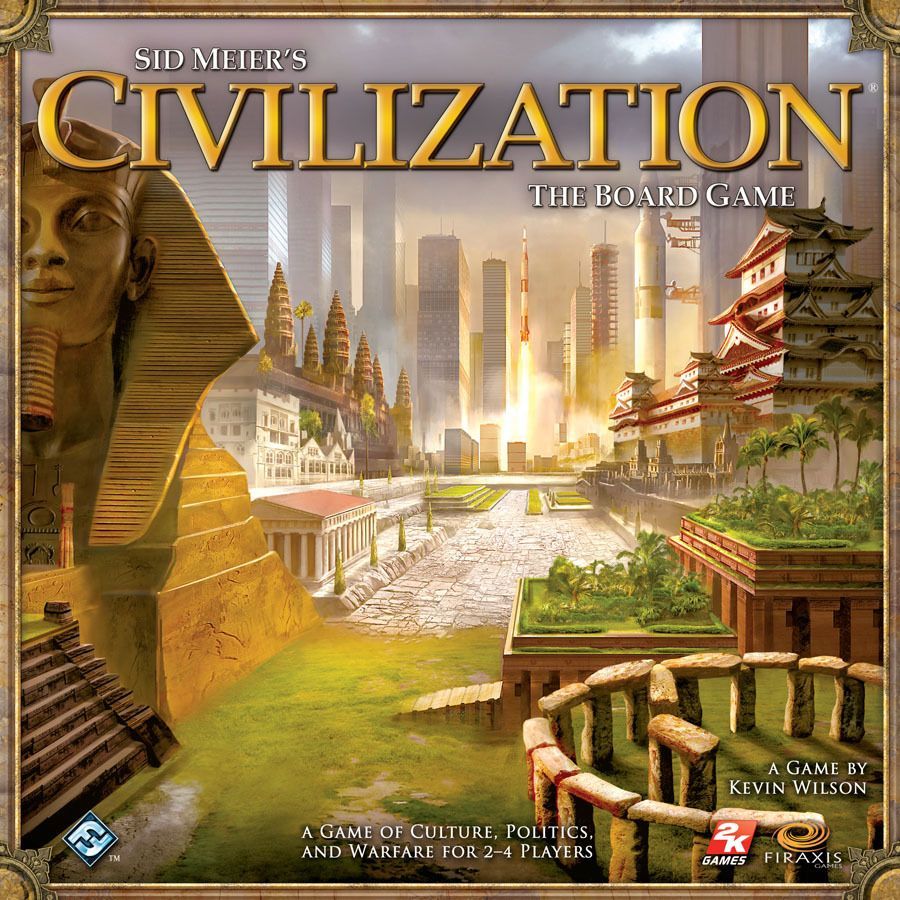
How to Play Sid Meier's Civilization: The Board Game
Fantasy Flight Games, ADC Blackfire Entertainment, Delta Vision Publishing · Board game · 2010What do you want to do now
Ask anything about Sid Meier's Civilization: The Board Game: rules, setup, components, complexity, price, or whether it fits your group.
Video: How to Play
Start here, then follow the written guide
Step by step
Game Objective
In Sid Meier's Civilization: The Board Game, players lead their own civilizations to greatness. While the provided text focuses on expansion content, the goal involves advancing through technologies, expanding your territory, and managing resources. Players strive for dominance by developing their cities and utilizing unique civilization abilities to gain advantages in trade, culture, and military strength. Consulte o manual para detalhes sobre esta seção regarding specific victory conditions and scoring.
Setup
To set up the game, follow these steps based on the available components:
- Map and Tiles: Place the map tiles. If a tile is revealed and contains a natural wonder icon, place a random natural wonder marker face-down on that square.
- Civilization Selection: Players choose their civilization. Depending on the choice, starting assets vary:
- The Koreans start with two techs and a home tile providing 5 trade and 6 hammer points.
- The Polynesians start on an island-shaped home map tile and with the Sculpture tech.
- The Portuguese start with the Compass tech.
- Tracks: Set up the culture track. If using the expansion, attach the religious culture track underneath the original one.
- Markers: Place hut and village markers on the map. These may include city-states, great prophets, natural wonders, or settlers.
- Market Board: Set up the market board, including the market board overlay for monument markers.
Game Flow
Consulte o manual para detalhes sobre esta seção regarding the general turn structure and round progression. However, the following specific mechanics influence the flow of play:
- Culture Advancement: As players advance on the culture track (or the religious culture track), they gain culture event cards. When entering a space with a religion symbol, players gain a great prophet.
- City Management: Normally, city management is a distinct phase. However, players with the Compass tech gain the ability to move their figures during city management.
- Exploration: Players use scouts and army figures to explore the map, revealing natural wonder markers and interacting with huts and villages.
Actions and How to Play
Exploration and Movement
- Exploring Natural Wonders: Players can explore a natural wonder marker by ending the movement of army figures or scouts on the marker. Alternatively, building a city next to a natural wonder icon (including diagonally) makes it an outskirt of the city, granting the player a natural wonder card.
- Huts and Villages: When exploring these, players may trigger different effects:
- City-state: Immediately place a random city-state on the square.
- Great prophet: Gain a great prophet.
- Natural Wonder: Place a random natural wonder marker on the square.
- Settlers: Build a scout on the square (respecting stack limits) or gain a resource of choice from the market.
Religion Mechanics
- Founding a Religion: Using a great prophet, a player can found one of the following: Catholicism, Buddhism, Islam, Judaism, or Taoism. A religion is unique and cannot be founded if another player has already claimed it. If a player has already founded one, they may use a great prophet to add a belief.
- Converting Cities:
- A player's capital is automatically converted upon founding a religion.
- To convert another city, a player must end the movement of their scouts in the target city; the scout is then sacrificed.
- A city cannot be converted to a religion it already follows, and only the founder of a religion can perform conversions.
- Religious Effects: Founder effects apply only to the founder, while City effects apply to any city following the religion (even if the religion hasn't been founded).
Technology and Construction
- Technologies: Players research techs to unlock abilities:
- Sculpture (Level 1): Introduces monument buildings (providing trade and archaeology in desert squares) and allows boosting construction plans with resources.
- Compass (Level 2): Allows movement of figures during city management.
- Electricity (Level 3): Boosts city production and allows for limited buildings with extra battle bonuses or coins.
- Penicillin (Level 4): An advanced version of Logistics.
- Archaeology: Each Archaeology Icon owned reduces the building cost of wonders by 1. When building a wonder, the player gains culture tokens equal to the total archaeology icons accessed via outskirts and scouts.
End of Game and Scoring
Consulte o manual para detalhes sobre esta seção regarding the specific triggers for the end of the game, the exact point calculation, and the criteria for victory and defeat.
Tips for Winning
- Leverage Archaeology: Focus on acquiring Archaeology Icons from buildings, city-states, natural wonders, or archaeology pits to lower the cost of wonders and generate more culture tokens.
- Strategic Expansion: If playing as The Koreans, utilize your home tile's high trade and hammer points to build tech pyramids faster.
- Religious Influence: Use scouts to convert cities to your religion to benefit from City effects, but remember that the scout is sacrificed in the process.
More videos
More rules explanations from the community
In English
-
 How to play Sid Meier's Civ: TBG Part 2: Overview and Turn Order
-
 How to play Sid Meier's Civ: TBG Part 3: Resources
-
 Primer Video Part 1 of 2
-
 How to play Sid Meier's Civ: TBG Part 1: Introduction
-
 How to play Sid Meier's Civ: TBG Part 5: Culture and Coin
-
 How to play Sid Meier's Civ: TBG Part 6: Technology
-
 Primer Video Part 2 of 2
-
 Sid Meier's Civilization: TBG - Unboxing
-
 Civilization: The Board Game - Runthrough - part1
-
 Sid Meier's Civilization (w/expansions) | how to play
-
 Civilization: The Board Game - Runthrough - part3
Rules manual
Official PDF file
Frequently Asked Questions
Quick answers about the rules
What is the objective of Sid Meier's Civilization: The Board Game?
How do you set up Sid Meier's Civilization: The Board Game?
How do you play Sid Meier's Civilization: The Board Game?
How does Sid Meier's Civilization: The Board Game end, and how do you score?
What are some tips for winning Sid Meier's Civilization: The Board Game?
Expansions
Published additional content

Other Games You'll Like
Based on mechanics and theme