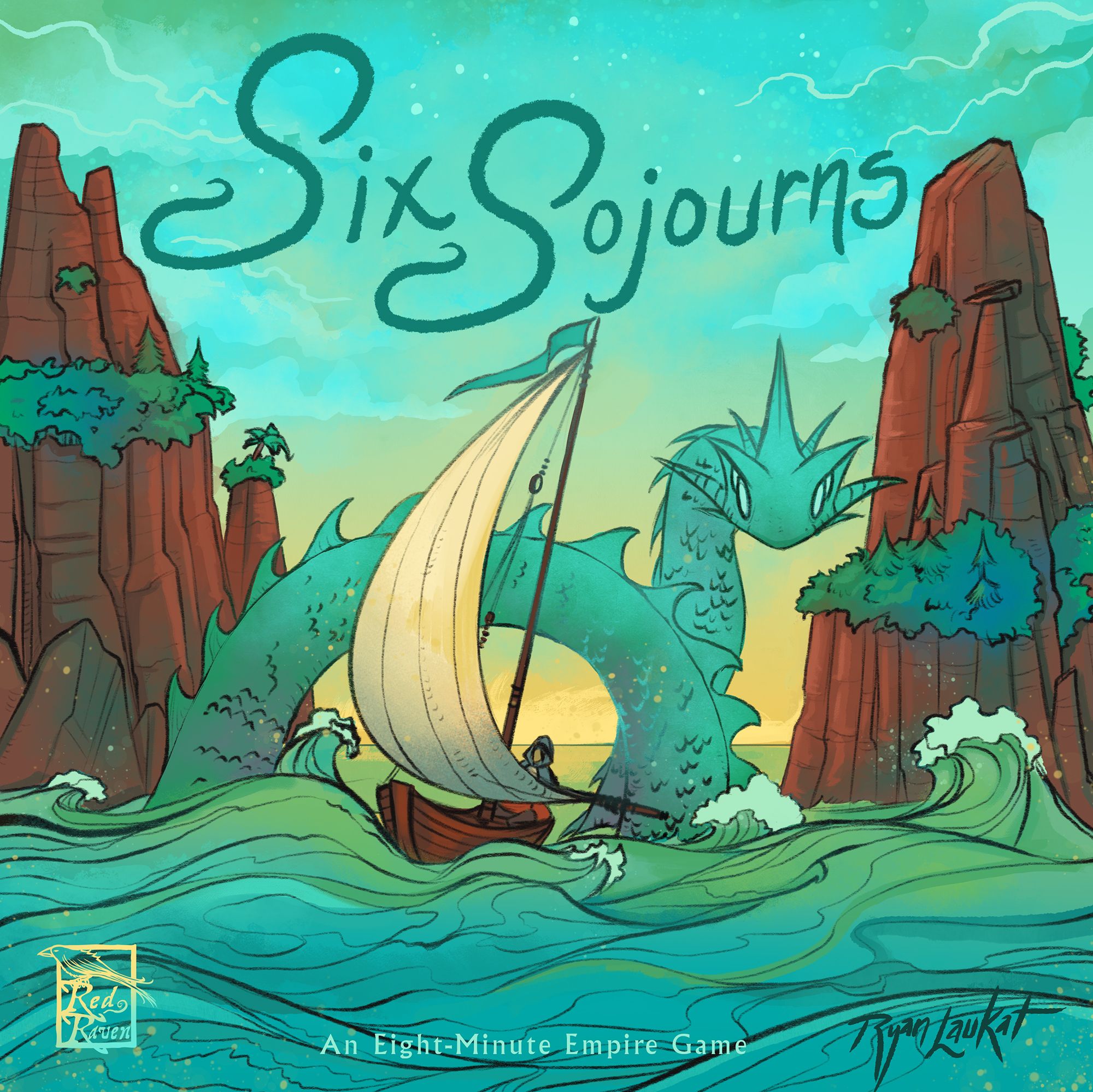
How to Play Six Sojourns: Deluxe Edition
Red Raven Games · Board game · 2025What do you want to do now
Ask anything about Six Sojourns: Deluxe Edition: rules, setup, components, complexity, price, or whether it fits your group.
Step by step
Game Objective
In Six Sojourns: Deluxe Edition, your goal is to expand your family and grow your influence. Players take turns selecting a card from five on display. Each card offers actions that allow players to build houses, gain boats, move, and acquire new family members.
Cards also have special abilities and sets of craft icons that represent your family's expertise in various professions: cooking, carpentry, sewing, shoemaking, art, blacksmithing, and jewelry. In each game, you only select nine cards, and you will face difficult choices each turn, focusing on crafts, abilities, or the map.
The game ends when all players have 9 cards. The player with the most victory points wins.
Setup
- Place the game board in the center of the table. Place the coins in a nearby supply.
- Shuffle the base cards and place them near the board. Base cards have no label in the bottom left corner of the face.
- Choose your expansions and collect the components for the chosen expansions. You may choose to play without expansions, but it is recommended to play with at least 1. The setup instructions for each expansion are as follows:
- PLACES: Shuffle the expansion cards with the "Places" label and the letter corresponding to your chosen map along with the base cards. If it's map A, use the "Places A" cards, etc.
- TRADES TOKENS: Shuffle the craft tokens in the box lid and place them on the map in various regions. No region may contain more than 1 token, but you may place them anywhere, even in sea spaces.
- SPECIALTIES: Shuffle the cards with the "Specialties" label along with the base cards.
- UPGRADES: Shuffle the cards with the "Upgrades" label along with the base cards. Place the upgrade tokens next to the board.
- SEA SERPENTS: Shuffle the cards with the "Sea Serpents" label along with the base cards. Place the sea serpent tokens next to the board.
- VALUES: Shuffle the value cards face down and deal 1 to each player. Each player places their value card face up in front of them.
- FEUDS: Place the feuds card near the board. Choose the "Feuds" or "Fierce Feuds" side.
- EXPLORATION: Shuffle the exploration tokens face down and place them face down on the map in various regions. No region may contain more than 1 token, but you may place them anywhere, even in sea spaces.
- MOUNTAINS: Place mountain tokens on land spaces on the board, preferably in spaces with rock or mountain art. No space should contain more than 1 mountain token.
- SHRINES: Give each player 3 shrine tokens. They place them in a supply next to their wooden pieces.
- AIRSHIPS: Place the airships on any 2 different land spaces on the board.
- Give each player 12 coins. Give each player a set of wooden pieces in 1 color.
- Place the card deck near the board and draw 1 card for each card space along the side of the board. Each space indicates the cost of each card.
- Use a method to randomly determine the first player. The game proceeds clockwise, starting with the first player. Each player must now return to the box a number of wooden tower pieces based on turn order. The LAST PLAYER always returns all towers. Each player retains 1 tower for each player AFTER THEM in turn order. For example, if playing with 3 players, the 1st player would keep 2 towers, the 2nd player would keep 1 tower, and the 3rd player would keep no towers. In a 2-player game, the 1st player would keep 1 tower and the 2nd player would keep no towers.
- Choose a starting space on the board. It can be any land space, but it is recommended that the space be on the largest island and adjacent to a sea space. Each player places 1 house and 2 people in this space.
- Place any unused components in the box.
Game Flow
Starting with the first player, players take turns clockwise until all players have had 9 turns. It's easy to keep track of this because each turn, a player selects 1 card to keep. Once all players have 9 cards, the game ends, you count victory points, and the player with the most points wins.
Turn
On your turn, perform the following steps: first draw a card from the row, then perform actions.
- Draw a Card: You MUST draw 1 card from the card row. There are 5 available to choose from, and the price of each card is listed in its space on the board, from 0 to 4. Pay the indicated coins to the supply and place the card face up in front of you. If you have no more coins, you MUST choose the 0-cost card. Each card gives you 1 or more craft icons, which are worth victory points at the end of the game. Most cards also have a special ability, which is active as soon as you place the card in front of you. After taking your card, fill the gap by sliding the cards towards the 0-cost. Then, draw a new card to fill the empty 4-cost space.
- Actions: Now perform the actions on your new card. You may perform actions IN ANY ORDER. You can even split movement actions between other actions. For example, if the card says 3 movement and build 1 boat, you can move a person 1 space, build a boat, and then move the boat 2 spaces. You may choose to ignore any actions if you do not wish to perform them. If you run out of pieces to place, you cannot place any more.
Actions and How to Play
The available actions are:
- Gain People: Place people in any space where one of your houses is located. You can split the people among the houses. You must place all people before the end of your turn.
- Build a House: You can place a house in a land space that contains at least one of your people and NO OTHER HOUSE. The starting space contains a house from each player, but players cannot build houses in spaces that already have houses during the game. If you do not yet want to build the house, you can "store" the house token on the card to save for a future turn. When performing actions in a future turn, you can place any "stored" houses from previous turns.
- Build a Boat: You can place a boat in a sea space that is adjacent to a land space that has at least one of your people. Houses do not count; it must be a person. If you do not yet want to build the boat, you can "store" the boat token on the card to save for a future turn. When performing actions in a future turn, you can place any "stored" boats from previous turns.
- Move: You can perform the indicated number of movement actions, split among any people and/or boats. On the map, adjacent land spaces are separated by white lines. Sea spaces are separated by dotted lines. A movement action consists of choosing a space on the board and moving any number of your people (or boats) to an adjacent space. People must move to land spaces and boats must move to sea spaces. For example, if you have a 1 movement action, you can move 6 people from one space to an adjacent space.
- CROSSING A SEA: You can move a group of people across a sea if there is a boat there. To cross the sea, choose a group of people in a land space adjacent to a sea space that has a boat. Then, move the group to ANY land space that is adjacent to that sea space. If the boat is yours, this costs nothing, but if the boat belongs to another player, you must pay them one coin (and they cannot refuse this). You must pay 1 coin per movement action. For example, if you move 3 people to an island and another group of 2 to a different island using the same boat, you would pay 2 coins. You cannot move people across multiple boats with 1 movement action (moving across adjacent sea spaces with 1 movement). Crossing a sea costs 1 movement.
- Towers: At the end of your 9th turn, you can place all the towers you possess. You can place a tower in a space you control, and it guarantees your control for the rest of the game. Even if a player moves more people into the space and gains more control, if you have a tower there, you automatically control it. You CANNOT place towers in spaces you do not control.
Card Abilities
Many cards have victory point objectives or other abilities.
- Objectives: Grant victory points at the end of the game if you meet the requirements. If you only partially meet the requirements, you do not gain the victory points. For example, if you have a card that requires 3 or more houses on the board to be completed, you gain 3 points at the end of the game if you meet it. Another example: if you have a card that requires at least 7 cooking icons (on cards you own and craft tokens you have) to gain 3 points at the end of the game.
- Abilities: Cards with abilities take effect as soon as you purchase the card. For example, a card that grants 1 coin at the start of each of your turns. It does not apply on the turn you purchase it, as you gain it after the start of your turn. A card that says: "You may build houses in spaces that contain houses" still requires you to build the house where you have at least 1 person. To gain a bonus "when you build" something, you must place it on the map. Storing a house or boat does not count as building. A card that says: "You may move your houses" allows you to move houses as if they were people. They can move over sea spaces. Your houses cannot move to spaces that already contain houses. If you have both cards above, you can move houses to spaces that already contain houses. A card that says "Gain 1 house when you buy a 4-cost card" does not activate, but activates each card bought after it that costs 4 coins.
Expansion Rules
Refer to the manual for details on this section.
End of Game and Scoring
When all players have 9 cards, the game ends. Players count victory points for the following:
- Spaces: Each space you control is worth 1 victory point. To control a space, you must have more people or boats there than any other player. For example, if you have 2 people and 2 other players have only 1 each, you control the space. When determining control, each house you have in a space is worth 2. So, if you have a house in a space and another player has only 1 person, you control it. To control sea spaces, you must have more boats there than any player. If there is a tie for control of a space, no one controls it and no one gains points for it.
- Islands: If you control more spaces on an island than any player, you gain 1 victory point. Even if a landmass is not completely surrounded by water on the map, it is still considered an island. For example, map A has a total of 9 islands.
- Crafts: You also gain victory points if you have enough of each type of craft on your cards (and tokens if you are playing with journey 2). Calculate your points for each type of craft: cooking, carpentry, sewing, shoemaking, art, blacksmithing, and jewelry. For example, if you have at least 5 cooking, you gain 4 points. If you have 9 or more cooking, you GAIN 7 points (4 or 7, not both). If you have less than 4 cooking, you gain 0 points.
- Card Victory Points: Many cards have victory point objectives. If you meet the requirements listed on the card, you gain the specified victory points.
Sum all these points. The player with the most victory points wins! Coins are not worth victory points (unless you have an ability that gives points for coins, or are playing with an expansion that changes this rule). However, if players are tied in victory points, the player with the most coins wins the tiebreaker.
Tips for Winning
- Pay attention to the craft icons on the cards, as they are an important source of victory points at the end of the game.
- Consider "storing" house or boat tokens on your cards to use in future turns, allowing flexibility in your actions.
- When moving people across the sea, remember that if you use another player's boat, you must pay 1 coin.
Rules manual
Official PDF file
Frequently Asked Questions
Quick answers about the rules
What is the objective of Six Sojourns: Deluxe Edition?
How do you set up Six Sojourns: Deluxe Edition?
How do you play Six Sojourns: Deluxe Edition?
How does Six Sojourns: Deluxe Edition end, and how do you score?
What are some tips for winning Six Sojourns: Deluxe Edition?
Other Games You'll Like
Based on mechanics and theme