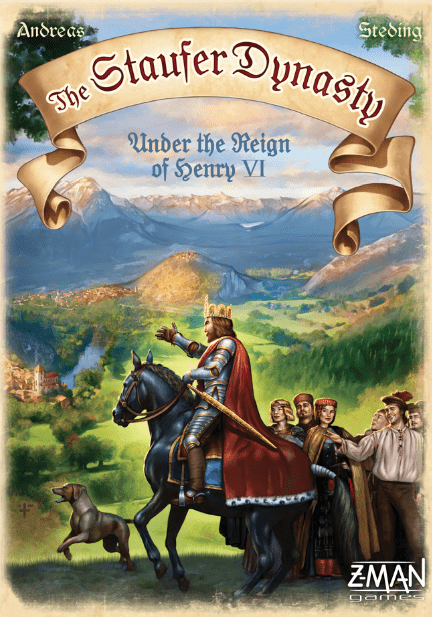
If you enjoy strategy games with a medieval theme, featuring area control and set collection mechanics, The Staufer Dynasty might be a great fit! The action selection dynamic and the competition for influence in the regions are its standout features.
thumb_up
Highlights
check_circle
Competition for regional influence
check_circle
Treasure and card collection
check_circle
Modular and replayable board
check_circle
Strategic action planning
warning_amber
Keep in mind
report_problem
Slight initial learning curve
report_problem
Interaction can be indirect
upload_file
Rules manual not indexed yetUpload the PDF rulebook to ask questions about this game with AI.
info
About the game
What you do in a play session
In 'The Staufer Dynasty', you step into the shoes of an ambitious noble in the 12th century, accompanying Emperor Henry VI on his European tours. Your goal is to boost your own standing by placing envoys and nobles in positions of power across the six regions featured on the board. The game spans five rounds, and each turn you have three actions to choose from. The gameplay loop is engaging: you either take supply actions (moving to one side of the action board) or move and deploy actions (heading to the other side). When taking supply actions, you select a space on the supply table, retrieve pieces (envoys and nobles) for your court, and collect treasure chests. These chests come in different colors, each offering a unique benefit: brown chests grant points based on quantity, orange ones provide immediate points or extra figures, blue chests offer one-time bonuses, and purple ones allow you to pick up privilege cards that modify actions or grant bonuses. To occupy an office, you choose a seat in a region, pay its cost, and place your figures (including nobles, if required) in the available seats, following the regional order. Occupying a seat also lets you grab its associated treasure chest. Scoring occurs at the end of each round, focusing on specific regions indicated by scoring tiles and additional conditions (like having the fewest chests, most occupants, or where the king is located). Each region also provides fixed bonuses. After five rounds, in addition to points from treasure chests, you score for secret objectives. The player with the most points wins!
photo_library
Gallery
Box and component photos
11 photos · from the community
01 / 11
Tap any photo to open fullscreen. Photos submitted by the community or publisher.
groups
Best player count
BGG community vote
2–5 players
2
REC
3
REC
4
BEST
5
REC
BestRecommendedWorks
music_note
Soundtrack
Ambience suggested by Melodice
music_noteLoading playlist...
sell
Where to Buy
Prices monitored daily
shopping_cartFinding best prices...
US$
infoPrices unavailable at this time.
Price history — last 6 months (lowest new offer)
As an Amazon Associate I earn from qualifying purchases. Prices and availability subject to change.
notifications_active
Alert enabled!
Join the BoardGamesBot deals group
Get the best board game deals every day — without message spam.
Cities: Aachen (North Rhine-Westphalia, Germany)History: Holy Roman Empire
businessPublisherArclight Games, Hans im Glück, Z-Man Games
editDesignerAndreas Steding
paletteArtistFranz Vohwinkel
groups_2
Community
Data from BoardGameGeek
3,656owners
451wishlist
83want to play
quiz
Frequently Asked Questions
Quick answers before you buy
6 questions
What is the average playtime for The Staufer Dynasty? expand_more
Games typically last around 90 minutes, as indicated on the box, though this can vary slightly depending on the players' familiarity with the rules.
How many players can participate? expand_more
The game is designed for 2 to 5 players, offering a different experience depending on the number of participants.
Is the game very complicated to learn? expand_more
The Staufer Dynasty has a medium weight (around 3/5 on BGG), meaning the rules aren't overly complex but require some attention to master the strategies.
Are the game components good quality? expand_more
Generally, the components are well-received by the community, with pieces and a board that serve the game's purpose effectively.
Who is this game best suited for? expand_more
It's ideal for players who enjoy strategy games with a medieval historical theme, appreciating mechanics like area control, action selection, and set collection.
Is there a lot of player interaction? expand_more
Interaction is present, mainly through the competition for board positions and regional influence, but it's not a direct conflict game.