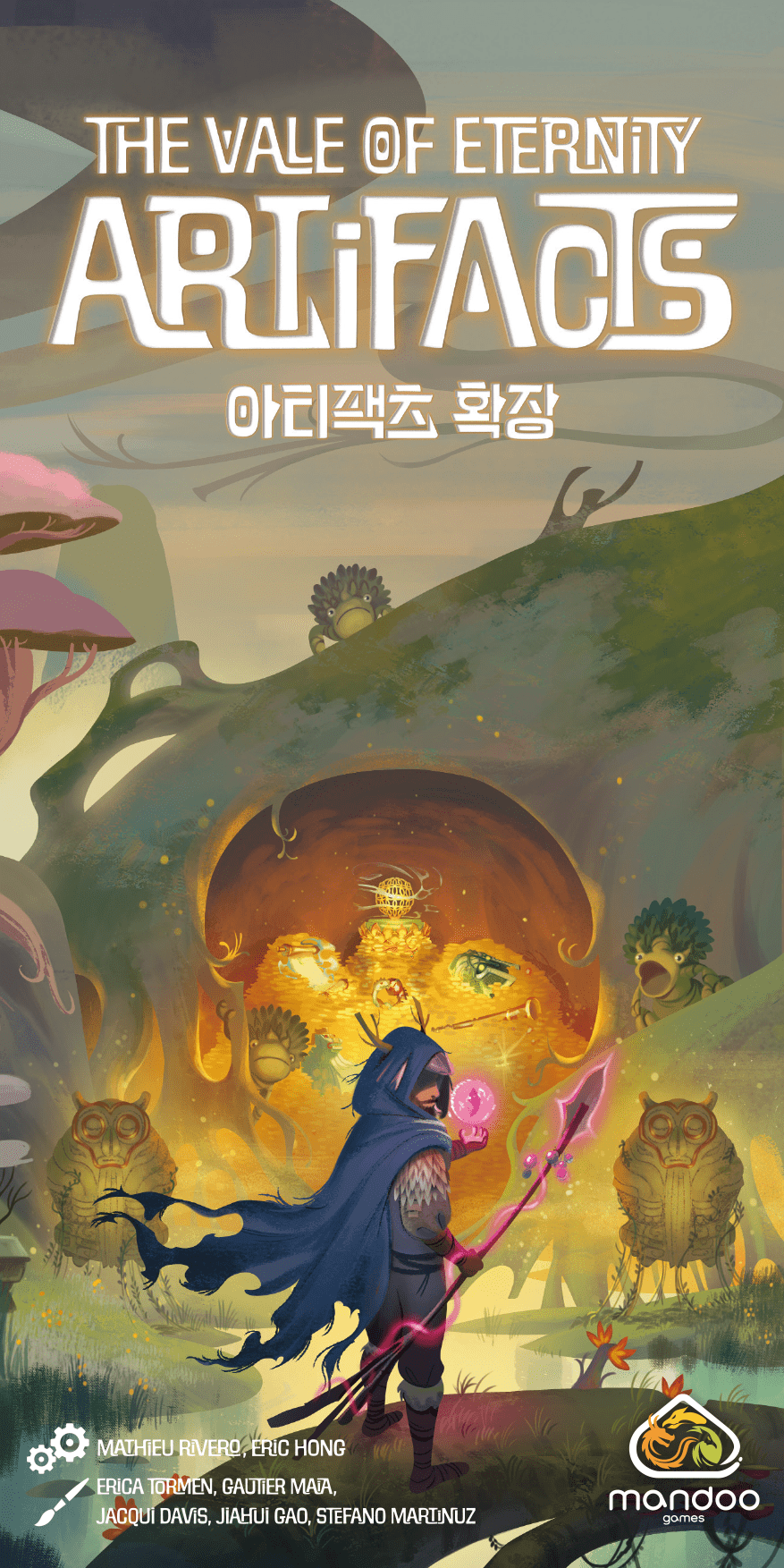
How to Play The Vale of Eternity: Artifacts
Mandoo Games, Blackrock Games, Broadway Toys LTD · Board game · 2024What do you want to do now
Ask anything about The Vale of Eternity: Artifacts: rules, setup, components, complexity, price, or whether it fits your group.
Video: How to Play
Start here, then follow the written guide
Step by step
Objective of the Game
In The Vale of Eternity: Artifacts, you are a tamer seeking glory, guided by the great dragon Eternity. He has revealed not only a glade where creatures love to gather but also the existence of hidden mythical Artifacts throughout the Vale. Your goal is to become a legendary tamer by acquiring the most points.
The game ends at the end of a round when a player has 80 points or more, or as usual, at the end of the 10th round. The player with the most points wins, regardless of which endgame condition was triggered.
Preparation (Setup)
To set up The Vale of Eternity: Artifacts, you'll need the base game. Follow the normal setup instructions for the base game, then add these extra steps:
- Shuffle the expansion cards together with the cards from the base game.
- Each player takes a square marker and a Shelter marker in their color, along with a player aid.
- Place Artifacts in a display beside the game area, within reach of all players.
- For Base Artifacts, select them according to your player count:
- 2 players: play with all Artifacts for 2+ players.
- 3 players: play with all Artifacts for 2+ players and all Artifacts for 3+ players.
- 4 players: play with all Artifacts for 2+ players, all Artifacts for 3+ players, and all Artifacts for 4 players.
- For Advanced Artifacts, take 3 random Artifacts.
- For Base Artifacts, select them according to your player count:
- Place Additional Area tiles near the supply of the stones.
- Place the Cave standee so that all players can see it. This standee serves as a reminder that the endgame condition has changed.
Fluxo do Jogo
The game progresses through phases, similar to the base game, but with modifications to the Hunting phase and the introduction of Artifacts. The phases are:
1. Hunting Phase
The Hunting phase now follows a new sequence:
- Reveal cards equal to twice the number of players as normal.
- Starting with the first player and proceeding in clockwise order, each player takes an Artifact tile from the display that does not have their own square marker on it. If the Artifact had another player’s token, return it to them. This means you cannot take the same Artifact twice in a row. Then, place your square marker face-up on the chosen Artifact.
- Starting with the first player and proceeding in clockwise order, each player chooses their first card by placing their player marker on a card that has none. (This step is similar to the base game.)
- Then, starting with the last player and proceeding in counterclockwise order, players choose their second card by placing their player marker on it. (This step is similar to the base game.)
Note: If space is limited, you can leave your selected Artifact in the display and simply move your square marker there to indicate possession. Instead of taking an Artifact, place your square marker on it face-up. Instead of returning it, flip your square marker face-down.
2. Action Phase
The Action phase is played like in the base game. If the Artifact you selected during the Hunting phase has an Action ability, you may use that ability on your turn. After using it, return the Artifact to the display with your square marker on it.
3. Resolution Phase
Consulte o manual para detalhes sobre esta seção.
After resolving all your effects, if you still have an Artifact (or unused Artifact) in front of you, put it back to the display with your square marker on it. This means you will not be able to select it in the next round.
Ações e Como Jogar
This expansion introduces Artifacts and new card abilities. Cards from this expansion can be recognized by a specific symbol.
Artifact Abilities
The abilities of Artifacts are divided into three types:
- Instant abilities: These are used as soon as you select the Artifact during the Hunting phase.
- Permanent abilities: These remain active as long as you have the Artifact in your area. They can trigger even in the midst of processing an action or another effect.
- Action abilities: These can be used once on your turn during the Action phase. After using such an ability, return the Artifact to the display with your square marker on it.
Specific Artifacts and Abilities
- Purchasing Areas: Some Artifacts allow you to purchase areas. Upon purchasing an area, take an Additional Area tile and place it in front of you, +1 side up. If you already had one, flip it to its +2 side up. A player may acquire up to two additional areas this way. With the Additional Area tile showing +1 side up, you may have up to 5 summoned cards in the 4th round.
- Pied Piper’s Pipe: The Retrieve ability of this card only applies to your shelter, not other players’ shelters.
- Gem of Kukulkan: You may use this ability only after you sell the card, earn its stones, and check your holding limit!
- Seven-League Boots: The revealed card is placed with the cards of its family around the board. The card you shelter with this Artifact doesn’t have to be the newly revealed card; it can be any card revealed at the beginning of the Hunting phase or by this Artifact.
- Incense Burner: The price you pay for acquiring a new area is 3. Pay as though you were summoning a creature with cost 3. However, creature cost reduction or fixing does not work on this price!
- Book of Toth: You cannot upgrade the same stone twice. You cannot “downgrade” stones, even if they are more valuable to you through effects.
- Ring of Wishes: You resolve the chosen effect when you use the Ring’s ability during the Action phase. You do not have to wait for your Resolution phase to resolve it!
General Rules for Abilities and Payments
- Instant Effect Resolution: A card cannot be summoned if any part of its Instant effect cannot be resolved. For example, if you must select a player with at least one summoned Fire card to swap with Pyro, and no such player exists, you cannot summon Pyro.
- Fixed Costs: If the cost of a card is fixed, it is no longer influenced by other card effects such as cost reduction. For example, with Belphegor in your area, you always pay a cost of 1 when summoning a fire card, even a card with cost 0 like Hestia. Pegasus does not reduce the cost of your Fire cards; it is always 1.
- Permanent Effects: Permanent effects remain active throughout the game, after finishing summoning of the card until it leaves your area. They can trigger even in the midst of processing an action or another effect. For example, if you have Thalassa in play and four stones, and an effect has you earn a stone and makes you recover Thalassa, even if you discard the stone as part of exceeding the magic stone limit, Thalassa has already been recovered.
- Discarding Cards: Discarding a card from your area means discarding one of your summoned cards. A card is discarded either by the Remove action, the effect of cards like Cerberus or Anubis, or the ability of Imperial Seal. For example, if you have summoned Totem Pole, when you resolve the effect of Dragon Egg or Mandrake to discard itself, you can earn a stone through the effect of Totem Pole. However, you cannot earn a stone when Pyro, Ash, or Tengu leave your area by resolving their effect, since they are not considered to be discarded.
- Loki's Family: If you have summoned Loki, you can treat this card as if it were of any family during your turn. "Your turn" refers to your Hunting, Action, and Resolution phases. But, during other players’ turns, Loki in your area is considered as a Wind card.
- Magic Stone Payments: When paying magic stones, you cannot pay extra stones beyond what is required. For example, if you have a red stone and a blue stone, to pay a cost of 1, you can pay either the red stone or the blue stone. However, you cannot pay both.
- Effects with Insufficient Resources: Every effect must be used. For example, if you have Hephaestus in your area, but have neither a red stone nor a blue stone, you must lose a red stone and earn a blue stone. The only exception to this is if you have less than one red stone; then you cannot use this card’s effect.
Shelter
To Shelter a card means to place it above your shelter marker, face up. If there are any existing sheltered cards, overlap them partially so players may look at cards in your shelter freely. However, your sheltered cards are neither in your hand nor summoned; they don’t have any effect while there, nor can be targeted by effects unless they specifically mention the Shelter. (Typically, those effects are found only on Artifacts.)
Retrieving a card means taking a card of your choice from your shelter and adding it to your hand.
Space Management
If space is limited and there is not enough space in front of you, you can save space by grouping the cards summoned in front of you by family or type of effect, and overlapping them so that only the bottom part of each card is visible.
Fim de Jogo e Pontuação
The game no longer ends when a player has 60 points or more. The game ends at the end of a round when a player has 80 points or more, or as usual, at the end of the 10th round.
The player with the most points wins, whichever endgame condition was triggered.
Dicas para Vencer
- Pay close attention to the new Artifacts and their abilities. Choosing the right Artifact during the Hunting phase can significantly impact your strategy for the round, especially with Instant, Permanent, and Action abilities.
- Consider acquiring Additional Area tiles if an Artifact allows it. Having more summoned cards can lead to more powerful combinations and higher scoring potential, especially in later rounds.
- Strategically use the Shelter mechanic. Cards in your shelter don't have effects, but Artifacts can interact with them, allowing you to retrieve them at opportune moments to add to your hand.
More videos
More rules explanations from the community

Rules manual
Official PDF file
Frequently Asked Questions
Quick answers about the rules
What is the objective of The Vale of Eternity: Artifacts?
How do you set up The Vale of Eternity: Artifacts?
How do you play The Vale of Eternity: Artifacts?
How does The Vale of Eternity: Artifacts end, and how do you score?
What are some tips for winning The Vale of Eternity: Artifacts?
Expansion for
Published additional content