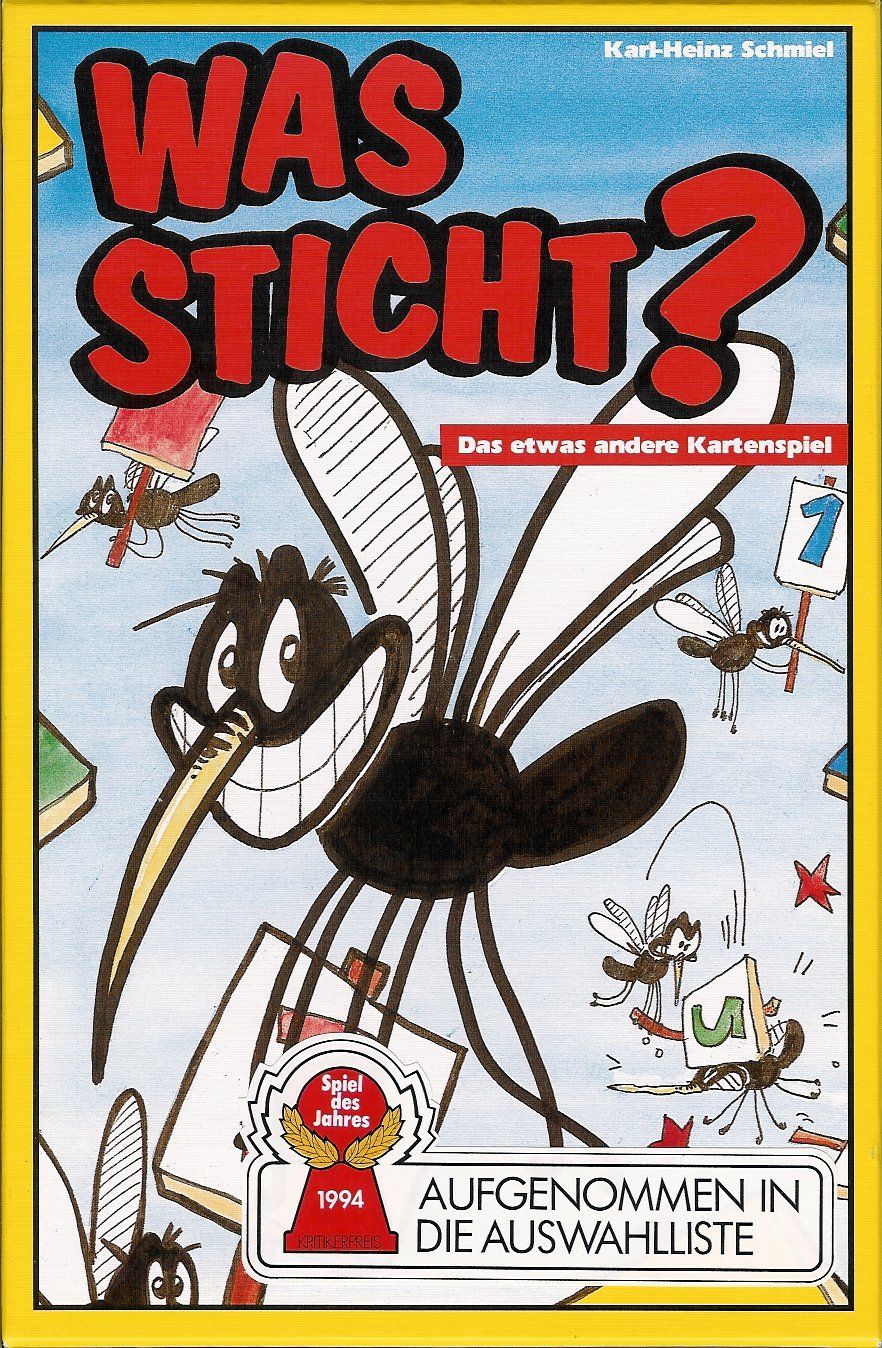
Was sticht?
Moskito Spiele, New Games Order, LLC · Board game · 1993
3–4 · best 4
60 min
Weight 2.4/5
Buy · from US$ 14.95
—
rating
Ludopedia
7.0
rating
BGG
Our Verdict
Trick‑taking with a deduction twist for card game lovers!
Highlights
- Open draft + trick‑taking
- Secret objectives
- Reading opponents challenge
Keep in mind
- Requires constant focus
- Moderate complexity
Rules manual not indexed yet
Upload the PDF rulebook to ask questions about this game with AI.
About the game
What you do in a play session
Picture a card game where every round feels like a strategic puzzle and a bluffing challenge. Created in 1993 by German designer Klaus Jäger, it’s called *Was sticht?* – or *Who Will Win?* in English. The premise is simple: at the start, each player selects a set of tasks they aim to accomplish, such as “take no tricks” or “take exactly one trick.” These tasks are secret missions you can only complete if you know exactly how the game will unfold.
Next comes an open draft. All cards are dealt into rows on the table—each row is a pool of cards that can be chosen. The dealer announces who would have won the trick if everyone had played perfectly; this gives clues about the trump suit and rank. After the draft, each player, except the dealer, picks one of the tasks they had chosen; the dealer, in turn, is “stealing” someone else’s task, trying to fulfill another player’s mission.
The rest of the game follows a traditional trick‑taking flow: each player plays a card, and whoever has the highest card in the trump suit takes the trick. But now strategy shifts: if your task is “take no tricks,” you’ll try to lose; if it’s “take exactly one,” you’ll aim to control the tricks you win. The game continues until someone completes five tasks, and that player wins.
What makes *Was sticht?* special is the blend of an open draft with a two‑trump trick‑taking mechanic, creating a deduction layer that demands constant attention. It’s perfect for those who enjoy deep card games but don’t want a mountain of complicated rules. If you love mental challenges and want to test your ability to read others, this game is for you.
In short, *Was sticht?* mixes the thrill of a classic trick‑taking game with the tension of an open draft, all in a compact, accessible format for 3‑4 players with about a 60‑minute playtime.
Next comes an open draft. All cards are dealt into rows on the table—each row is a pool of cards that can be chosen. The dealer announces who would have won the trick if everyone had played perfectly; this gives clues about the trump suit and rank. After the draft, each player, except the dealer, picks one of the tasks they had chosen; the dealer, in turn, is “stealing” someone else’s task, trying to fulfill another player’s mission.
The rest of the game follows a traditional trick‑taking flow: each player plays a card, and whoever has the highest card in the trump suit takes the trick. But now strategy shifts: if your task is “take no tricks,” you’ll try to lose; if it’s “take exactly one,” you’ll aim to control the tricks you win. The game continues until someone completes five tasks, and that player wins.
What makes *Was sticht?* special is the blend of an open draft with a two‑trump trick‑taking mechanic, creating a deduction layer that demands constant attention. It’s perfect for those who enjoy deep card games but don’t want a mountain of complicated rules. If you love mental challenges and want to test your ability to read others, this game is for you.
In short, *Was sticht?* mixes the thrill of a classic trick‑taking game with the tension of an open draft, all in a compact, accessible format for 3‑4 players with about a 60‑minute playtime.
Gallery
Box and component photos
Tap any photo to open fullscreen. Photos submitted by the community or publisher.
Best player count
BGG community vote
3
REC
4
BEST
Soundtrack
Ambience suggested by Melodice
Loading playlist...
Where to Buy
Prices monitored daily
Finding best prices...
Prices unavailable at this time.
Price history — last 6 months (lowest new offer)
As an Amazon Associate I earn from qualifying purchases. Prices and availability subject to change.
Alert enabled!
Join the BoardGamesBot deals group
Get the best board game deals every day — without message spam.
Join the WhatsApp groupGame details
Mechanics, categories, families and credits
Mechanics
Categories
Families
Publisher
Moskito Spiele, New Games Order, LLC
Designer
Karl-Heinz Schmiel
Artist
Ralf E. Kahlert
Community
Data from BoardGameGeek
1,096owners
172wishlist
60want to play
Frequently Asked Questions
Quick answers before you buy
How many players can play?
The game supports 3 to 4 players, which is the ideal range to keep the draft and trick‑taking dynamic.
How long does a game take?
Each hand takes about 60 minutes, but total time can vary depending on draft speed and strategic decisions.
What’s the game’s complexity?
The mechanics are moderate: you need to grasp trick‑taking, open draft, and trump deduction, but the rules are straightforward.
What components are included?
A standard card deck, task tiles, and a small board to organize the draft cards.
Who is this game for?
Great for those who enjoy deep card games, deduction, and friendly competition, but don’t want a mountain of complex rules.
Does it have expansions or variants?
No official expansions exist; players can create task variations to boost replayability.
How does the dealer role work?
The dealer drafts cards and attempts to fulfill another player’s task, adding a strategic “steal” element.
Other Games You'll Like
Based on mechanics and theme