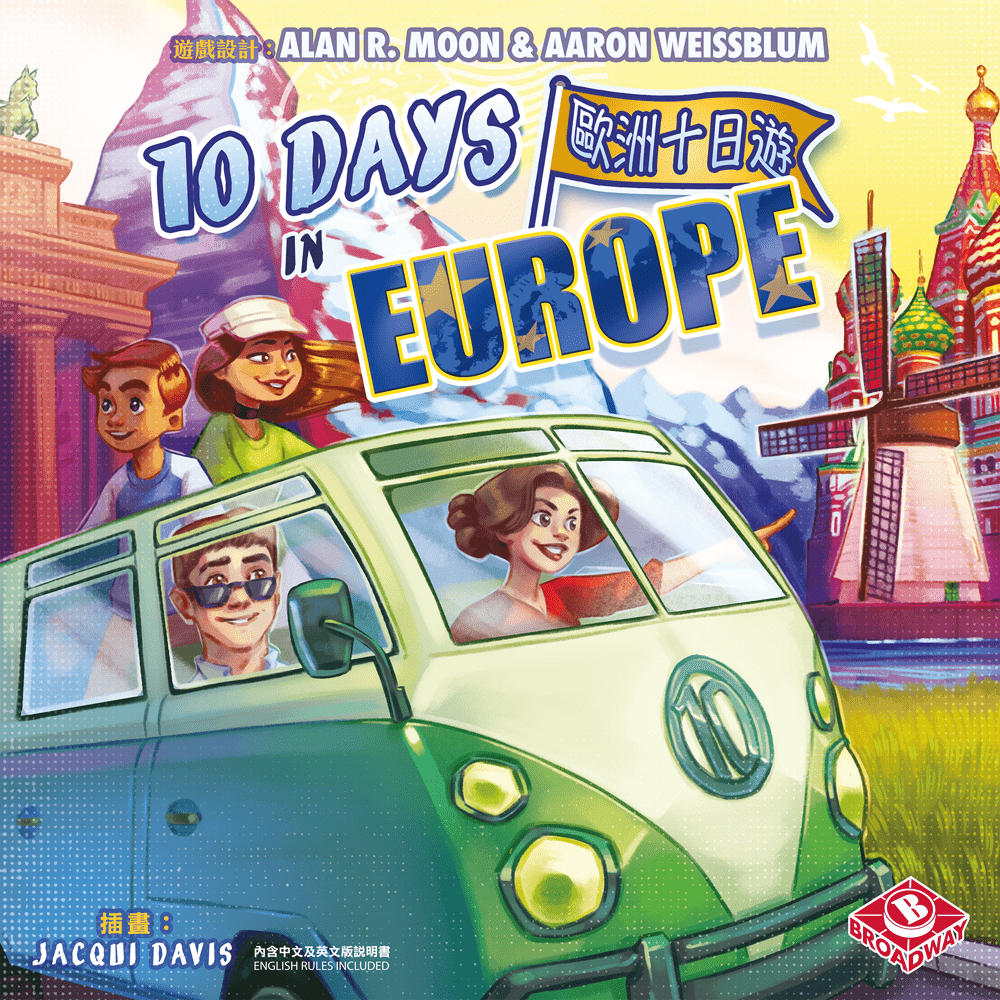
10 Days in Europe — Prices
Schmidt Spiele, Broadway Toys LTD, DV Games · Board game · 2002
2–4 · best 2
20–30 min
Weight 1.4/5
Buy · from US$ 14.00
10.0
rating
Ludopedia
6.6
rating
BGG
Our Verdict
RECOMMENDED
If you enjoy a light spatial puzzle and want to learn European geography in a fun way, 10 Days in Europe is definitely worth checking out!
Highlights
- Simple and accessible gameplay
- Excellent for learning geography
- Interesting tactical decisions
- Quick to play
- High replayability
Keep in mind
- Can have luck of the draw
- Indirect player interaction
Rules manual not indexed yet
Upload the PDF rulebook to ask questions about this game with AI.
About the game
What you do in a play session
Ready for a trip across Europe without leaving your table? In 10 Days in Europe, the goal is to be the first to assemble a continuous ten-day route, connecting countries by land, sea, or air. It's the third installment in the popular '10 Days in...' series, bringing all the fun and planning challenge we've come to expect.
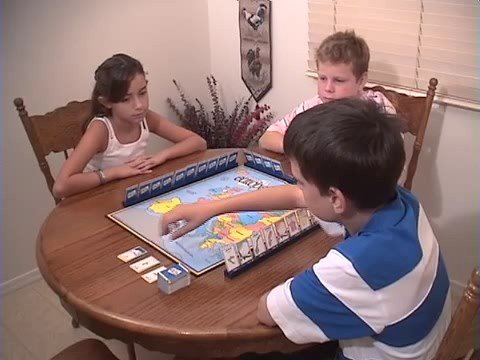
At the start, each player picks up ten tiles and arranges them on their tile holder. The magic happens when you begin to draw and discard tiles. Each turn, you draw one tile—either from one of the face-up discard piles or the face-down pile—and decide whether to swap it for one of your already arranged tiles. The replaced tile (or the one you drew and didn't want to use) goes into one of the discard piles. The big catch is that you cannot rearrange your tiles once they're placed, so every swap decision is crucial!
Connections are the heart of the game. To travel by land, countries need to be adjacent on the map. For air travel, you need an airplane of the correct color between two countries of the same color. And for sea travel, a ship connects countries that share a sea border. The game is a super fun way to learn geography while trying to outsmart your friends in assembling the perfect route. With 42 countries on the map and a variety of country, ship, and airplane tiles, each game is a new adventure in planning and strategy. It's a light, fast-paced game perfect for anyone who enjoys a good spatial puzzle with an educational twist.
At the start, each player picks up ten tiles and arranges them on their tile holder. The magic happens when you begin to draw and discard tiles. Each turn, you draw one tile—either from one of the face-up discard piles or the face-down pile—and decide whether to swap it for one of your already arranged tiles. The replaced tile (or the one you drew and didn't want to use) goes into one of the discard piles. The big catch is that you cannot rearrange your tiles once they're placed, so every swap decision is crucial!
Connections are the heart of the game. To travel by land, countries need to be adjacent on the map. For air travel, you need an airplane of the correct color between two countries of the same color. And for sea travel, a ship connects countries that share a sea border. The game is a super fun way to learn geography while trying to outsmart your friends in assembling the perfect route. With 42 countries on the map and a variety of country, ship, and airplane tiles, each game is a new adventure in planning and strategy. It's a light, fast-paced game perfect for anyone who enjoys a good spatial puzzle with an educational twist.
Gallery
Box and component photos
Tap any photo to open fullscreen. Photos submitted by the community or publisher.
Rules videos
Learn by watching before you open the box

Best player count
BGG community vote
2
BEST
3
REC
4
REC
Soundtrack
Ambience suggested by Melodice
Loading playlist...
Where to Buy
Prices monitored daily
Finding best prices...
Prices unavailable at this time.
Price history — last 6 months (lowest new offer)
Alert enabled!
Join the BoardGamesBot deals group
Get the best board game deals every day — without message spam.
Join the WhatsApp groupGame details
Mechanics, categories, families and credits
Mechanics
Categories
Families
Publisher
Schmidt Spiele, Broadway Toys LTD, DV Games, Mandoo Games, Martinex, Mega Bleu, Out of the Box Publishing, Peliko Oy, Popcorn Games, Rebel Sp. z o.o., TCG Factory
Designer
Aaron Weissblum, Alan R. Moon
Artist
Cathleen Quinn-Kinney, Jacqui Davis, John Kovalic, Max Winter Osterhaus
Community
Data from BoardGameGeek
2,904owners
339wishlist
82want to play
Frequently Asked Questions
Quick answers before you buy
How many players can participate in 10 Days in Europe?
The game is ideal for 2 to 4 players, making it perfect for a family game night or with a small group of friends.
What's the average game duration?
A game of 10 Days in Europe is quite quick, usually lasting between 20 to 30 minutes. Great for filling a short time slot or playing multiple rounds!
Is it a complex game? What's the difficulty level?
Not at all complex! With a BGG weight of 1.35/5, it's considered a light game, easy to learn and teach, ideal for beginners and families.
What are the main components of the game?
You'll find a board with the map of Europe, country, ship, and airplane tiles, plus tile holders to organize your travel pieces. Everything is well-illustrated and functional!
Who is 10 Days in Europe most recommended for?
It's highly recommended for families, casual gamers, and anyone who enjoys puzzle games and wants a dose of geography learning. If you like the '10 Days in...' series, you'll love this one!
Does the game have any language dependency?
No, the game is language independent! The components are visual and the rules are simple, making it accessible to players of any language.
Other Games You'll Like
Based on mechanics and theme