What is your question about CDG Solo System?
Ask before downloading the manual: the assistant was trained on this file and answers instantly, citing the exact page.
Ask questions about the game
Ask anything about CDG Solo System: rules, setup, components, complexity, price, or whether it fits your group.
Write your question first. You will create your free account to see the answer — it takes 20 seconds.
Full rulebook
Browse the manual or download the original PDFFull manual text available to read Open text
GMT Games, LLC
P.O. Box 1308, Hanford, CA 93232-1308
www.GMTGames.com
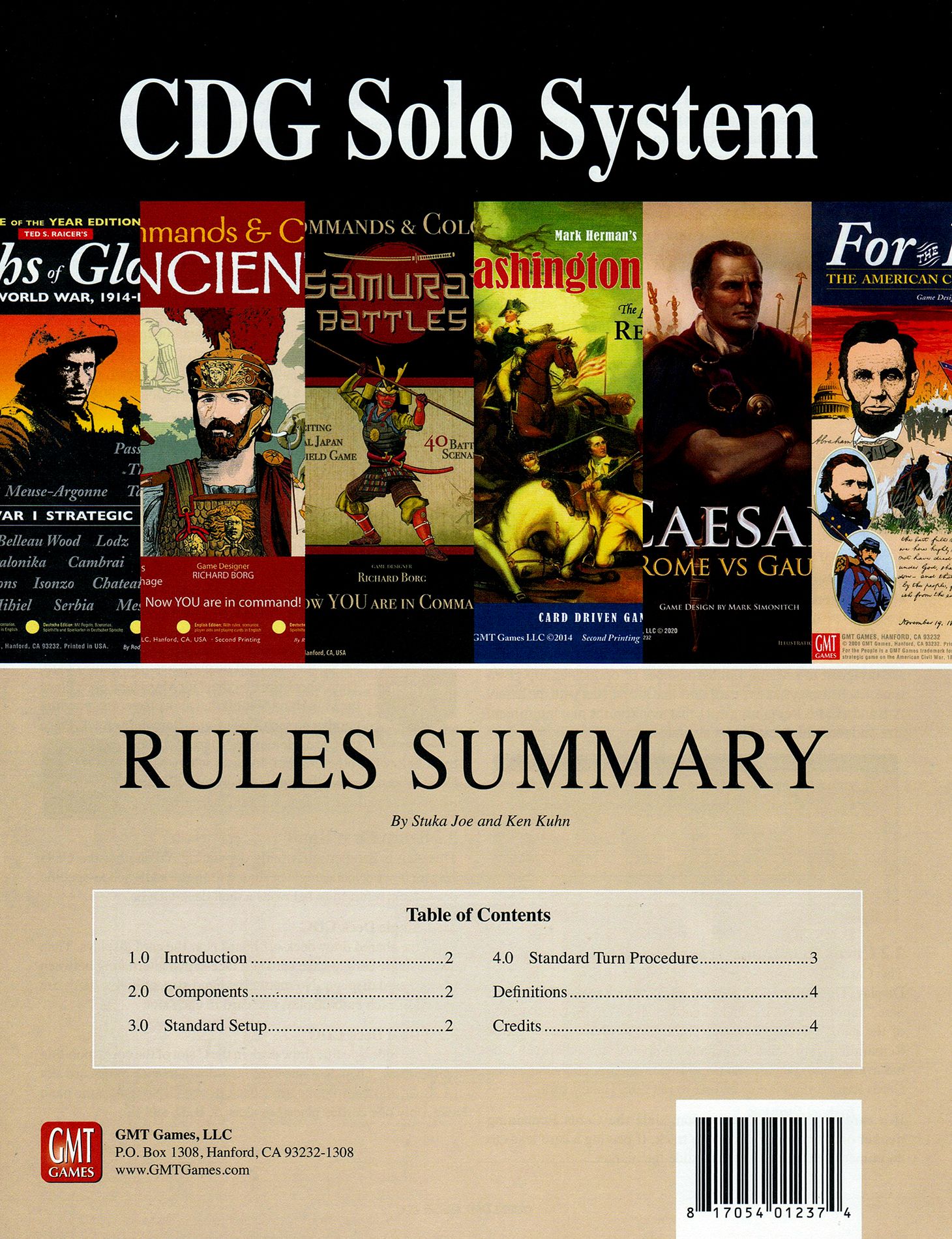
Table of Contents
RULES SUMMARY
By Stuka Joe and Ken Kuhn
1.0 Introduction...............................................2
2.0 Components...............................................2
3.0 Standard Setup..........................................2
4.0 Standard Turn Procedure...........................3
Definitions..........................................................4
Credits................................................................4
CDG Solo System
---
CDG Solo System
© 2022 GMT Games, LLC
1.0 Overview
The CDG Solo System is a revised implementation of Stuka Joe’s CDG solo method, and streamlines two-handed solitaire gameplay by decreasing turn-to-turn overhead and maintenance. At the beginning of each Side’s turn, you will roll a Fate Die to determine which of the five cards are available for play. Typically two or three cards are available, but the final decision of which card to play is ultimately yours. This method of play increases narrative immersion as the great battles of history unfold on your tabletop.
The CDG Solo System is not a bot and cannot be played against. Instead, it provides two Card Displays to help organize your play space and limit your decision space as you control both sides. Therefore, it is compatible with most two-player card-driven strategy games. The following rules summary provides an introduction to the system, general guidelines for play, and game-specific Playsheets covering a handful of GMT’s most popular titles. If desired, the rules and principles in this rulebook can be applied to nearly any CDG.
2.0 Components
The CDG Solo System includes:
• 2 Card Displays
• 1 Six-Sided Custom Die
• 4 Markers for the Cards Remaining Track
• This Rules Summary
• 7 Playsheets
2.1 Card Displays
Each Side’s hand is managed via their Card Display. The displays are designed to reveal a limited number of options at any given time. Each display has five card slots that are labeled with the letters A-E and a Cards Remaining track that monitors the maximum hand size and remaining card plays available.
2.2 Cards Remaining Track
The Cards Remaining track is centered at the top of the Card Display. The marker with a down arrow, which reads “Max Hand Size,” represents the number of cards that a Side draws at the top of the game’s Strategy Phase. The marker, which reads “Cards Remaining,” represents the current number of cards that each Side has available for play. At the beginning of each Strategy Phase, the Cards Remaining marker is reset to the Max Hand Limit.
If a card is played for any reason, slide the Cards Remaining marker one step to the left on the track. If playing a card leads to an immediate card draw, do not slide the marker.
2.3 Fate Die
The Fate Die is a custom six-sided die which is rolled to determine which cards from the Card Display are available for play. Each face of the die depicts a combination of letters and symbols that pertains to one of the six options noted on the Results Chart found on each Playsheet. Only the symbols on the top face are considered after each roll. The !! result on the C face of the Fate die isn’t used in these first seven Playsheets, but it is included on the die to allow the system greater flexibility going forward.
2.4 Playsheets
Playsheets are single sheets of rules, front and back, that contain all of the game-specific rules needed to use this system. These include a listing of die result rulings and modifications to the CDG Solo System that are necessary to meet the demands of unique game rules. Rule references in the playsheets refer to the game’s rulebook, not to the CDG Solo System rules, unless otherwise noted. Rules and explanations provided in a Playsheet supersede this rules summary in situations where the two are in conflict.
3.0 Standard Setup
Set up the game normally, but before drawing cards for the two Sides, find the corresponding Playsheet and place it near the game board for frequent reference during play. Consult the Playsheet for setup instructions. Most CDGs follow the standard setup explained below. But, some CDGs require additional setup modifications and are designated as Standard+. Playsheets with a Standard+ setup have a “modified setup” section that explains the differences.
3.1 Setup Card Displays
Set up the two card displays near the game board. Then, check the Playsheet for Max Hand Size. Place the Max Hand Size marker above the corresponding number on each Side’s Cards Remaining track. Place the Cards Remaining marker on the track below the other marker. In cases where Max Hand Size changes throughout a game, further instructions will be included in the Playsheet.
3.2 Setup First Hand
This step is handled differently depending on whether the CDG you are playing has a single or shared draw deck OR a Side-specific draw deck, referred to below as a dual deck CDG.
3.2.1 Single Deck CDG
Place the shared draw deck off-board near the card displays. Then deal a single card to each card slot face-down alternating between the two card displays. No matter the hand size, only five cards are placed in each card display, one card in each slot.
Cards Remaining marker on the track below the other marker In cases where Max Hand Size changes throughout a game further instructions will be included in the Playsheet 3 2 Setup First Hand This step is handled differently depending on whether the CDG you are playing has a single or shared draw deck OR a Side specific draw deck referred to below as a dual deck CDG 3 2 1 Single Deck CDG Place the shared draw deck off board near the card displays Then deal a single card to each card slot face down alternating between the two card displays No matter the hand size only five cards are placed in each card display one card in each slot
3.2.2 Dual Deck CDG
Place the Side-specific draw deck in the C slot of the corresponding card display. Then deal one card face-down to each open card slot (A, B, D, and E) from the draw deck in slot C. No matter the hand size, only one card is placed in slots A, B, D, and E.
---
3 © 2022 GMT Games, LLC
CDG Solo System
3.2.3 Flip Cards in Slots A and B
Finally, no matter whether the game is a single or dual deck CDG, the cards in slot A and slot B are flipped face-up on each Card Display. The background color of A and B’s labels are white to help you remember that the cards in these two slots start face-up at the beginning of the game.
4.0 Standard Turn Procedure
In all CDGs, the normal sequence of play is followed. In the phase where cards are played, often called the Strategy phase or similar, determine which Side will start the round (consult the Playsheet if necessary) and then alternate between Sides following the turn procedure below. The following turn procedure explains how to determine which options are available for the Active Side, but does not tell you which card to select. When more than one option is allowed, the final decision is yours. As the player, it should be your goal to play each side as best as possible.
DESIGN NOTE: The CDG Solo System is not a solitaire bot and will not explicitly select a card for you. Instead, the Fate Die limits the allowable options, but two or more cards are often available for selection. When there are multiple valid options, the final decision must be made by you.
4.1 Roll Fate Die
If a Side has one or more Cards Remaining, roll the Fate Die and consult the Result Chart on the Playsheet. If the Cards Remaining marker has reached zero, then the Side has exhausted their hand for the round, and play proceeds to the other Side. If neither Side has Cards Remaining, the Strategy Phase is over. Proceed to the next phase in the sequence of play.
4.2 Consult Result Chart
After rolling the Fate Die, consult the Result Chart on the corresponding Playsheet to see which cards are available for selection. When multiple face-up cards are available for selection, the decision of which to play is made by the player. Face-up cards in both displays can be legally considered for strategic deliberation, but, unless otherwise noted in the Playsheet, only face-up cards from the Active Side’s card display may be selected to play.
4.3 Play Selected Card
After selecting a face-up card from the display, play the card following the guidelines given by the Result Chart on the Playsheet. Typically, this means playing the card for any allowable purpose according to the game’s rules of play. Generally, a single card is played each turn.
When the result of the Fate Die roll is associated with one or more of the card slots labeled A-E, you may play any one of the permitted face-up cards for the Active Side’s event or for any other allowable purpose dictated by the game’s rules of play.
When the result of the Fate Die roll directs the player to play a face-up event card, the event card must be a legally playable event for the Active Side and may not be played for the operations value unless it is also the lowest valued operations card face-up on the Card Display.
When the result of the Fate Die roll directs the player to play the lowest valued face-up operations card, the player consults the operations value on each of the face-up cards and must select the lowest. In cases where there are two or more cards tied for the lowest operations value, the player may choose between them.
After playing a card, move the Cards Remaining marker one space down the Cards Remaining track for that Side.
Example of Setup for Washington’s War.
Setup: Standard
Max Hand Size: 7
Draw Pile: Single Deck
---
4CDG Solo System
© 2022 GMT Games, LLC
4.4 Discard Card
After playing the card, check for any text on the card that may dictate an alternative action (e.g. That the card should be removed from the game or that the draw deck might need to be reshuffled). If there are no further instructions printed on the card, discard the card to an off-board discard pile. If playing a dual deck CDG, be sure to keep the discard piles separate. If a card’s text requires a reshuffle of the draw deck, be sure to complete the reshuffle before proceeding to the next step.
4.5 Refill Card Slot
The final step in the standard turn procedure is to refill the now empty card slot. To do so, draw a card from the draw deck and place the card face-down in the slot. Note: Be sure to consult the die Result Chart on the Playsheet. Whether you play the card face-up or face-down to the empty card slot can vary across games. After refilling the empty card slot, play alternates to the other Side and begins with rolling the Fate Die (4.1).
Credits
Original Solo Method Designer: Jose Ruiz (Stuka Joe)
CDG Solo System Designer: Ken Kuhn
Developer: Ken Kuhn
Playsheet Contributors: Stuka Joe, Chris Crane, Shane Avery, Ken Kuhn
Proofreaders: Jason Carr, Jerry Hall, Joe Dewhurst, Scott Mansfield, Shaun O’Keeffe, and Stephen Rangazas
Playtesters: Andrew Waller, Ash Brimhall, Ben Morrison, Daniel Hernández Iniesta, Dominick Lauzon, Evan Walter, Hank Wong, Ignacio Cobos, Luc Boyer, Marcel Meerkerk, Marco Kamerbeek, Phil Sauer, Rahul Keswani, Richard Class, Saverio Spagnolie, Shane Avery, Stefano Corridori, Steffen Siewert, Tim Kreuz, Warren Maruschak, Wooyoung Kim
Production Coordination: Tony Curtis
Producers: Gene Billingsley, Tony Curtis, Rodger MacGowan, Andy Lewis, and Mark Simonitch
GMT Games, LLC
P.O. Box 1308, Hanford, CA 93232-1308
www.GMTGames.com
Definitions
Active Side: The faction whose turn is currently in progress.
Card Display: The play mats that display each Side’s hand (see 2.1).
Cards Remaining: The number of card plays a Side has available to them (see 2.2).
CDG: Card-Driven Game
Fate Die: The custom six-sided die used to determine available options for play (see 2.3).
Result Chart: The chart printed on a Playsheet that provides game specific instructions to resolve each face of the Fate Die.
Side: Term used throughout these rules to refer to the factions typically played by different players.
Strategy Phase: This is the game phase, typically found in a CDGs sequence of play, wherein play alternates between Sides playing their hand of strategy cards. In some games it is referred to as the ‘Action Phase’.
Playsheet: Game-specific rules addendum (see 2.4)
---
Why ask BoardGamesBot
Instead of flipping through the whole manual- Accurate answers Based exactly on this manual, with the source page.
- Save time Find the rule in seconds, without flipping 4 pages.
- Anytime Settle rules mid-game, straight from your phone.
- 100% free Create your free account and start using it now.
How it works
Three steps to the answer- 1 Ask your question Type your question about this game's rules.
- 2 Create your free account Takes 20 seconds — it only saves your history.
- 3 Get the answer The AI finds the exact rule and cites the manual page.
Expansion for
Published additional content

Manual published by the publisher · for rules reference only. More about the game on BoardGameGeek and Ludopedia .