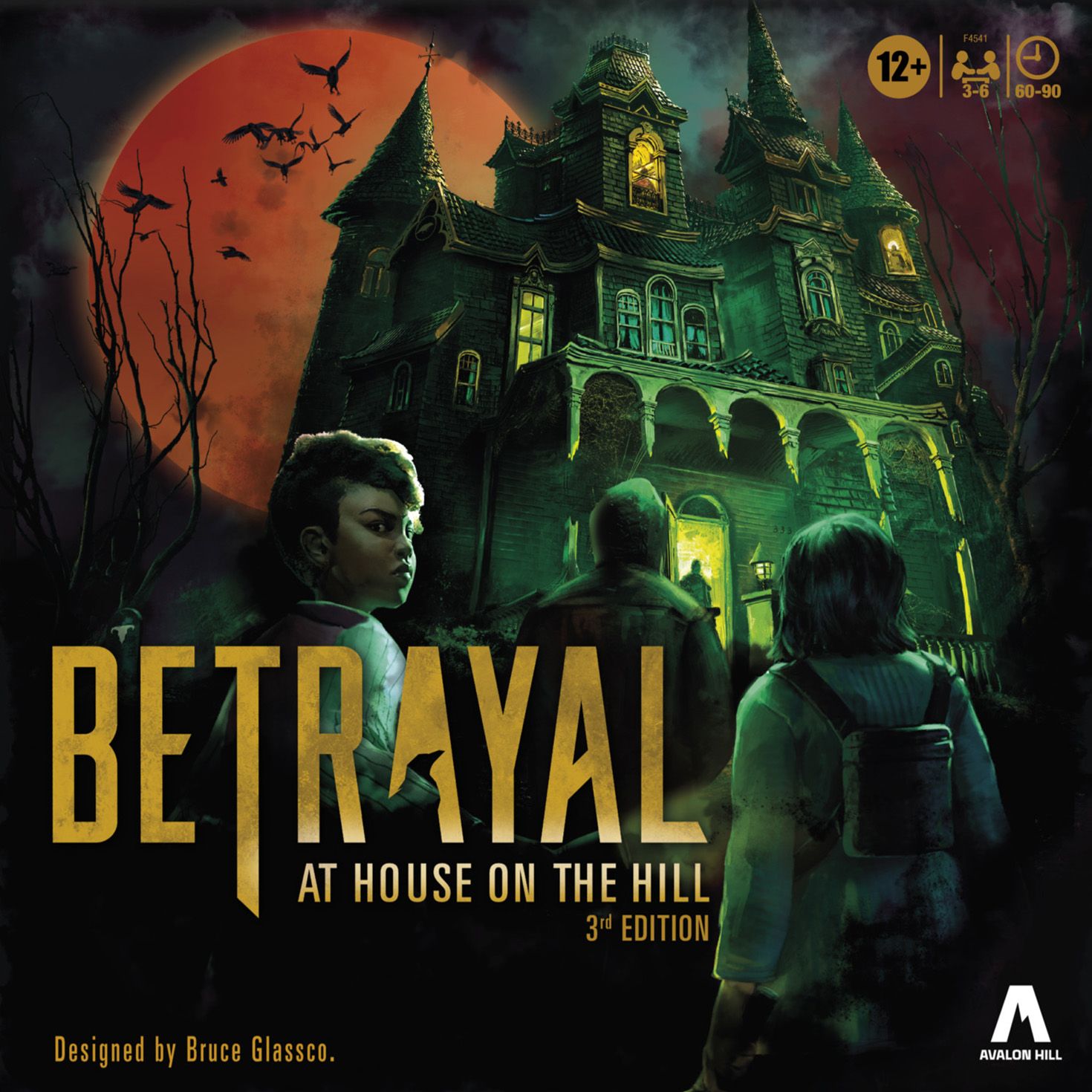
How to Play Betrayal at House on the Hill
Avalon Hill, Wizards of the Coast, asmodee · Board game · 2004
3–6 · best 5
60 min
Weight 2.4/5
8.0
rating
Ludopedia
7.0
rating
BGG
What do you want to do now
Ask questions about the game
Ask anything about Betrayal at House on the Hill: rules, setup, components, complexity, price, or whether it fits your group.
Example questions
Continue this chat in the Assistant
Game page
Prices, ratings and our review
Rules manual
Official PDF file
Video: How to Play
Start here, then follow the written guide
How to Play: Betrayal at House on the Hill
Step by step
Objective of the Game
Welcome, brave explorers, to the chilling halls of *Betrayal at House on the Hill*! Your primary goal is to delve into a creepy old house, discovering new rooms and making your explorer stronger. But beware, for this isn't just a simple exploration! At some random point, a terrifying scenario called a **haunt** will begin, transforming one of you into a **traitor** bent on defeating your former companions. The rest of you become **heroes**, struggling to survive the house's horrors. From then on, the game becomes a desperate fight for survival, often to the death, with each side striving to complete their unique **victory condition**. Will you escape the house alive, or succumb to its sinister influence?Preparation (Setup)
Getting ready to face the horrors of the House on the Hill is straightforward. Here's how to set up your game:- First things first, set aside the **Traitor’s Tome** and **Secrets of Survival** haunt books. You'll only need these once the **haunt** is revealed.
- Each player chooses a **character card**. These are double-sided, so pick the explorer that calls to your adventurous spirit!
- Attach 4 **plastic clips** to your chosen **explorer card**. Each clip should point to one of your explorer's starting values for **Might**, **Speed**, **Knowledge**, and **Sanity**. These starting values are conveniently colored green.
- Shuffle the **omen cards**, **item cards**, and **event cards** separately. Place each stack face down where everyone can easily reach them.
- Find the **Basement Landing**, **Entrance Hall/Foyer/Grand Staircase**, and **Upper Landing room tiles**. Place them reasonably far apart, from left to right, to form the initial layout of the house.
- Mix all the remaining **room tiles** together and place them face down in a stack. Don't worry about the floor shown on the back of the tiles for now.
- Each player places their **explorer’s plastic figure** in the **Entrance Hall**. Your figure's color matches the color behind your explorer's picture on their **character card**.
- Put the **dice** in a pile within easy reach – you'll be rolling them often!
- Finally, determine who goes first. The explorer with the next birthday starts the game! (Check your **explorer’s character card** for their birthday.) Players will take turns clockwise from the first explorer.
The Turn of Play
Turns in *Betrayal at House on the Hill* are all about exploration and discovery, at least until things get really spooky! Starting with the first player and moving clockwise, each player takes a turn exploring the house. On your turn, you can perform as many of the following actions as you want, in any order:-
Move: You can move up to a number of spaces (rooms) equal to your character’s current **Speed**. You can even perform other actions, like using an item or attacking, in the middle of your movement. However, if a game effect makes you draw a card, you must stop moving for the rest of your turn.
- Discover a New Room: When you enter a doorway with no room on the other side, draw the top tile from the **room stack**. If it matches the floor you're on (ground, basement, or upper), turn it over and connect it to the doorway. Then, move into that new room! Add new tiles as logically as possible, connecting doors when you can. If doors can't be matched, you create a **false feature** like a blocked door. If the drawn tile isn't for your current floor, set it aside face down in a discard pile and keep drawing until you find one that works.
- Special Rooms: Some rooms have unique rules printed on them, or additional effects described in the rulebook. For example, **Barrier Rooms** like the Chasm require a **trait roll** to cross, and failing ends your movement. The **Coal Chute** immediately sends you to the **Basement Landing**. The **Mystic Elevator** moves you to a random floor by rolling 2 dice (unless you're a monster or traitor, who choose the destination).
-
Drawing Event, Item, and Omen Cards: Some rooms have symbols on them. The first time you discover a room with a symbol, you must end your move there and draw the corresponding card:
- Event Card (spiral symbol): Draw it, read it aloud, and follow its instructions. Discard it afterward unless it has an ongoing effect.
- Item Card (bull’s head symbol): Draw it, read it aloud, and place it face up in front of you. You now possess this item and can use it immediately and once on each of your turns (unless the card states otherwise).
- Omen Card (raven symbol): Draw it, read it aloud, and place it face up in front of you. You might have to do something immediately. Crucially, at the end of your turn, if the **haunt** has not yet begun, you must make a **haunt roll**!
-
Use Item and Omen Cards: You can use an item once at any point during your turn. Most **omen cards** are treated like items. There's no limit to how many items you can carry. Once per turn, you can also:
- Trade an item with another explorer in the same room (if both agree).
- Drop any number of items, placing a **pentagonal Item Pile token** in the room.
- Pick up one or more items from an **Item Pile token**.
-
Attempt a Die Roll: Many cards, tiles, or game effects will require you to roll dice. Each die has faces with 0, 1, or 2 dots. There's no limit to how many times you can roll dice in a turn, but you can't attempt the same roll more than once per turn (e.g., you can't keep trying to open the Vault).
- Damage Rolls: If an effect says "take 1 die of physical damage," roll a die and take damage to **Might** and/or **Speed** equal to the dots rolled. Mental damage works similarly, distributed between **Knowledge** and **Sanity**.
- Trait Rolls: If a card or tile tells you to attempt a roll based on one of your traits, roll dice equal to your current value in that trait. The card or tile will tell you the results of success or failure.
- Task Rolls: Some haunts require specific task rolls, like an exorcism. You can only attempt one such roll per turn.
-
Make an Attack: You can't attack anyone until after the **haunt** starts. Once the haunt begins, you can attack an opponent in the same room once during your turn.
- To attack, you and your opponent each roll a number of dice equal to your **Might**. The higher roll wins, inflicting physical damage equal to the difference between the rolls. Ties result in no damage.
- Some effects let you attack with other traits (like **Speed** for physical damage, or **Sanity** or **Knowledge** for mental damage). You cannot attack an opponent who doesn't have that trait.
- Monsters are usually only **stunned** when defeated, not killed, unless a haunt specifies otherwise. Stunned monsters miss their next turn and don't slow movement.
- Special Attacks: Some weapons, like the **Revolver**, allow **distance attacks** through a straight line of doors. If you lose a distance attack, you take no damage. If you inflict 2 or more points of physical damage in an attack, you can choose to **steal** a tradable item or omen instead of inflicting damage (cannot be done with distance attacks).
The Haunt Begins!
The game dramatically changes when the **haunt** starts. Before the haunt, if you draw an **omen card**, you must make a **haunt roll** at the end of your turn.- Making a Haunt Roll: Roll 6 dice. If your result is less than the total number of **omen cards** all players have drawn so far, the haunt begins! The player who triggered it is the **haunt revealer**.
- Revealing the Haunt: The **haunt revealer** consults the haunt chart in the **Traitor’s Tome**. By matching the drawn **omen card** and the room the **haunt revealer** was in, you'll find the specific haunt number and, crucially, who becomes the **traitor**. The **haunt revealer** is not necessarily the **traitor**! The **traitor** takes the **Traitor’s Tome** and leaves the room to read their instructions, while the remaining players become **heroes** and read the corresponding haunt in the **Secrets of Survival** together.
- Playing the Haunt: The first turn after the haunt begins always starts with the player to the **traitor’s** left and proceeds clockwise. Each **hero** takes a turn, then the **traitor** takes their turn, followed by any **monsters** the **traitor** controls. This means the **traitor** gets two turns!
- After the Haunt: Explorers can now die! If any of your traits drop to the skull symbol, your explorer dies. The **traitor** gains new powers, such as ignoring harmful room text and choosing not to be affected by certain cards. **Monsters** also behave differently, moving based on a die roll equal to their **Speed** and usually only being **stunned** instead of killed.
End of Game and Scoring
The game ends when one side (either the **traitor** or the **heroes**) successfully completes its goals for the **haunt**. These goals are described under the "You Win When..." section in the respective haunt books. It's important to note that the **heroes** must have at least one survivor to win. However, some haunts allow the **traitor** to win even after they die, as their controlled **monsters** might still be able to achieve the haunt's objectives. When a side wins, someone from that winning side reads the "If You Win..." section from their haunt book aloud, revealing the thrilling conclusion to your terrifying tale!Tips for Winning
Navigating the House on the Hill can be tricky, especially with a traitor lurking! Here are a few tips to help you survive (or conquer):- Explore Wisely, But Don't Be Afraid to Push Your Luck (Pre-Haunt): Before the **haunt** starts, no one can truly die. This is your chance to explore aggressively, discover new rooms, and draw cards to power up your explorer's **traits** and gather useful **items**. Don't be too cautious, as strengthening your character is key for the inevitable conflict. However, be mindful of **omen cards**, as drawing them brings you closer to the **haunt roll** and the game's dramatic shift!
- Communicate (But Be Wary of the Traitor!): As **heroes**, communication is vital for survival. Discuss plans, share information about discovered rooms, and strategize how to achieve your haunt's objective. However, remember that the **traitor** is listening! Don't reveal all your secrets, especially your specific victory conditions, unless the haunt explicitly requires it. The **traitor** benefits from your mistrust and confusion.
- Understand Your Role and Exploit Your Strengths: Once the **haunt** begins, whether you're a **hero** or the **traitor**, fully embrace your new role. As a **hero**, focus on your haunt's specific victory conditions and use your combined strengths to overcome the **traitor** and **monsters**. As the **traitor**, leverage your new powers (like ignoring harmful room effects and controlling **monsters**) to sow chaos and achieve your sinister goals. Remember that **trait rolls** and **attacks** are crucial, so know which of your **traits** are highest and use them effectively!
More videos
More rules explanations from the community
In English
-
 Betrayal at House on the Hill Soundboard
-
 How to play Betrayal at House on the Hill - Teach The Table
-
 How to Play Betrayal at House on the Hill - Roll For Crit
-
 Learn to play Betrayal at House on the Hill better, faster | Making learning the game easier
-
 Noobs Explain: Betrayal at House on the Hill
-
 2GASCB - Betrayal Tutorial Part 1
-
 2nd Edition Detailed Rules
-
 GamingNight: Betrayal setup & mechanics
-
 2GASCB - Betrayal Tutorial Part 2
-
 So, You want to play Betrayal at House on the Hill
-
 Betrayal at House on the Hill Gamesplained - Part 1
Rules manual
Official PDF file
Prefer the Official PDF?
Download the official Betrayal at House on the Hill rulebook or browse it online with our AI rules assistant.
View Rulebook PDF
Frequently Asked Questions
Quick answers about the rules
What is the objective of Betrayal at House on the Hill?
Welcome, brave explorers, to the chilling halls of *Betrayal at House on the Hill*! Your primary goal is to delve into a creepy old house, discovering new rooms and making your explorer stronger. But beware, for this isn't just a simple exploration! At some random point, a terrifying scenario called a **haunt** will begin, transforming one of you into a **traitor** bent on defeating your former companions. The rest of you become **heroes**, struggling to survive the house's horrors. From then…
How do you set up Betrayal at House on the Hill?
Getting ready to face the horrors of the House on the Hill is straightforward. Here's how to set up your game: First things first, set aside the **Traitor’s Tome** and **Secrets of Survival** haunt books. You'll only need these once the **haunt** is revealed. Each player chooses a **character card**. These are double-sided, so pick the explorer that calls to your adventurous spirit! Attach 4 **plastic clips** to your chosen **explorer card**. Each clip should point to one of your explorer's…
How do you play Betrayal at House on the Hill?
Turns in *Betrayal at House on the Hill* are all about exploration and discovery, at least until things get really spooky! Starting with the first player and moving clockwise, each player takes a turn exploring the house. On your turn, you can perform as many of the following actions as you want, in any order: Move: You can move up to a number of spaces (rooms) equal to your character’s current **Speed**. You can even perform other actions, like using an item or attacking, in the middle of…
How does Betrayal at House on the Hill end, and how do you score?
The game ends when one side (either the **traitor** or the **heroes**) successfully completes its goals for the **haunt**. These goals are described under the "You Win When..." section in the respective haunt books. It's important to note that the **heroes** must have at least one survivor to win. However, some haunts allow the **traitor** to win even after they die, as their controlled **monsters** might still be able to achieve the haunt's objectives. When a side wins, someone from that…
What are some tips for winning Betrayal at House on the Hill?
Navigating the House on the Hill can be tricky, especially with a traitor lurking! Here are a few tips to help you survive (or conquer): Explore Wisely, But Don't Be Afraid to Push Your Luck (Pre-Haunt): Before the **haunt** starts, no one can truly die. This is your chance to explore aggressively, discover new rooms, and draw cards to power up your explorer's **traits** and gather useful **items**. Don't be too cautious, as strengthening your character is key for the inevitable conflict…
Want to compare prices and check reviews?
Find where to buy at the lowest price, price history, and our full game review.
View Betrayal at House on the Hill
Expansions
Published additional content
Other Games You'll Like
Based on mechanics and theme