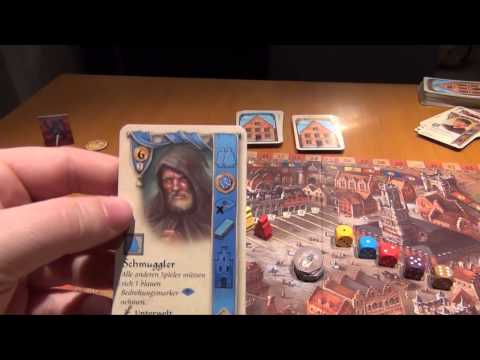
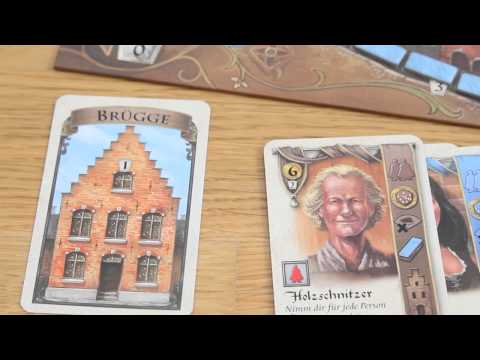
Bruges
Hans im Glück, Arclight Games, Broadway Toys LTD · Board game · 2013Objective of the Game
Welcome to Bruges, a game where you'll dive into the bustling life of a medieval city, aiming to become the most influential citizen! Your ultimate goal is to accumulate the most Victory Points (VP) by the end of the game. You'll achieve this by managing resources, building houses, navigating the canal, and gaining reputation. Every decision you make will shape your path to becoming the most esteemed figure in Bruges!
Preparation (Setup)
Let's get Bruges ready for play! Here's how to set up your game:
- Place the game board in the center of your playing area.
- If you're using a homemade board, find 8 tokens/meeples/cubes and place them on each of the numbered circles on the top left panel of the board. These will be used to assign tokens to houses based on the white die during Phase 2.
- Place the boats and harbor components onto their designated spaces on the board.
- Set up the expanded reputation track.
- Place the "Monastery" track (which should really be the "houses track" in Bruges) on the board. Note that the canal on this track has a "6" instead of a "1" due to a random number assignment during its design.
- Place the VP majority token within reach.
- Each player receives their starting cards.
- Prepare the split colored-deck. Although there are no specific components for this, ensure the cards are separated by color as intended.
- Place the resource cards (marked "Star ¥ing resource cards" in the manual) in a designated area, ready to be drawn or acquired.
- Ensure the dice are ready, including the 6th die, which is white.
The Game Turn
A round in Bruges is dynamic and full of choices! Here’s a breakdown of what happens during a player's turn:
Each round involves rolling dice and then taking actions based on those rolls. While the full action breakdown isn't detailed, we know that during Phase 2, you'll be assigning 1 token/meeple/cube to the houses as per the pips shown on the white die. This suggests that the die rolls will dictate certain actions or resource allocations, particularly concerning your houses and the "houses track."
Players will use their resource cards and development cards (implied by the "split colored-deck" and the overall game design) to build, gain influence, and manage threats. The core of the game revolves around utilizing the cards in multiple ways, making each turn a strategic decision.
End of Game and Scoring
The game continues until a certain condition is met (not explicitly detailed, but typically when a deck runs out or a certain number of buildings are constructed). Once the game ends, it's time to tally up those hard-earned Victory Points!
Points will be awarded for:
- Your position on the reputation track.
- The houses you've built on the "houses track".
- Control over the VP majority token, which suggests there are opportunities to gain a majority in certain categories throughout the game.
- Other elements like your boats and influence in the harbor will also contribute to your final score.
The player with the most Victory Points at the end of the game is declared the winner and the most influential citizen of Bruges!
Tips for Winning
To truly shine in Bruges, keep these tactical pointers in mind:
- Master the Dice: Pay close attention to the white die during Phase 2. Its pips dictate where tokens are assigned to houses, which is crucial for progressing on the "houses track" and potentially gaining VP. Don't underestimate its influence!
- Track Your Reputation: The expanded reputation track is a key source of VPs. Always look for opportunities to advance your standing on this track, as a strong reputation can be a significant boost to your final score.
- Utilize Resource Cards Wisely: While not fully detailed, the presence of "Star ¥ing resource cards" indicates that managing and deploying these resources effectively will be paramount. Think about how to best convert them into valuable assets or actions that contribute to your VP total.