How to Play Carcassonne Big Box 7
Hans im Glück, 999 Games, Bard Centrum Gier · Board game · 2021What do you want to do now
Ask anything about Carcassonne Big Box 7: rules, setup, components, complexity, price, or whether it fits your group.
Video: How to Play
Start here, then follow the written guide
Step by step
Game Objective
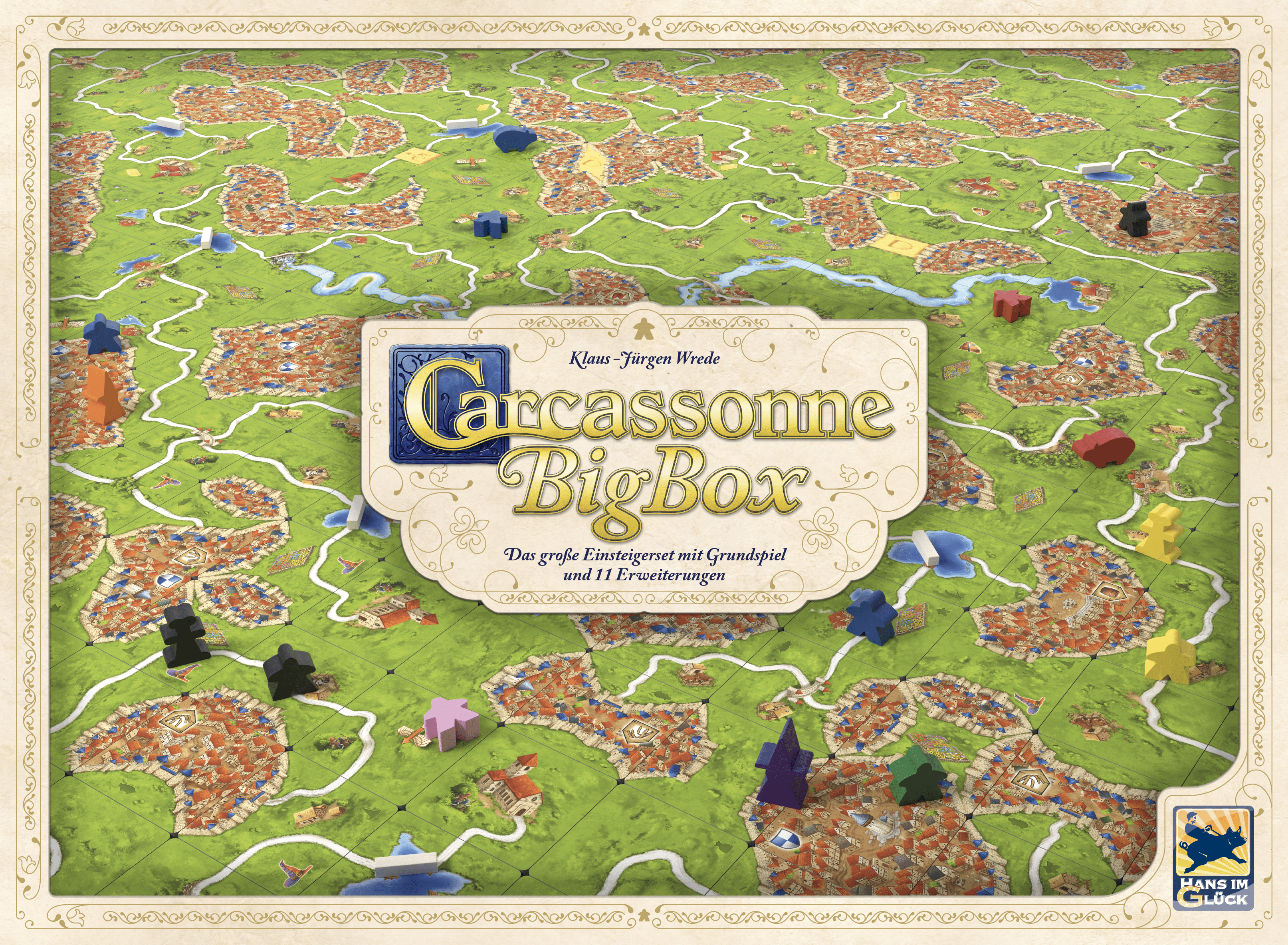
In Carcassonne Big Box 7, players build the map of a medieval region by placing land tiles that represent roads, cities, monasteries, and fields. Each player places their followers (called meeples) on these structures to claim control and earn points. The game ends when all land tiles have been placed, and the player with the most points wins.
Setup
- Place the starting tile (with a dark back) in the center of the table.
- Shuffle the remaining land tiles and form face-down piles, accessible to all.
- Each player chooses a color and takes 7 meeples of that color, placing the 8th on the "0" space of the scoreboard.
- Return unused colors to the box.
Beginner tip: For your first games, ignore the river tiles and farmers (supplemental rules).
Game Flow
Each turn consists of 3 mandatory actions, in this order:
- Place a land tile: Draw a tile and position it to expand the existing landscape (roads, cities, etc.). If placement is impossible, discard it and draw another.
- Place a meeple: Optionally, place a meeple from your reserve on the newly placed tile as:
- Thief (on roads)
- Knight (in cities)
- Monk (in monasteries)
- Farmer (in fields, lying down)
- Score: If the tile completes a structure (closed road, walled city, or surrounded monastery), the player with the most meeples on it earns points. Remove the scored meeples.
Actions and How to Play
Structure Types and Scoring
- Roads: Complete when closed at both ends. Each road tile is worth 1 point.
- Cities: Complete when fully walled. Each tile and coat of arms in the city is worth 2 points.
- Monasteries: Complete when surrounded by 8 tiles. Worth 9 points (1 per adjacent tile + the monastery).
- Fields: Score only at the end of the game. Each adjacent completed city is worth 3 points (4 with a pig).
Disputes: If there is a tie for a structure, all tied players receive the full points.
End of Game and Scoring
The game ends when all land tiles have been placed. During final scoring:
- Incomplete roads: 1 point per tile.
- Incomplete cities: 1 point per tile and coat of arms (half the normal value).
- Incomplete monasteries: 1 point per adjacent tile + the monastery.
- Fields: 3 points per adjacent completed city (see farmer rules).
The player with the most points wins!
Winning Tips
- Control large structures: Cities with coats of arms and long roads yield more points.
- Use farmers carefully: They remain until the end and can decide the victory.
- Block opponents: Complete contested structures to force scoring before others increase their influence.
Expansions: Consult the manual for details on the 11 included expansions (such as The Abbot, Ferry, etc.).
Rules manual
Official PDF file
Frequently Asked Questions
Quick answers about the rules
What is the objective of Carcassonne Big Box 7?
How do you set up Carcassonne Big Box 7?
How do you play Carcassonne Big Box 7?
How does Carcassonne Big Box 7 end, and how do you score?
What are some tips for winning Carcassonne Big Box 7?
Other Games You'll Like
Based on mechanics and theme