Kensington
(Unknown), Arxon, Canada Games Company Lmt. · Board game · 1979
2–6 · best 2
20 min
Weight 2.2/5
Buy
—
rating
Ludopedia
5.4
rating
BGG
Our Verdict
FOR GENRE FANS
Perfect for those who love chess and pure logic games; the piece repositioning mechanic is brilliant.
Highlights
- Intriguing board geometry
- Zero luck, pure strategy
- Fast and intense matches
- Simple rules, high depth
Keep in mind
- Steep tactical learning curve
- Can be frustrating for beginners
Rules manual not indexed yet
Upload the PDF rulebook to ask questions about this game with AI.
About the game
What you do in a play session
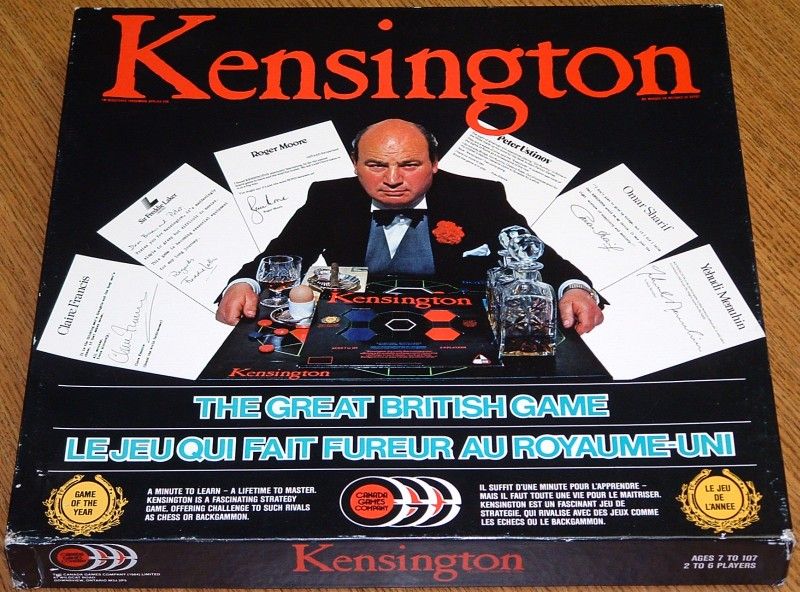
If you enjoy the kind of game where luck has no place and everything depends on your ability to predict your opponent's moves, Kensington is exactly what you need. Released back in 1979, this game is a classic example of abstract strategy, focusing entirely on spatial control and board geometry. The structure is fascinating: imagine a set of seven hexagons (one central surrounded by six others), interconnected by squares and triangles. The game doesn't take place 'inside' the shapes, but rather at the intersections, the points where the lines meet.
The dynamics begin with the placement phase. Each player has 15 pieces and, taking turns, you place them on the board's points until all pieces are in play. This is where the tension starts, as where you place a piece now can define your victory or defeat ten turns later. Once all pieces are on the board, the movement phase takes over: you move one piece at a time from one connected point to another.
The real 'twist' of Kensington lies in the rewards for area control. If you manage to dominate the three vertices of a triangle, you earn the right to reposition any one of your opponent's pieces. If you're bolder and dominate the four points of a square, you can reposition two of the opponent's pieces. This 'board clearing' mechanic makes the match extremely aggressive and dynamic, as territorial control can shift drastically in a single move. The final goal is clear but challenging: you win when you manage to control all six points of any one of the hexagons. It's a duel of patience, calculation, and spatial vision that keeps your brain buzzing until the very last move.
The dynamics begin with the placement phase. Each player has 15 pieces and, taking turns, you place them on the board's points until all pieces are in play. This is where the tension starts, as where you place a piece now can define your victory or defeat ten turns later. Once all pieces are on the board, the movement phase takes over: you move one piece at a time from one connected point to another.
The real 'twist' of Kensington lies in the rewards for area control. If you manage to dominate the three vertices of a triangle, you earn the right to reposition any one of your opponent's pieces. If you're bolder and dominate the four points of a square, you can reposition two of the opponent's pieces. This 'board clearing' mechanic makes the match extremely aggressive and dynamic, as territorial control can shift drastically in a single move. The final goal is clear but challenging: you win when you manage to control all six points of any one of the hexagons. It's a duel of patience, calculation, and spatial vision that keeps your brain buzzing until the very last move.
Gallery
Box and component photos
Tap any photo to open fullscreen. Photos submitted by the community or publisher.
Rules videos
Learn by watching before you open the box

Best player count
BGG community vote
2
BEST
3
OK
4
OK
5
OK
6
OK
Soundtrack
Ambience suggested by Melodice
Loading playlist...
Where to Buy
Prices monitored daily
Finding best prices...
Prices unavailable at this time.
Price history — last 6 months (lowest new offer)
As an Amazon Associate I earn from qualifying purchases. Prices and availability subject to change.
Alert enabled!
Join the BoardGamesBot deals group
Get the best board game deals every day — without message spam.
Join the WhatsApp groupGame details
Mechanics, categories, families and credits
Mechanics
Categories
Families
Publisher
(Unknown), Arxon, Canada Games Company Lmt., Crown & Andrews Ltd., Forbes Taylor, Irwin Toy Ltd., Master Ion Sdn. Bhd., Nelostuote Oy, Samuel Ward Co., Whale Toys
Designer
Brian Taylor, Peter Forbes
Community
Data from BoardGameGeek
1,211owners
36wishlist
5want to play
Frequently Asked Questions
Quick answers before you buy
Is the game hard to learn?
The rules are quite simple and quick to grasp, but the strategy to win requires practice and spatial awareness.
How long does a match last?
Matches are quite brisk, averaging around 20 minutes.
How many people can play?
The game supports 2 to 6 players, though the most intense experience is usually the 1v1 duel.
Do I need any mathematical knowledge to play?
No, just a basic understanding of geometric shapes (triangles, squares, and hexagons) to understand how pieces move.
Is the game language-dependent?
Not at all. Since it's an abstract game with no text, anyone from anywhere in the world can play.
Other Games You'll Like
Based on mechanics and theme