6.8
rating
Ludopedia
5.7
rating
BGG
Our Verdict
FOR GENRE FANS
Perfect for those who love pure strategy and want to move beyond traditional checkers.
Highlights
- Fluid movement dynamics
- Deep tactical challenge
- Simple rules to learn
- Tense and cerebral duel
Keep in mind
- May feel repetitive for some
- Requires total player focus
Rules manual not indexed yet
Upload the PDF rulebook to ask questions about this game with AI.
About the game
What you do in a play session
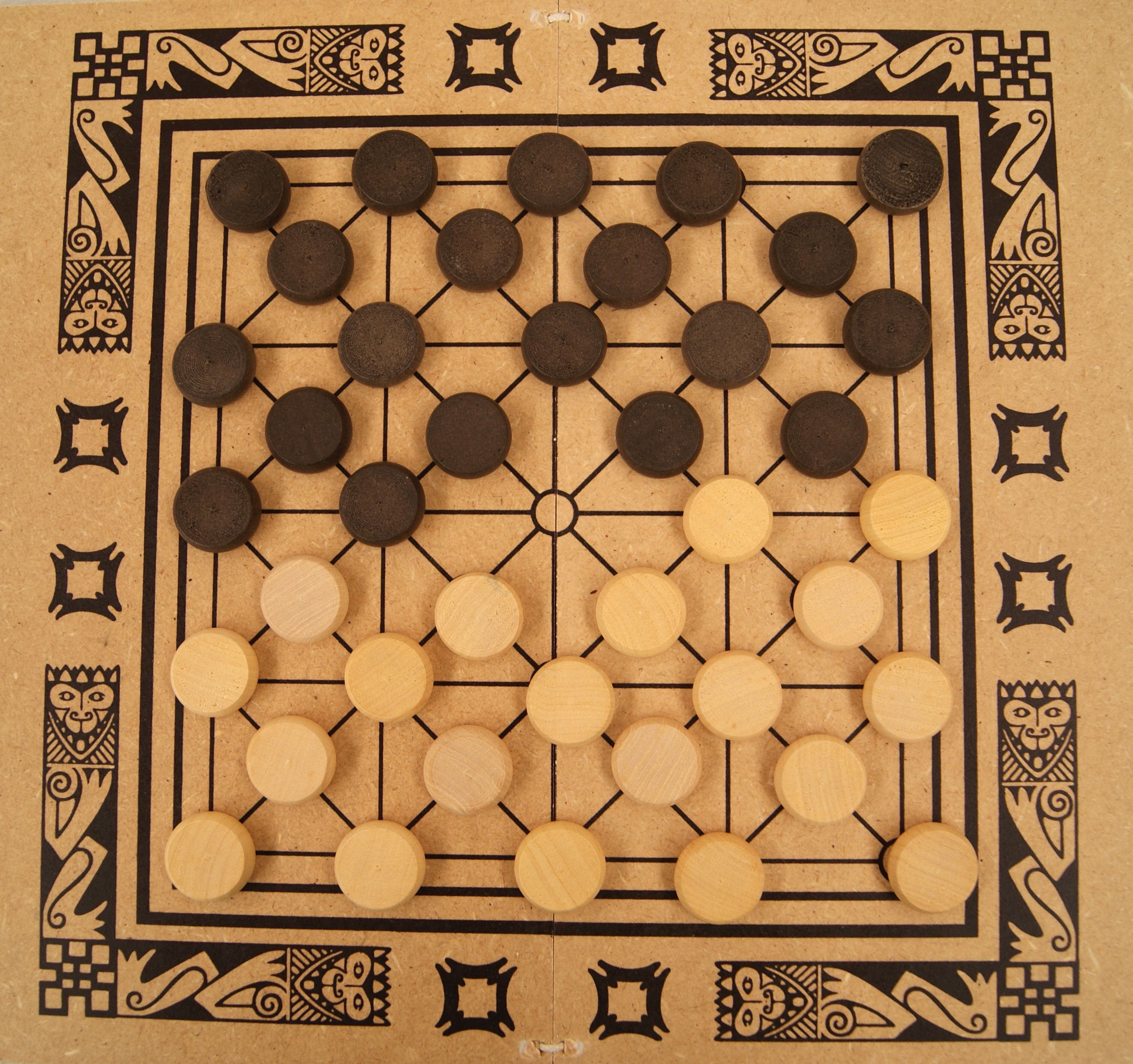
If you enjoy the mental challenge of chess or checkers but are looking for something with a different twist, Kharbaga is the perfect choice. This game is a close relative of the Zamma family and is very popular in Morocco. At first glance, it looks like a standard checkers game, but the secret lies in the board's layout. While other similar games limit diagonals, Kharbaga does the opposite: it reduces orthogonal lines and opens up far more diagonal movements. This completely shifts the game dynamics, giving players a freedom of movement that makes the game surprisingly complex, despite having a limited number of squares.
The mechanics are straightforward: you move your pieces to empty adjacent points. If an opponent's piece is in the way and the space directly behind it is vacant, you are forced to jump and capture it. Interestingly, if you can make multiple captures in a single sequence, you must choose the path that captures the most opponent pieces. When one of your pieces manages to cross the entire board and reach the last rank, it is promoted to a 'Mullah' (or Sultan). The Mullah is the most powerful piece in the game, capable of moving and capturing in any direction, sliding across any number of squares, similar to the king in international draughts.
The ultimate goal is simple yet challenging: eliminate all of your opponent's pieces. The strategic depth comes from positioning management and anticipating mandatory jumps, which can be used to set traps. There are even variants regarding when the captured piece is removed from the board—either immediately or only at the end of the capturing sequence. It is a pure tactical duel with no luck involved, where victory depends entirely on who can better read the board and dominate the space.
The mechanics are straightforward: you move your pieces to empty adjacent points. If an opponent's piece is in the way and the space directly behind it is vacant, you are forced to jump and capture it. Interestingly, if you can make multiple captures in a single sequence, you must choose the path that captures the most opponent pieces. When one of your pieces manages to cross the entire board and reach the last rank, it is promoted to a 'Mullah' (or Sultan). The Mullah is the most powerful piece in the game, capable of moving and capturing in any direction, sliding across any number of squares, similar to the king in international draughts.
The ultimate goal is simple yet challenging: eliminate all of your opponent's pieces. The strategic depth comes from positioning management and anticipating mandatory jumps, which can be used to set traps. There are even variants regarding when the captured piece is removed from the board—either immediately or only at the end of the capturing sequence. It is a pure tactical duel with no luck involved, where victory depends entirely on who can better read the board and dominate the space.
Gallery
Box and component photos
Tap any photo to open fullscreen. Photos submitted by the community or publisher.
Best player count
BGG community vote
2
BEST
Soundtrack
Ambience suggested by Melodice
Loading playlist...
Where to Buy
Prices monitored daily
Finding best prices...
Prices unavailable at this time.
Price history — last 6 months (lowest new offer)
As an Amazon Associate I earn from qualifying purchases. Prices and availability subject to change.
Alert enabled!
Join the BoardGamesBot deals group
Get the best board game deals every day — without message spam.
Join the WhatsApp groupGame details
Mechanics, categories, families and credits
Mechanics
Categories
Families
Publisher
(Public Domain), (Web published), Mitra
Community
Data from BoardGameGeek
9owners
3wishlist
Frequently Asked Questions
Quick answers before you buy
How many players can play?
Kharbaga is an exclusive duel for 2 players.
Is it hard to learn?
Not at all! The basic rules are quite simple, similar to checkers, but the strategy to win is where the real challenge lies.
How long does a game last?
Time varies based on player skill, but games are generally fast-paced and intense.
Is there luck involved or is it pure strategy?
Pure strategy. There are no dice or cards; everything depends on your decisions and board reading.
What is a Mullah?
It is a promoted piece that reaches the opposite end of the board, gaining the ability to move and capture in any direction over any distance.
Other Games You'll Like
Based on mechanics and theme