How to Play Mirianth Wars
Ludofun · Board game · 2024What do you want to do now
Ask anything about Mirianth Wars: rules, setup, components, complexity, price, or whether it fits your group.
Video: How to Play
Start here, then follow the written guide
Step by step
Objective of the Game
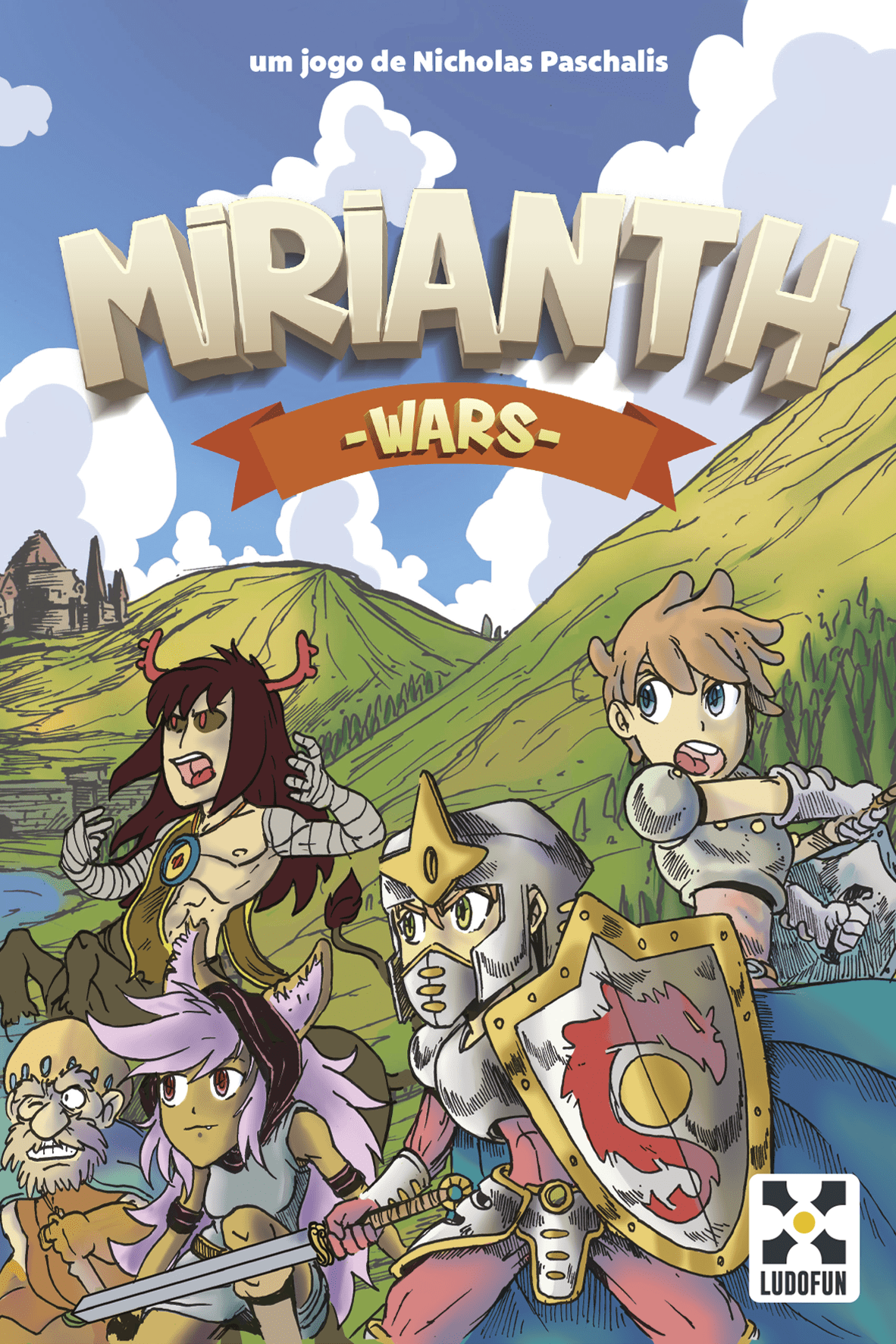
In Mirianth Wars, you are a leader in the kingdom of Mirianth, a land constantly at war with terrible monsters and divided nations. Your goal is to gather the best resources for your cause by negotiating with opponents and using diplomacy to secure the loyalty of the best warriors. You'll build your strategy based on balance, aiming to survive the coming winter. The player with the most points at the end of the game will be the winner.
Preparation (Setup)
- Separate and shuffle the Plague Cards to create a separate deck, known as the plague deck. Place it in the center of the play area within everyone's reach.
- Separate the other cards (Treasure Cards, Building Cards, Hero Cards, Monster Cards) according to the number of players, using the symbol on the lower right side of the cards. These form the draw deck. Unused cards are returned to the game box.
- Draw a specific number of cards from the draw deck: 10 cards for 2 players, 15 cards for 3 players, or 20 cards for 4 players. Shuffle this pile together with the “Last Round” card.
- Place the remaining cards from the draw deck on top of the pile containing the Last Round card. Place this combined draw deck in the center of the play area within everyone's reach. The draw deck is now ready for the start of the game.
Game Flow
A game of Mirianth Wars consists of three distinct phases:
- Negotiation Phase
- Resolution Phase
- Scoring Phase
Negotiation Phase
During this phase, players will perform consecutive rounds to acquire game cards that will be used in later phases. To start a new round, one player is chosen to reveal a number of cards from the draw deck equal to the number of players, placing them in the center of the playing area (e.g., 3 cards in a 3-player game).
Players can freely announce which of the revealed cards they intend to acquire for the current round, attempting to reach an agreement so that each player gets a different card. This ensures each player receives a card at the end of the current round.
If one or more players show interest in the same card, that card becomes a disputed card. Players can then trade freely within the game's limits. Allowed negotiations include: offering a previously acquired card, giving priority of choice in a later round, giving priority in choice when a certain card or card type is revealed in another turn, or swapping 2 cards for 1. Negotiations can only use game elements and decisions, and promises must be honored. Only participants of a negotiation are bound by it.
If players agree on a deal, the player(s) who gave up the disputed card must choose another available card for that round.
If players disputing a card cannot reach an agreement, they must perform a plague test. One player takes a number of Plague Cards equal to the number of players involved in the dispute minus 1. Without revealing their faces, these Plague Cards are shuffled together with the disputed card to form the deck of fate. It is recommended that multiple players shuffle these cards until everyone is satisfied. After shuffling, one card from the deck of fate is dealt to each player involved in the dispute, and they reveal their cards simultaneously. One player will receive the disputed card, while the other(s) will receive a Plague Card. A player who receives a Plague Card will not receive another card this round. Any card from the draw deck that was not drawn this round is discarded and placed back in the game box. Cards obtained in this phase can be placed next to the Kingdom Card in the indicated positions according to their type.
After all players have received a card (either from the draw deck or a Plague Card), players can choose to attach one of their “paladin” cards to a monster card.
The current round then ends, and a new negotiation round begins, continuing in the same way until the end of the Negotiation Phase.
When the “Last Round” card is revealed from the draw deck, set it aside and reveal a new card in its place for the current round. The Last Round will occur after the current round (the one in which the “Last Round” card was revealed), or in the round where it's not possible to reveal a number of cards from the draw deck equal to the number of players.
After the Last Round, the Resolution Phase begins.
Resolution Phase
In this phase, cards obtained during the Negotiation Phase are used and their effects are applied. The steps must be completed in the following order:
- Initial Accommodation
- Plague Effect
- Battles
- Final Accommodation
Each step must be fully completed before proceeding to the next.
Initial Accommodation
Each player verifies that they have enough accommodation for all their heroes. For every hero card a player owns, they need the same amount of accommodation guaranteed by their cards. If a player has less accommodation space than the number of heroes, they must discard 1 hero card for each hero without accommodation.
Plague Effect
Each player must discard 1 Hero card for each hero penalty symbol shown on their plague cards. Players can minimize these effects using “Priestess” and/or “Wall” cards if they have them. Note: Do not discard Plague cards if you also have the Necromancer Card, as they will be scored in the Scoring Phase.
Battles
Players use their surviving hero cards to battle monster cards they acquired during the Negotiation Phase (players can only battle monsters they acquired). Each player chooses one battle at a time, in their preferred order, and determines which hero cards will participate. In each battle, the attack value of the heroes is calculated. If this value is equal to or greater than the monster’s resistance, the monster is defeated. Defeated monster cards are placed in a pile next to the Kingdom Card at the indicated location and will be worth points in the Scoring Phase. Each hero card has a different way of battling, and some hero types cannot participate in more than one battle.
After all player battles, each surviving monster will make its attack and discard one card of each type shown on its penalty symbols (the symbol in the lower part of the card). After all surviving monsters have attacked, they are discarded and placed in the game box, ending the Battles step.
Final Accommodation
This step is similar to Initial Accommodation. Each player must verify if they have enough accommodation for all their heroes, comparing the amount of hero cards they have with the amount of accommodation remaining on their cards. The player must discard 1 hero card for each hero without accommodation. After this step, the Resolution Phase ends, and the Scoring Phase begins.
Actions and How to Play
Card Types and Effects
- Treasure Cards (white): Used for various purposes, some grant victory points.
- Building Cards (green): Provide accommodation and may grant victory points.
- Hero Cards (blue): Used to battle monsters, provide abilities, and grant victory points.
- Archer (ranged attack): Attacks only one monster and is not allocated to the target. Its target is announced at the start of the Resolution Phase. Its attack value varies depending on the total number of archers in the faction (1, 3, 5, and 8 attack for 1, 2, 3, and 4 archers, respectively), even those not battling the same monster.
- Builder: Gains 1 victory point for each building card in their faction during the scoring of Hero cards.
- King: Earns 1 victory point for each hero card (including the King card) in their faction, during scoring Hero cards.
- Mage (global attack): Attacks all of the player’s monsters. The attack’s value depends on the amount of monsters currently on the battlefield. If a monster is defeated or discarded, the Mage’s attack is decreased by 1. The Mage’s attack can be accumulated if the player has more than one Mage card.
- Miner: Gains 2 victory points for each Treasure card in their faction during scoring of Hero cards.
- Necromancer: Earns 1 victory point for each plague card in their faction, during scoring of Hero cards.
- Paladin (melee attack): Must first be allocated to a target during the Negotiation Phase to attack (only one paladin can be allocated per round). Paladins not tied to any targets cannot battle. Their attack value ranges from 2 to 5.
- Peddler (1 VP) / Merchant (2 VP): If there is a card in dispute during the Negotiation Phase, the player with the Peddler or Merchant card can use its effect to decide who gets the disputed card. The player must then deliver the Peddler (or Merchant) card to a player who participated in the dispute.
- Priestess (1 VP): Can be discarded to cancel two character penalties in the “Plague Effects” or “Battles” steps. This effect cannot be split into more than one Resolution Phase step.
- Rogue (2 VP): During the Battles step of the Resolution Phase, the player may discard the Rogue card to also discard a monster card of their choice. The player will not receive the discarded monster’s penalties, but also will not receive the discarded Rogue’s victory points.
- Saboteur (1 VP for owner & -2 VP for neighbors): In the Scoring Phase, when scoring Heroes, players sitting next to the player who has the Saboteur lose 2 victory points.
- Squire: Increases the attack value of all their melee heroes by 1.
- Monster Cards (red): Have a stamina value, victory points for defeating them, and penalty symbols (discard hero card / discard construction card / discard treasure card) if not defeated.
- Plague Cards (purple): Indicate the amount of character penalties the player suffers in the Plague Step of the Resolution Phase (0 to 2 penalties - discard hero card).
- Last Round Card: Triggers the end of the Negotiation Phase.
- Kingdom Card (player aid): Used to organize cards.
Specific Card Details
- Barracks: Provides 3 accommodation.
- Cabin: Provides 3 VP & 1 accommodation.
- Castle: Provides -2 VP & 4 accommodation.
- Diamond: Gains 1 victory point for each Monster card defeated in their faction, during the scoring of Treasure cards.
- Emerald: Provides 2 VP.
- Gold: Gains 1 victory point for each different defeated monster card in their faction, during scoring treasures cards.
- Palace: Provides 1 VP & 3 accommodation.
- Ruby: Provides 1 VP.
- Temple: Provides 2 VP & 2 accommodation.
- Village: Provides 2 accommodation.
- Wall: Can be discarded to cancel any penalty in the “Plague Effects” or “Battles” steps.
End of Game and Scoring
The game ends after the Resolution Phase is completed. The Scoring Phase then begins.
In the Scoring Phase, all players calculate the victory points (VP) their remaining cards have granted them. Each player must follow these steps in order:
- Heroes: Gain the victory points indicated on the hero cards.
- Buildings: Gain the victory points indicated on the building cards.
- Treasures: Gain the victory points indicated on the treasure cards.
- Monster Defeated: Gain the victory points indicated on the monster cards that were defeated by the player.
Add up all the victory points received. The player with the most points is the winner of the match.
In the event of a tie, the player who defeated the most monsters wins. If the tie persists, the tied players share the victory.
Some cards directly indicate their victory point value (the value inside the symbol). Other cards indicate victory points that are calculated based on variables existing at the time of the Scoring Phase.
Tips for Winning
- Focus on balancing your strategy between acquiring resources and ensuring you have enough accommodation for your heroes to survive the Resolution Phase.
- Utilize negotiation effectively during the Negotiation Phase to acquire desired cards and avoid plague tests, or to gain an advantage by offering previously acquired cards or future priorities.
- Strategically allocate your Paladins during the Negotiation Phase to specific monster cards, as unallocated Paladins cannot battle.
Rules manual
Official PDF file
Frequently Asked Questions
Quick answers about the rules
What is the objective of Mirianth Wars?
How do you set up Mirianth Wars?
How do you play Mirianth Wars?
How does Mirianth Wars end, and how do you score?
What are some tips for winning Mirianth Wars?
Other Games You'll Like
Based on mechanics and theme