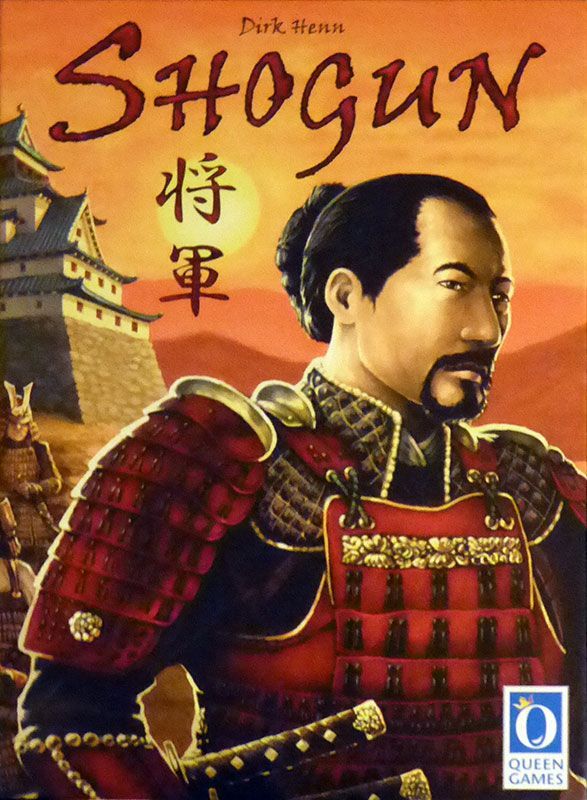
How to Play Shogun
Queen Games, Enigma (Bergsala Enigma), G3 · Board game · 2006What do you want to do now
Ask anything about Shogun: rules, setup, components, complexity, price, or whether it fits your group.
Video: How to Play
Start here, then follow the written guide
Step by step
Game Objective
Welcome, future Shoguns! In *Shogun*, you are feudal lords in 16th-century Japan, vying for supremacy to become the most powerful Daimyo and, ultimately, the great **SHOGUN**! To achieve this, you will need to expand your domain by controlling the most **provinces** and developing your kingdoms by building **castles**, **temples**, and **Noh theaters**. The player who builds the most buildings in each of the 5 regions of Japan will be rewarded with valuable bonus points. Victory will be yours if, at the end of two years of play, you have the highest amount of **victory points**!Setup
Let's set up the table and prepare the battlefield!- Choose Board Side: Decide whether you will play on the sun or moon side of the **Game Board**. The **Province Cards** from the unchosen side are returned to the box. If there are 3 players, 8 provinces marked with a light border on the board will not be used, and their corresponding cards are also returned to the box.
- Player Materials: Each player chooses a color and takes:
- An **individual player board**.
- 62 **colored cubes** (their troops).
- A **Daimyo Card**.
- A set of 5 **War Chest Cards** (with values from 0 to 4 chests).
- **War Chests** (the game's currency):
- With 3 players: 18 chests.
- With 4 players: 15 chests.
- With 5 players: 12 chests.
- Claiming Starting Provinces:
- Shuffle the **Province Cards** and place them face down. Flip 2 cards face up.
- Each player places the indicated number of troops on their **individual player board** (7 to 9 areas, depending on the number of players). These troops form small groups.
- Starting with the oldest player and in turns, each player chooses 1 of the 2 face-up province cards or the top card of the deck. They transfer a group of troops from their individual player board to the chosen province on the game board. The chosen province card goes into the player's hand.
- Tip for Newcomers: If you prefer a predetermined starting setup, use the tables in the Supplement for the sun side of the board.
- This process continues until all initial troops of all players are on the board. The remaining province cards (unowned) are placed within everyone's reach.
- After this, each player flips their **individual player board** to the side showing the action spaces. Any remaining troops form their individual reserve.
- Victory and Rice Markers: All players place their **Victory Markers** on the "0" space of the **score track** and their **Rice Markers** on the lowest level of the **supply track**.
- Loading the Battle Tower: Seven **colored cubes** from each player and 10 **green cubes** (armed/neutral farmers) are thrown together into the **Battle Tower**. Troops that fall out of the tower return to their respective players. Farmers that fall out return to the general supply.
- Event Cards: Shuffle the **Event Cards** and place them face down. Flip 4 cards face up and place them next to the board. They will indicate the events of the next 3 rounds and the rice cost in winter.
- Action and Special Cards: The **Action Cards** and **Special Cards** are placed face down within everyone's reach.
- War Chests: The remaining chests (after initial distribution) form the general supply.
The Game Turn
The game unfolds over 2 years, each with 4 rounds: Spring, Summer, Autumn, and Winter. The first three rounds follow the same sequence:Spring, Summer, and Autumn (The First 3 Rounds)
- Arrange Action Cards: Shuffle the 10 **Action Cards**. Reveal the first 5 one by one and place them in spaces 1 to 5 at the bottom of the board. The remaining 5 are placed face down in spaces 6 to 10. The order of these cards determines the sequence of actions in the round.
- Arrange Special Cards: Shuffle the 5 **Special Cards** and place them face up in the 5 marked spaces on the board. Each special card grants a privilege and determines a position in the turn order.
- Planning Individual Actions and Bidding for Turn Order:
- Simultaneously and secretly, each player decides how they will distribute their 10 actions among the provinces they control. For each action they wish to perform, the player chooses one of their **Province Cards** and places it face down in the corresponding action space on their **individual player board**.
- If a player does not want to perform a specific action or does not have enough province cards, they can leave the space empty or place one of their **War Chest Cards** face down (which will be ignored).
- Additionally, each player makes a secret bid for turn order and the special privilege. They choose one of their **War Chest Cards** or a **Province Card** and place it face down in the bid space on their **individual player board**. Offering a province card means not paying chests, but it reveals to opponents that that province cannot be used for actions this round.
- Determine the Event: Shuffle the remaining **Event Cards** (2, 3, or 4, depending on the round). Flip one card face up and place it in the event space. This card shows the event that will affect all players' actions this round. Remember: first the event is applied, then the special card.
- Determine Turn Order:
- Players reveal their bids for turn order and pay the chest value to the bank (if they bid with a chest card).
- In bid order (from highest to lowest), each player chooses their position in the turn order by taking one of the **Special Cards** and placing their **Daimyo Card** in its place. Remaining special cards are removed.
- In case of a tie in bidding, the tied players shuffle their **Daimyo Cards** and draw them in sequence to determine the order.
- Execute Actions: Actions are executed in the order in which the **Action Cards** are arranged on the board (from 1 to 10).
- First, players who bid with a **Province Card** perform their actions.
- Then, players who bid with **War Chest Cards** perform their actions, starting with the highest bid.
- Finally, players who did not bid cards (due to lack of provinces) perform their actions.
- Each action is executed by all players before the next action is performed. Players reveal their **Province Cards** when it is their turn to execute the action.
- If a player cannot perform a specific action, they ignore it.
- The Actions:
- Build a Castle: Pay 3 chests, place 1 **Castle** in a province you own.
- Build a Temple: Pay 2 chests, place 1 **Temple** in a province you own.
- Build a Noh Theater: Pay 1 chest, place 1 **Noh Theater** in a province you own.
- Confiscate Rice: Receive the number of rice units shown on the chosen province card. Move your **Rice Marker** up on the **supply track**.
- Collect Taxes: Take the number of war chests shown on the province card from the supply.
- Place 5 troops: Pay 3 chests, place 5 troops from your reserve in the chosen province.
- Place 3 troops: Pay 2 chests, place 3 troops from your reserve in the chosen province.
- Place 1 troop/Move troops: Pay 1 chest, place 1 troop from your reserve in the chosen province. Additionally, you can move troops from this province to one of your adjacent provinces (without combat).
- Combat/Move -A-: Move troops from the selected province to an adjacent one. If the destination province is not yours (neutral or another player's), a battle begins.
- Combat/Move -B-: The same Combat/Move -A- rules apply.
- After all 10 actions have been performed by all players, the **Province Cards** are removed from the individual player boards. The **Daimyo Cards** are collected and the **Special Cards** returned. The **Event Cards** from this round are removed. The **Action Cards** are re-shuffled for the next round.
Winter Round
If the round that just ended was Autumn, then it's time for winter, which brings rice losses, possible revolts, and scoring!- Supplying Provinces with Rice:
- The fourth **Event Card** (the last remaining one) shows how many units of rice each player must decrease. Move your **Rice Markers** down on the **supply track**.
- Each player must have one unit of rice for each of their provinces. If not, 1 or more revolts occur in their kingdom.
- The **Supply Table** on the board determines the number of provinces with revolts and their power. The player to the left of the affected player randomly draws **Province Cards** from the latter's hand to determine where the revolts occur.
- In case of a revolt, the player removes their armies from the province and places them in the **Battle Tower** along with farmers (1 for each **revolt marker** in the province, plus additional ones from the supply table).
- Revolts: (See "Resolving Battles" below for details).
- Scoring: Players gain **victory points** as follows:
- For each **Province** controlled: 1 VP.
- For each **Building** (Castle, Temple, Noh Theater): 1 VP.
- For having the most **Castles** in a region: 3 VP.
- For having the most **Temples** in a region: 2 VP.
- For having the most **Noh Theaters** in a region: 1 VP.
- Year Restart: After scoring, 4 new **Event Cards** are revealed, all **Rice Markers** return to 0, and all **Revolt Markers** are removed from the provinces. Four more rounds take place (Spring, Summer, Autumn, and Winter), culminating in the second and final scoring round.
Resolving Battles
Battles occur in three situations:- Combat between players: You move troops into another player's province.
- Invading a neutral province: You move troops into a province without enemy troops.
- Farmer revolt:
- You collect rice or taxes from a province with at least one **revolt marker**.
- You cannot supply all your provinces with rice in winter.
All battles are fought with the **Battle Tower**. Throw all participating armies (attacker, defender, farmers) and all cubes already in the tower's tray into the tower. Some cubes will remain in the tower, others will fall into the tray, determining the outcome.
To determine the outcome, count the number of attacking and defending troops that fell into the tray. The side with more troops wins. Troops not participating in the battle are disregarded. If there are no **revolt markers** in the defender's province, farmers in the tray count for the defender. If the farmers win or there is a tie, all participating troops are removed, buildings and revolt markers are removed from the province, and the **Province Card** returns to the reserve.
In wars between players or neutral provinces, the player with fewer troops is defeated, and their troops return to the reserve. The winner also removes the same number of troops as the defeated from the tray and returns them to their reserve. The winner's remaining troops occupy the province, and they receive the corresponding **Province Card**. In case of a tie, all troops return to the reserve, and the province becomes neutral.
End of Game and Scoring
The game ends after the **second winter round**, with the final scoring. The player with the highest amount of **victory points** wins! In case of a tie, the player with the most **war chests** wins the game.Tips for Winning
- Manage Your Actions Wisely: Secretly planning your 10 actions is crucial. Think about the order of the visible **Action Cards** and try to anticipate the needs of your provinces. Don't be afraid to leave action spaces empty or use a **War Chest Card** if you don't have an ideal **Province Card** for the action.
- Region Control and Buildings: Remember that controlling the majority of a type of building in a region grants valuable bonus points. Keep an eye on your opponents and plan your constructions to dominate these majorities, especially **castles** (3 VP).
- Pay Attention to Events and Special Cards: **Event Cards** and **Special Cards** can change the game! Always consider the events revealed for the year when planning your actions. If you get a **Special Card** that aligns with your strategy (like "+1 War Chest" for collecting taxes), maximize that benefit.
More videos
More rules explanations from the community


Rules manual
Official PDF file
Frequently Asked Questions
Quick answers about the rules
What is the objective of Shogun?
How do you set up Shogun?
How does Shogun end, and how do you score?
What are some tips for winning Shogun?
Expansions
Published additional content

Other Games You'll Like
Based on mechanics and theme