Skat
(Public Domain), (Unknown), AG Müller (AGMüller) · Board game · 1810
3 · best 3
30 min
Weight 3.1/5
Buy
7.0
rating
Ludopedia
7.3
rating
BGG
Our Verdict
RECOMMENDED
If you love tense bidding and trick‑taking in a half‑hour session, Skat will hook you with its memory‑test and bluffing duel.
Highlights
- Intense bidding
- Three‑player only
- Quick rounds
- Multiple game modes
Keep in mind
- Steep learning curve
- Complex rules
- Ramsch can be brutal
Rules manual not indexed yet
Upload the PDF rulebook to ask questions about this game with AI.
About the game
What you do in a play session
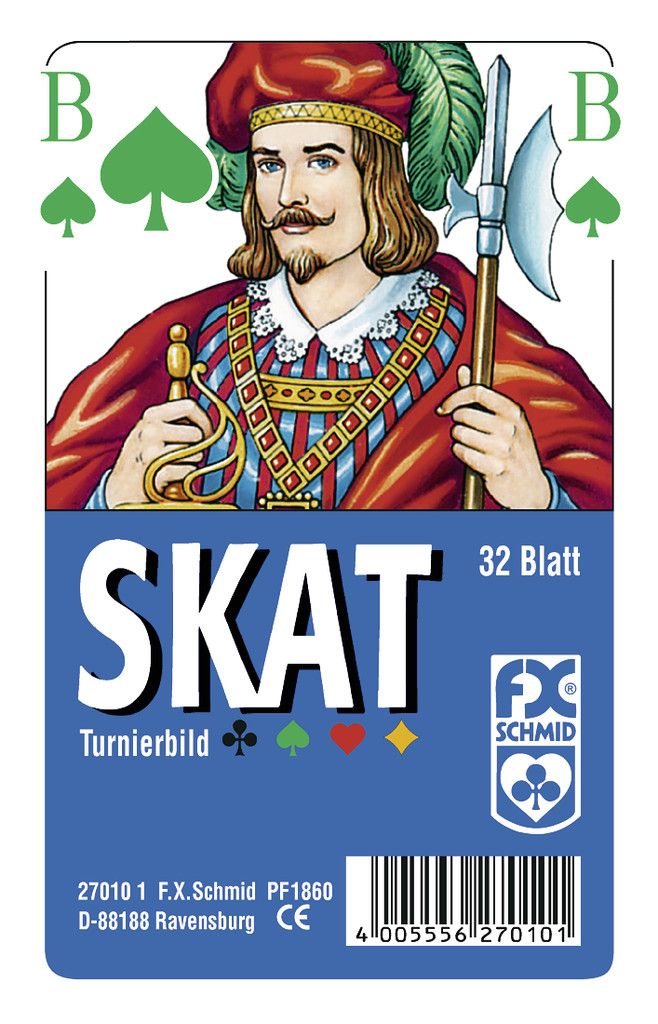
Skat is a classic German three‑player card game played with a standard 52‑card deck stripped of the 2‑6s. With roughly two centuries of history, it blends elements from Schafkopf, Ombre and Tarock, delivering a distinctive mix of bidding and trick‑taking. Each round consists of two phases: first, a "once‑around" auction where players, in turn, either bid or pass until one becomes the solo player and selects the game type – Suit (one suit plus Jacks as trumps), Grand (only Jacks), or Null (no trumps, solo must avoid taking any tricks). The second phase is the trick‑play; the solo tries to capture more than half the total card points, scoring the announced value if successful, while the two opponents each score double that amount if the solo fails. Advanced options include declaring margins (schneider, schwarz), playing "hand" (no card exchange), open play, and doubling the score with Kontra and Re. Unofficial variants add flavor, the most popular being Ramsch, triggered when no one bids; here the highest point total loses, often producing dramatic negative scores. Another variant, Revolution, lets the defenders exchange cards in an open Null. Skat’s rules solidified in the trenches of World War I, adopting many "trench" conventions now standard. The official tournament deck merges German‑style suit colors with French symbols to suit different regions. A typical game lasts about 30 minutes, carries a medium weight (3/5), and holds a BGG rating of 7.3. Skat appeals to players who love deep strategy, subtle bluffing, and quick rounds, but it demands careful attention to the bidding process and point calculations. It’s perfect for groups that enjoy temporary team dynamics and testing their memory and opponent‑reading skills.
Gallery
Box and component photos
Tap any photo to open fullscreen. Photos submitted by the community or publisher.
Rules videos
Learn by watching before you open the box
In English

Best player count
BGG community vote
3
BEST
Soundtrack
Ambience suggested by Melodice
Loading playlist...
Where to Buy
Prices monitored daily
Finding best prices...
Prices unavailable at this time.
Price history — last 6 months (lowest new offer)
As an Amazon Associate I earn from qualifying purchases. Prices and availability subject to change.
Alert enabled!
Join the BoardGamesBot deals group
Get the best board game deals every day — without message spam.
Join the WhatsApp groupGame details
Mechanics, categories, families and credits
Mechanics
Categories
Families
Publisher
(Public Domain), (Unknown), AG Müller (AGMüller), AMIGO, ASS Altenburger Spielkarten, Beardshaker Games, Berliner Spielkarten, Bielefelder Spielkarten, Cartamundi, Castrol, Clicker Spiele, Coeur, Dino Entertainment, English Heritage, F.X. Schmid, Heinrich Schwarz & Co, Heraclio Fournier, Heritage Products Ltd, Heye Verlag, Ilsespiel, Kömmerling, Nürnberger-Spielkarten-Verlag, Pelikan, Piatnik, Solvay S.A., Teepe Sportverlag, Trienekens R+T Entsorgung, TS Spielkarten, Underberg, The United States Playing Card Company, VEB (Volkseigener Betrieb) Spielkartenfabrik Altenburg, Verlag Neue Kritik
Designer
(Uncredited)
Artist
Christian Fiore, Erich Schmitt, Guillermo Mordillo, Günther Schmitz, Hein Gas, Kim Casali, Klaus Oliv, Loriot, Sven Hartmann, Wilhelm Hartung
Community
Data from BoardGameGeek
2,215owners
134wishlist
19want to play
Frequently Asked Questions
Quick answers before you buy
How many players can play?
Exactly three players; there are no official variants for other player counts.
How long does a game take?
Around 30 minutes, depending on the players' familiarity with the rules.
Do I need any special components?
Just a standard 52‑card deck with the 2‑6s removed. Tournament decks combine German suit colors with French symbols.
Is the game hard for beginners?
The learning curve is moderate to steep; bidding and point counting require focus, but the core trick‑taking is straightforward.
Which variant should a newcomer try first?
Start with the basic game types (Suit, Grand, Null) without open play or margin declarations. Save Ramsch and doubling mechanics for later.
Other Games You'll Like
Based on mechanics and theme