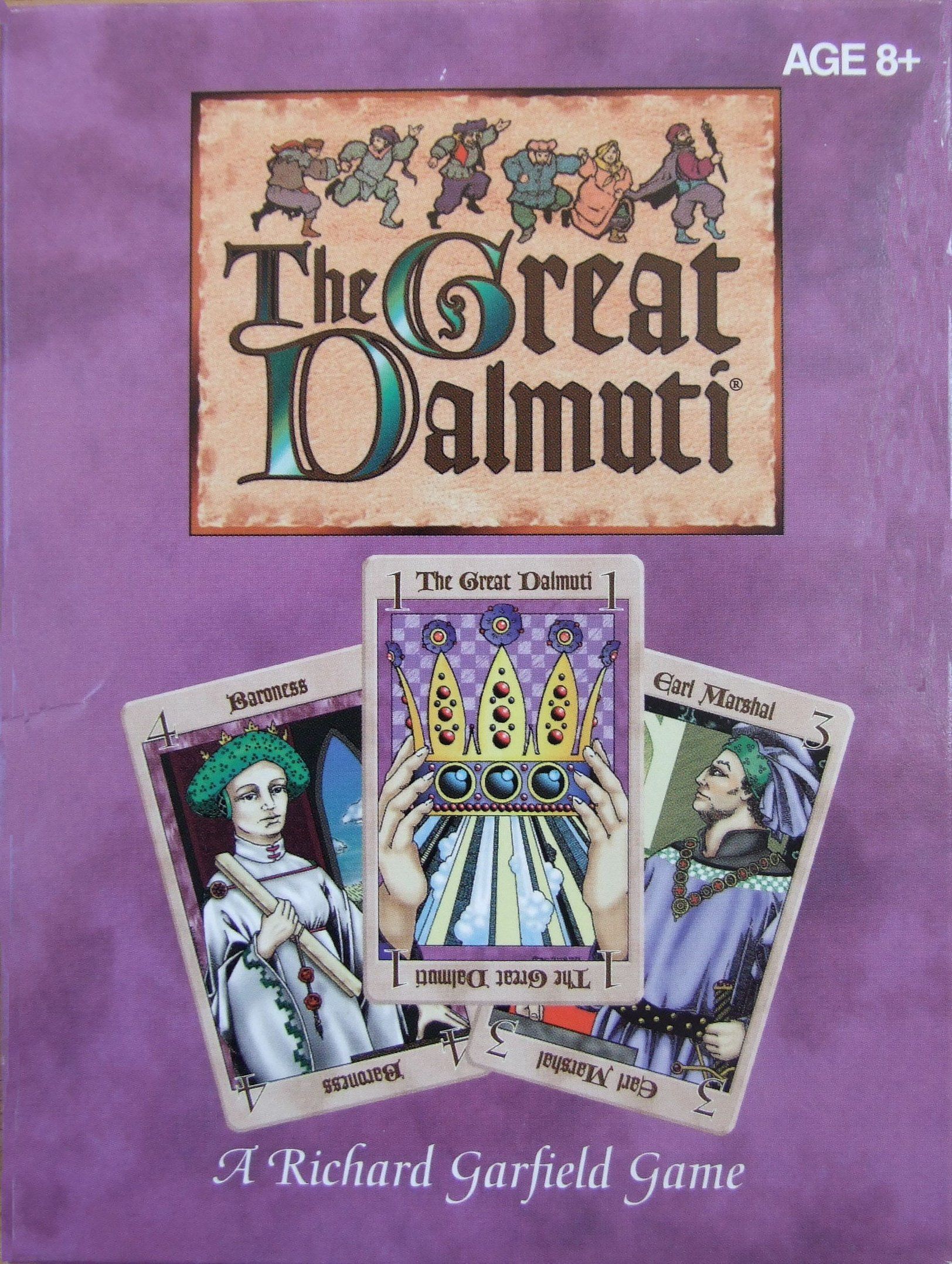
The Great Dalmuti
Wizards of the Coast, 999 Games, AMIGO · Board game · 1995
4–8 · best 6
60 min
Weight 1.3/5
Buy · from US$ 8.30
7.3
rating
Ludopedia
6.6
rating
BGG
Our Verdict
RECOMMENDED
If you love quick, laugh‑filled games, you’ll enjoy the status‑climbing chaos of The Great Dalmuti.
Highlights
- Very simple rules
- Constant social interaction
- Fast‑paced rounds
Keep in mind
- Initial hand can favor the leader
- Luck‑dependent start
Rules manual not indexed yet
Upload the PDF rulebook to ask questions about this game with AI.
About the game
What you do in a play session
The Great Dalmuti is a light, laugh‑filled card game that turns every group into a status‑climbing showdown. The 80‑card deck is numbered 12 down to 1, plus two Jesters that act as wild cards. Each number not only shows rank (lower is better) but also tells you how many copies of that card exist – twelve 12s, eleven 11s, four 4s, and a single 1. After shuffling, the cards are dealt to 4‑8 players and the goal is to shed all your cards as fast as possible.
A round starts with the current top player (usually the Great Dalmuti) playing one or more cards of the same rank to the centre. In clockwise order, each player must match the number of cards played but with a higher rank (lower number). Jesters can be mixed with any set, serving as jokers. If a player can’t or doesn’t want to improve the play, they pass. When everyone passes, the pile is cleared and the last player to lay down cards leads the next round. When a player empties their hand, they become the Great Dalmuti for that round; the last person left becomes the ‘Peon’ or similar, depending on the variant. After each round, seats are rearranged to reflect the new hierarchy, and the cycle begins again.
The core mechanic is hand management: deciding which cards to discard and when to use the jokers can swing the entire flow. Ladder climbing adds a “move‑up‑the‑chain” tension that keeps every round competitive. Rules are tiny (under five minutes to learn) and rounds are quick, making it perfect for large groups, parties, or a fast filler between heavier games. The only drawback is that the initial deal can give the Dalmuti a head start, but the seat‑swap after each round usually balances things out. In short, The Great Dalmuti delivers laughs, social interaction, and the feeling of climbing the social ladder – all with a simple deck of cards.
A round starts with the current top player (usually the Great Dalmuti) playing one or more cards of the same rank to the centre. In clockwise order, each player must match the number of cards played but with a higher rank (lower number). Jesters can be mixed with any set, serving as jokers. If a player can’t or doesn’t want to improve the play, they pass. When everyone passes, the pile is cleared and the last player to lay down cards leads the next round. When a player empties their hand, they become the Great Dalmuti for that round; the last person left becomes the ‘Peon’ or similar, depending on the variant. After each round, seats are rearranged to reflect the new hierarchy, and the cycle begins again.
The core mechanic is hand management: deciding which cards to discard and when to use the jokers can swing the entire flow. Ladder climbing adds a “move‑up‑the‑chain” tension that keeps every round competitive. Rules are tiny (under five minutes to learn) and rounds are quick, making it perfect for large groups, parties, or a fast filler between heavier games. The only drawback is that the initial deal can give the Dalmuti a head start, but the seat‑swap after each round usually balances things out. In short, The Great Dalmuti delivers laughs, social interaction, and the feeling of climbing the social ladder – all with a simple deck of cards.
Gallery
Box and component photos
Tap any photo to open fullscreen. Photos submitted by the community or publisher.
Rules videos
Learn by watching before you open the box


Best player count
BGG community vote
4
OK
5
REC
6
BEST
7
BEST
8
BEST
Soundtrack
Ambience suggested by Melodice
Loading playlist...
Where to Buy
Prices monitored daily
Finding best prices...
Prices unavailable at this time.
Price history — last 6 months (lowest new offer)
As an Amazon Associate I earn from qualifying purchases. Prices and availability subject to change.
Alert enabled!
Join the BoardGamesBot deals group
Get the best board game deals every day — without message spam.
Join the WhatsApp groupGame details
Mechanics, categories, families and credits
Mechanics
Categories
Families
Publisher
Wizards of the Coast, 999 Games, AMIGO, Devir, Enigma (Bergsala Enigma), Hasbro, Korea Boardgames, Lautapelit.fi, Play Factory, PS-Games, Swan Panasia Co., Ltd.
Designer
Richard Garfield
Artist
Anson Maddocks, Christophe Swal, Harry Conway, Margaret Organ-Kean, Sandra Garavito
Community
Data from BoardGameGeek
16,136owners
611wishlist
70want to play
Frequently Asked Questions
Quick answers before you buy
How many players can join?
4 to 8 players, making it great for larger groups.
How long does a game last?
A single round takes about 10‑15 minutes; a full session usually runs 45‑60 minutes.
What is the complexity level?
Very low – the rules can be taught in under five minutes.
What components are included?
An 80‑card deck (numbers 12‑1) plus two Joker cards called Jesters.
Who is the game best for?
Anyone who enjoys light, social, and laugh‑heavy games; perfect for parties and families.
Are there official variants?
Yes, themed versions like Dilbert: Corporate Shuffle exist, but the core mechanics stay the same.
Do I need a big table?
Just enough space for a central pile and each player’s hand.
Other Games You'll Like
Based on mechanics and theme