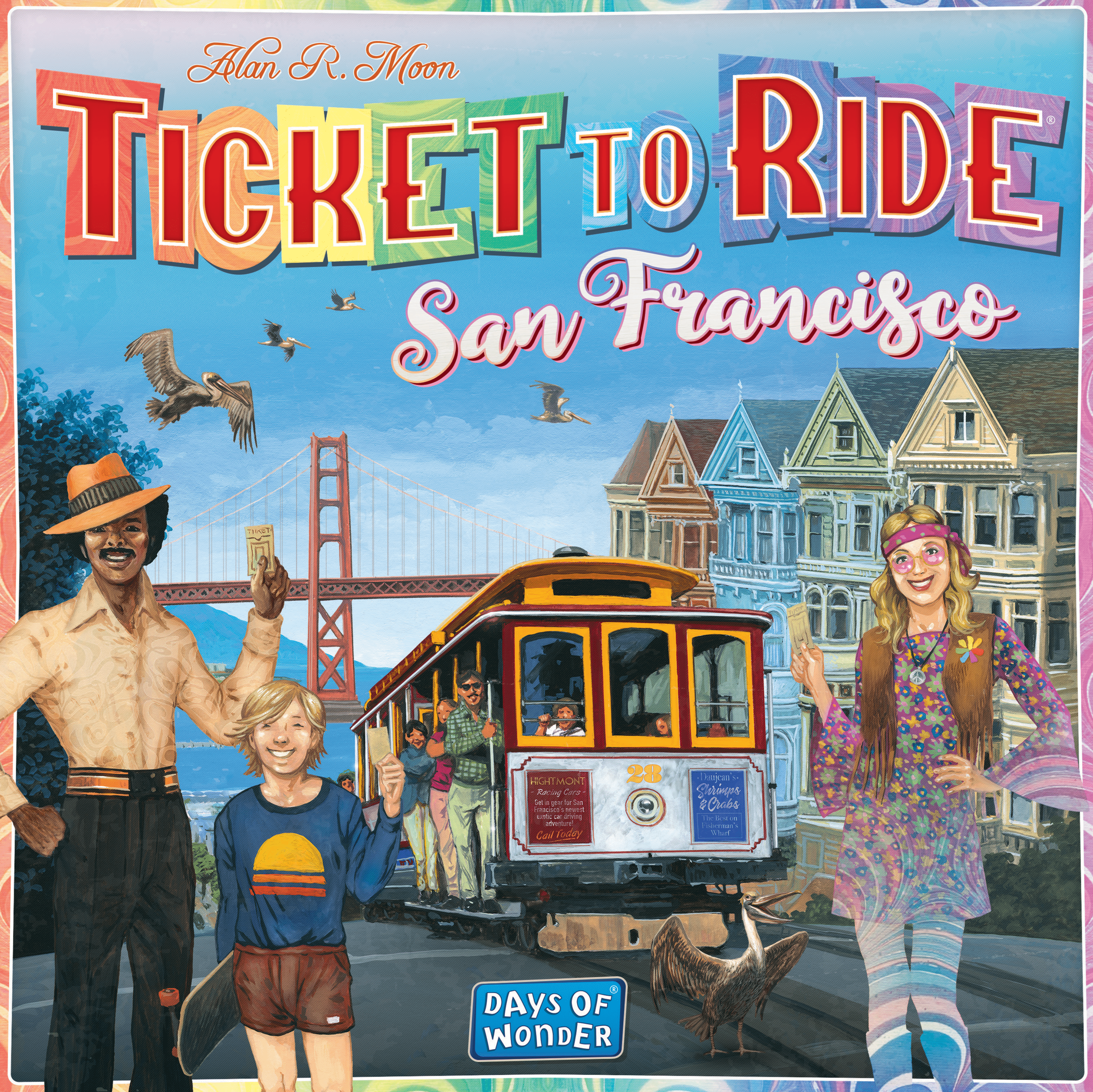
How to Play Ticket to Ride: San Francisco
Days of Wonder, ADC Blackfire Entertainment, Galápagos Jogos · Board game · 2022What do you want to do now
Ask anything about Ticket to Ride: San Francisco: rules, setup, components, complexity, price, or whether it fits your group.
Video: How to Play
Start here, then follow the written guide
Step by step
Game Objective
In Ticket to Ride: San Francisco, the objective is to be the player with the most points at the end of the game. You earn points in several ways:
- By controlling a Route between two adjacent Locations on the board.
- By successfully completing a Continuous Path of Routes between the two Locations listed on your Destination Tickets.
- By collecting a set of different Tourist Tokens.
It's important to note that you also lose points for each Destination Ticket you fail to complete by the end of the game.
Setup
To start playing Ticket to Ride: San Francisco, follow these steps:
- Place the board in the center of the table.
- Each player takes a set of colored Cable Cars and their corresponding Scoring Marker, placing it on space 0 of the Score Track.
- Stack the Tourist Tokens by symbol and place one stack on each of the following 5 Locations on the map: Alcatraz, Golden Gate Bridge, The Embarcadero, Sunset, and Potrero Hill (identified by red dots). Keep the remaining two stacks aside for now.
- The number of Tourist Tokens in each stack depends on the number of players:
- 3 Tokens in four-player games.
- 2 Tokens in two or three-player games.
- The number of Tourist Tokens in each stack depends on the number of players:
- Shuffle the Transport Cards and deal a starting hand of two cards to each player. Place the remaining Transport Cards pile next to the board and turn the top five cards face up. If, when doing so, three of the five face-up cards are Ferry cards, immediately discard all five cards and turn five new cards face up to replace them.
- Shuffle the Destination Tickets and deal two to each player. Each player looks at their Destination Tickets and decides which ones they want to keep. Each player must keep one card, but may keep both. If they choose to keep only one, the returned card is placed at the bottom of the Destination Tickets pile. Then, place this pile next to the board. Players should keep their Destination Tickets secret until the end of the game.
- Randomly determine the first player. Turns will proceed clockwise, starting with that player.
- Before starting, in a three or four-player game, the last player takes one of the two saved Tourist Token stacks and places it on any Location that does not yet have a stack. Then the second to last player does the same with the last saved stack. In a two-player game, the second player places two stacks of only one token each on any two Locations that do not yet have stacks. This way, the board will have five stacks of two tokens and two stacks of one token.
- You are ready to begin!
Gameplay Flow
The game proceeds in turns, starting with the first player and continuing clockwise, until the end of the game. On your Turn, you must perform one (and only one) of the following three actions:
- Draw Transport Cards
- Claim a Route
- Draw Destination Tickets
Actions and How to Play
On your turn, you can choose one of the following actions:
Draw Transport Cards
Transport Cards correspond to the colors of the Routes on the board (blue, green, black, purple, red, and orange), except for Ferry cards, which are multicolored and serve as wildcards (they represent any color when claiming a Route). You can have any number of Transport Cards in your hand at any time.
This action allows you to draw two Transport Cards. You can take the top card from the deck (a blind draw) or take any of the five face-up cards. In this case, immediately replace it with the top card from the deck.
As an exception, if you draw a Ferry card as your first card, you cannot draw another one this turn. You also cannot draw a Ferry card as your second card.
If, at any time, three of the five face-up Transport Cards are Ferry cards, immediately discard all five cards and turn five new cards from the deck face up to replace them.
When the deck runs out, shuffle the discarded cards to form a new Transport Cards deck.
Claim a Route
A Route is a set of continuous colored spaces (in some cases, the spaces are gray) between two adjacent Locations on the map. To claim a Route, you must discard a number of cards from your hand equal to the number of spaces on the Route and place a Cable Car on each of those spaces.
- Most Routes require a specific set of cards. For example, a Blue Route must be claimed by discarding Blue Transport Cards. Gray Routes, on the other hand, can be claimed with a set of cards of any single color.
- You can claim any open Route on the board, even if it is not connected to a Route you already control.
- You cannot claim more than one Route per turn.
- If you do not have enough Cable Cars to place on each space of a Route, you cannot claim that Route.
- When claiming a Route, you immediately record the points you received, based on the Route Scoring Table printed on the board, and move your Scoring Marker on the Score Track accordingly. Tourist Tokens will be worth points at the end of the game.
Double Routes
Some Locations are connected by Double Routes (two Routes of the same length connecting the same Locations). The same player cannot claim both Routes of a Double Route.
Note: In two-player games, when one Route of a Double Route is claimed, the other cannot be claimed by the other player.
Ferries
Ferry Routes are special Routes connecting two adjacent Locations across a body of water. They are easily identifiable by the Ferry icon on one of the spaces that make up the route.
To claim a Ferry Route, the player must play one Ferry card for each Ferry symbol on the Route (on this map, one), and the usual set of cards of the corresponding color for the remaining spaces of the Ferry Route.
Tourist Tokens
If there is at least one Tourist Token on one of the Locations you just connected, take one Token, provided you do not already have one with that symbol. If there are Tourist Tokens on both connected Locations, you must choose which Tourist Token to take, following the same restriction. Tourist Tokens are kept in front of you, visible to all players.
If you do not already have the Tourist Token with that symbol, take it and place it in front of you.
Draw Destination Tickets
Each Destination Ticket shows two Locations and a point value. At the end of the game, you score the value of each completed Destination Ticket or lose the point value of any uncompleted Tickets.
To complete a Destination Ticket, you must connect the two Locations listed on the card by creating a continuous path of Routes that you control. You can have any number of Destination Tickets.
This action allows you to draw more Destination Tickets. To do this, draw two cards from the top of the Destination Tickets pile. You must keep at least one of these cards, but you can keep both if you wish. Any returned card must be placed at the bottom of the Destination Tickets pile.
You cannot discard a Destination Ticket after choosing to keep it.
If there is only one Destination Ticket in the pile, you can still perform this action, but you must keep the card.
Destination Tickets and their completion must be kept secret from other players until the end of the game.
End of Game and Scoring
The game ends when a player has two or fewer Cable Cars remaining in their supply. When this happens, each player, including the one who triggered the end of the game, gets one more final turn. After that, the game ends and players calculate their final score:
- Players should have already recorded the points received for claimed Routes. To ensure no errors were made, you can recount each player's Route points.
- Then, each player reveals all their Destination Tickets, adds the value of each completed card to their score, and subtracts the value of any card that was not completed.
- Finally, each player scores points for the Tourist Tokens they collected according to the following table:
- Tokens: 0, 1, 2, 3, 4, 5, 6, 7
- Points: 0, 1, 2, 4, 6, 9, 12
The player with the most points wins the game.
In case of a tie, the tied player who completed more Destination Tickets wins. If the tie persists, they happily share the victory.
Tips for Winning
Refer to the manual for details on this section.
Rules manual
Official PDF file
Frequently Asked Questions
Quick answers about the rules
What is the objective of Ticket to Ride: San Francisco?
How do you set up Ticket to Ride: San Francisco?
How do you play Ticket to Ride: San Francisco?
How does Ticket to Ride: San Francisco end, and how do you score?
What are some tips for winning Ticket to Ride: San Francisco?
Other Games You'll Like
Based on mechanics and theme