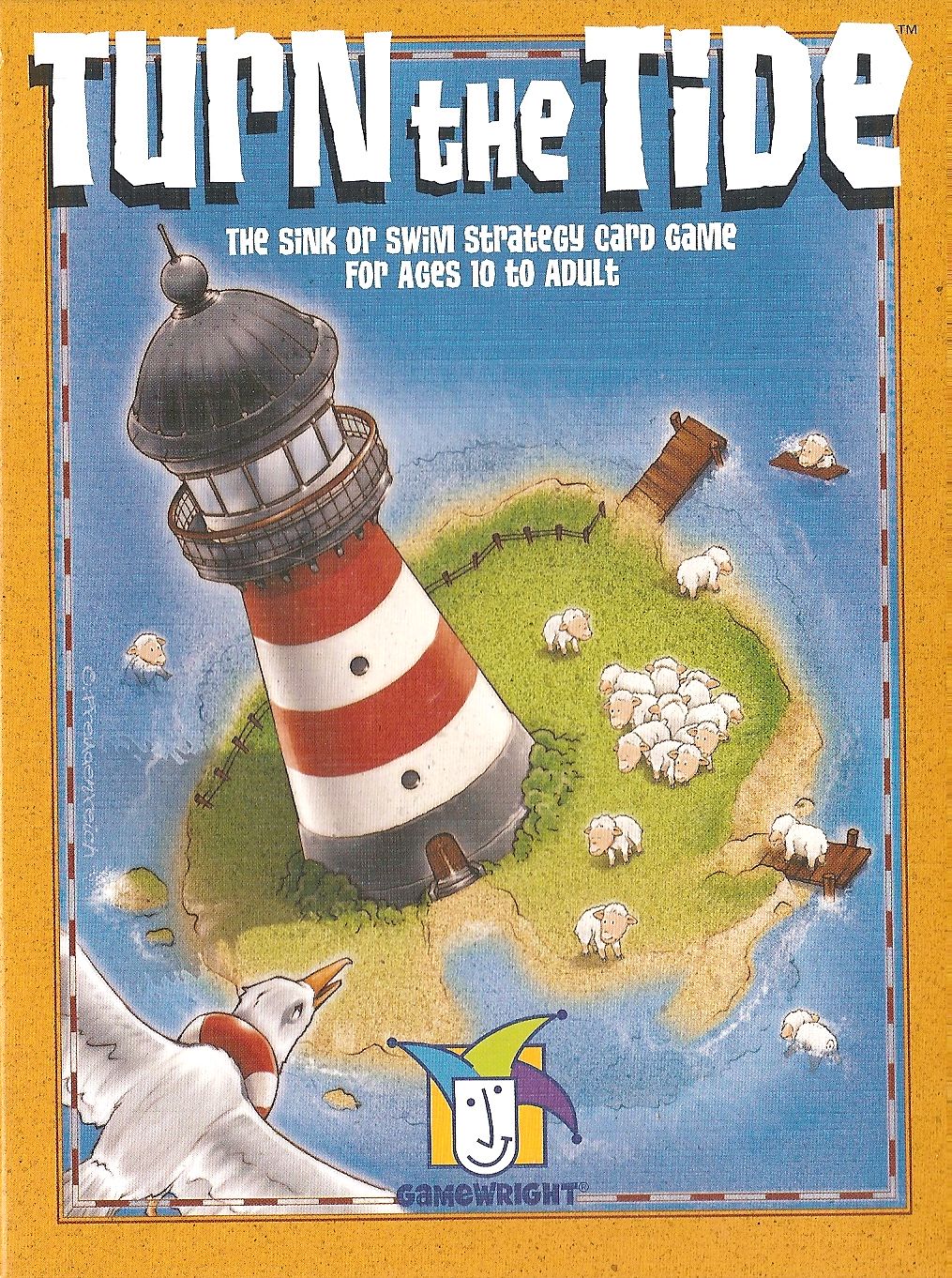
Turn the Tide — Price & soundtrack
999 Games, AMIGO, Arclight Games · Board game · 1997
3–5 · best 4
30 min
Weight 1.5/5
Buy · from US$ 8.50
7.4
rating
Ludopedia
6.8
rating
BGG
Our Verdict
RECOMMENDED
Perfect for those who love fast-paced card games with a bit of mischief and adaptive strategy.
Highlights
- Genial hand-passing mechanic
- Fast and fluid gameplay
- Easy to learn, hard to master
- High player interaction
Keep in mind
- Player elimination might frustrate some
- Heavily dependent on reading opponents
Rules manual not indexed yet
Upload the PDF rulebook to ask questions about this game with AI.
About the game
What you do in a play session
Ever played a card game that seems straightforward but leaves you racking your brain trying to predict your neighbor's next move? That's Turn the Tide. The premise is intriguing: you're dealt 12 cards and must use them to score points, but there's a cruel twist—at the end of each round, you pass your entire hand to the player on your left. This means you'll have to manage the exact same set of cards your opponent just used, challenging you to be smarter and extract more value from the same hand.
The core gameplay works like a secret auction. Two scoring cards are revealed on the table, and everyone chooses a card from their hand to reveal simultaneously. The highest value played takes the lowest scoring card, and the second highest takes the other. Sounds counterintuitive? That's where the strategy lies! You must manage your hand carefully so you don't burn through your high cards too quickly, while avoiding being stuck with useless cards at the end.
Adding to the tension are the marker cards. The player who leads the round gets to flip one of their markers (like lifesavers), which directly affects the final score. The game flows quickly, with dynamic rounds and that classic 'I should have played card X instead of Y' feeling. The game ends once every player has used every hand, and the highest total score wins. It's a blend of memory, bluffing, and adaptation, as your 'toolkit' changes every single round. It's perfect for those who enjoy light card games with a tactical layer that rewards reading your opponents' intentions.
The core gameplay works like a secret auction. Two scoring cards are revealed on the table, and everyone chooses a card from their hand to reveal simultaneously. The highest value played takes the lowest scoring card, and the second highest takes the other. Sounds counterintuitive? That's where the strategy lies! You must manage your hand carefully so you don't burn through your high cards too quickly, while avoiding being stuck with useless cards at the end.
Adding to the tension are the marker cards. The player who leads the round gets to flip one of their markers (like lifesavers), which directly affects the final score. The game flows quickly, with dynamic rounds and that classic 'I should have played card X instead of Y' feeling. The game ends once every player has used every hand, and the highest total score wins. It's a blend of memory, bluffing, and adaptation, as your 'toolkit' changes every single round. It's perfect for those who enjoy light card games with a tactical layer that rewards reading your opponents' intentions.
Gallery
Box and component photos
Tap any photo to open fullscreen. Photos submitted by the community or publisher.
Best player count
BGG community vote
3
REC
4
BEST
5
BEST
Soundtrack
Ambience suggested by Melodice
Loading playlist...
Where to Buy
Prices monitored daily
Finding best prices...
Prices unavailable at this time.
Price history — last 6 months (lowest new offer)
Alert enabled!
Join the BoardGamesBot deals group
Get the best board game deals every day — without message spam.
Join the WhatsApp groupGame details
Mechanics, categories, families and credits
Mechanics
Categories
Families
Publisher
999 Games, AMIGO, Arclight Games, Berliner Spielkarten, Dal Negro, DiceTree Games, F.X. Schmid, Fractal Juegos, Funbox Editora, Gamewright, Kikigagne?, Lifestyle Boardgames Ltd, Mercurio, Nasza Księgarnia, Neptuno Games, Nürnberger-Spielkarten-Verlag, Oya, Primigenio, PS-Games, Swan Panasia Co., Ltd., Wargames Club Publishing
Designer
Stefan Dorra
Artist
Franz Vohwinkel, Oliver Freudenreich, Sandra Freudenreich, Vanessa Gale Ambata
Community
Data from BoardGameGeek
7,988owners
752wishlist
156want to play
Frequently Asked Questions
Quick answers before you buy
Is the game complex to learn?
Not at all! The rules are very simple and can be explained in a few minutes, while the strategy emerges naturally as you play.
How long does a game last?
It's quite fast, usually lasting around 30 minutes, making it a great 'filler' between longer games.
How many players can play?
The game supports 3 to 5 players, making it ideal for small groups who enjoy direct interaction.
What happens when hands are swapped?
You take over the hand your neighbor just used. The challenge is to score more points with the same cards they had, proving you're the smarter strategist.
Is it suitable for children?
Yes, since it's a card game with simple rules and no complex text, it's a great way to introduce hand management mechanics to younger players.
Other Games You'll Like
Based on mechanics and theme