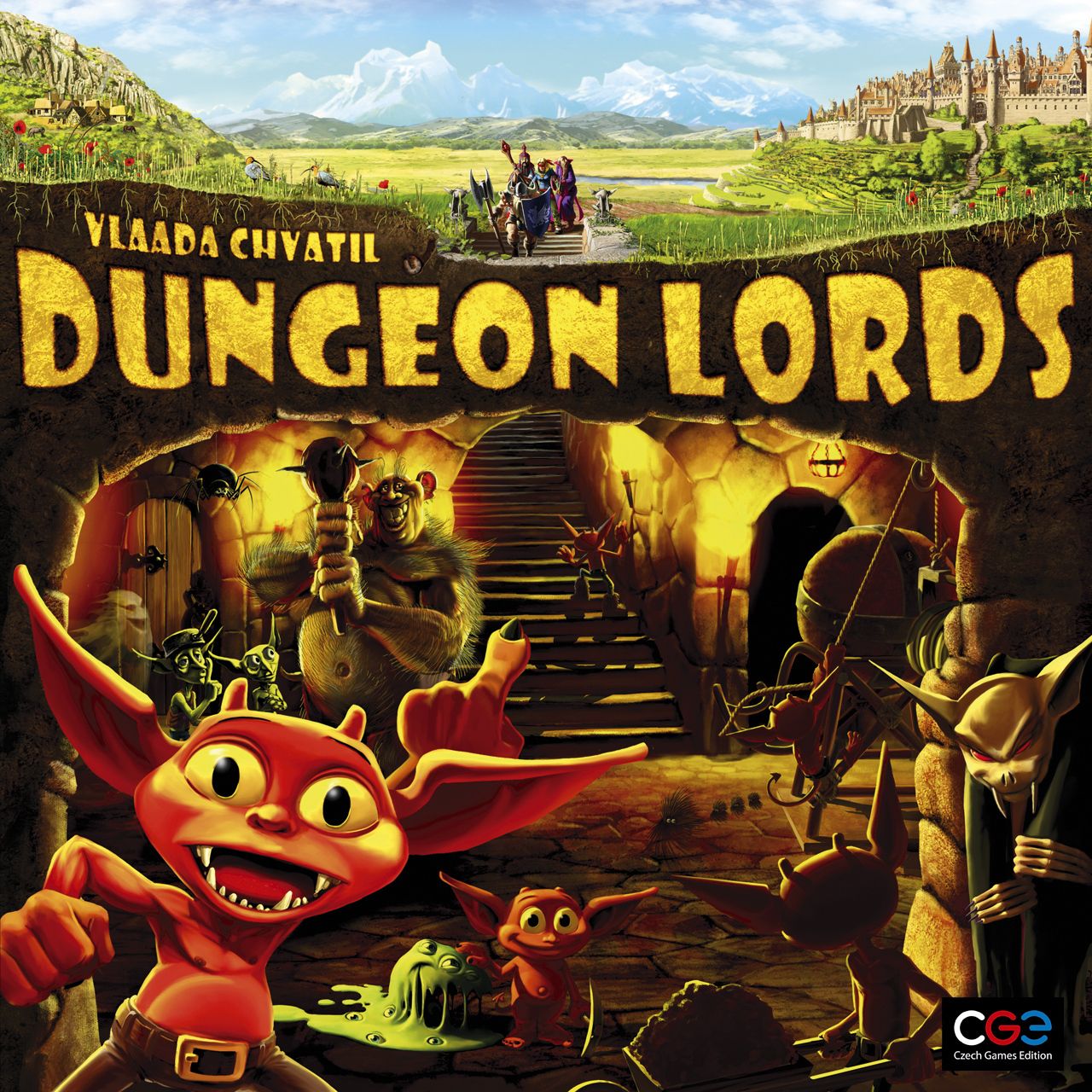
How to Play Dungeon Lords
Czech Games Edition (CGE), Giochi Uniti, Heidelberger Spieleverlag · Board game · 2009What do you want to do now
Ask anything about Dungeon Lords: rules, setup, components, complexity, price, or whether it fits your group.
Video: How to Play
Start here, then follow the written guide
Step by step
Game Objective
In Dungeon Lords, players take on the role of dungeon masters competing to build the most effective and sinister dungeon. The goal is to capture Adventurers and manage your resources to earn the most points. The player with the most points at the end of the game is declared the Underlord.
Setup
- Combat Cards: Deal 5 random 1st year Combat cards to the Central board and 5 2nd year cards to Distant Lands (with 2 Event cards on top and 2 beneath).
- Events: Place shuffled Events face-down.
- Evilometer: Put Evil counters on the start space. In a 2P game, add 1 non-player counter.
- Orders: Choose 2 of 3 random Orders as initially inaccessible. Choose 1 of 2 Dungeon Setup cards. In 2P/3P games, deal non-player(s) 3 random inaccessible orders.
- Starting Resources: Each player takes 3 Food, Imps, Gold, and Tunnels. Set up the dungeon and take the indicated imps, food, and gold.
- Items: Each player takes item tokens in their color.
Game Flow
The game progresses through a series of rounds divided into the following phases:
- New Round Phase: Draw 3 new Monsters and 2 Rooms. Discard any from the previous round. Except for the first round, replace one location with a Unique Opportunity. Except for the last round, draw Adventurer tiles (4 for 4P, 3 for 2P/3P), order them by power, reveal the Event tile and Unique Opportunity for the next round.
- Pet Phase (Round 1 Only): Draw 2 Pet cards, pass 1 unused pet to the left, and discard 1 unused pet, keeping the remaining face down.
- Orders Phase: Players choose and reveal Orders to place Minions and perform actions (detailed in the next section).
- Festival Phase (Round 5 Only): Set out Unique Opportunity boards. Players bid imps to determine order. Use the Unique Opportunity and get the pictured item. Players may also buy Rooms or Monsters from the discard pile for 1 gold (plus hiring cost for monsters).
- Production and Orders Retrieval Phase: Use Production Rooms with unused Imps or Troll tokens. Retrieve inaccessible Orders (take back the first played or one with a Minion; move others to Inaccessible Order spaces).
- Event Phase: Pay Day (pay for Monsters or gain 1 evil), Taxes (pay 1 gold per 2 dungeon tiles, ignoring rented rooms; gain a Red mark for unpaid gold), and resolve the Special Event card.
- Adventurers Phase: Reveal Items and assign them to matching Adventurers. Assign Adventurers to the Evilometer (least powerful goes to the lowest).
- End of the Round: Return all Imps to the Den and pass the Starting Player token to the left.
- Item Phase (Last Round Only): Give 1 Item to each player (and the opponent's non-player board in 2P). Reveal Items and return empty ones to the owner (except in 2P/3P).
Actions and How to Play
Orders Phase Actions
Players place Minions on Order cards to perform the following actions:
- Dig Tunnels: Create a new Tunnel adjacent to a previous Tunnel or Room. You cannot fill 2x2 blocks. One digger per tunnel. Gain treasures on the square. Hard rock requires the first imp to remove the rock; two imps can also dig the tunnel.
- Mine Gold: Each Imp can mine 1 gold per unconquered Tunnel (one miner per tunnel).
- Hire Monsters: Pay the cost and expertise cost to hire Monsters.
- Build Rooms: Replace unconquered Tunnels or place a rented room beside the Player Board. Two Rooms cannot be adjacent.
- Improve Tunnels: Choose to de-conquer a room, de-conquer a tunnel, or replace an unconquered tunnel with an improved tunnel.
- Install Trap: Choose 1 of 3 face-up traps and mark an unconquered tile. Pay the cost (+1 gold if in a room).
- Other Actions: Food, Improve Reputation [Masquerade], Hire Imps [Acquire Pet], Buy Traps, and Invest Gold.
Combat
Combat occurs when Adventurers enter the dungeon. It follows these steps:
- Planning Phase: Mark the unconquered tile closest to the entrance or rented room with a Minion. Place Traps and Monsters (limits vary by Tunnel or Room). Ghosts can be played in any number.
- Reveal Combat Card Phase: Reveal the Combat card.
- Battle Phase:
- Bard Step: Bards assign tokens to reduce damage.
- Traps Step: Reveal effects. Thieves reduce damage.
- Fast Spell: Triggered if on the Combat card and magic points are available.
- Monsters: Monsters attack and are then knocked out for the rest of the year.
- Slow Spell: Triggered if on the Combat card and magic points are available.
- Healing: Reduce damage if a Monster or Ghost attacked.
- Conquering: Party takes damage from the Combat card. If at least one Adventurer remains, they conquer the tile (flip it) and move down on the Evilometer.
End of Game and Scoring
The game ends after the specified rounds (e.g., 4 or 5 rounds depending on player count). Points are calculated as follows:
- Pets: +1 per unused pet.
- Dungeon Aspects:
- +2 per unconquered room (not rented).
- +1 per monster (0 per ghost).
- +2 per Adventurer in prison.
- +5 per Human Paladin, +4 per Elf Paladin, +6 per Dwarf Paladin.
- +1 per magic item in prison.
- -2 per conquered tile (rented room counts).
- -3 per red mark.
- Bonus Rooms: Points based on specific room types (e.g., 1 point per Troll/Goblin/Slime/Witch in specific rooms).
- Titles: +3 per exclusive title, +2 per shared title (2P: +2 exclusive, +1 shared). Titles include Dark Deeds (highest on Evilometer), Halls, Tunnellord, Monsterlord, Imps, Riches, and Battlelord.
- Hall of Fame: Points if owned.
- Dead Letter Office: If the total score is positive, +2 per Item in the Dead Letter Office.
The player with the most points wins and is declared the Underlord. All players with positive scores earn a Dungeon Lord License.
Tips for Winning
- Manage your Imps: Use Production Rooms to generate resources or recover Imps from rooms to cause extra damage during the Battle Phase.
- Strategic Trapping: Use installed traps in conjunction with regular traps to maximize damage, but remember that Thieves can reduce this damage.
- Paladin Management: Be aware that the Paladin moves toward the most evil player; eliminating a Paladin makes you ignored by other Paladins.
More videos
More rules explanations from the community


Rules manual
Official PDF file
Frequently Asked Questions
Quick answers about the rules
What is the objective of Dungeon Lords?
How do you set up Dungeon Lords?
How do you play Dungeon Lords?
How does Dungeon Lords end, and how do you score?
What are some tips for winning Dungeon Lords?
Expansions
Published additional content

Other Games You'll Like
Based on mechanics and theme