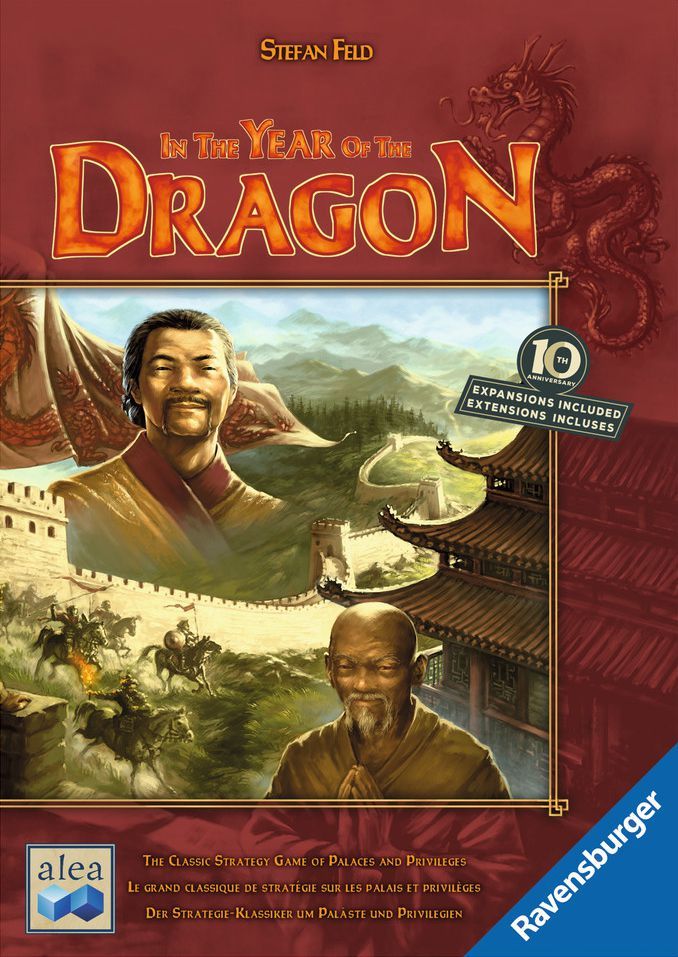
How to Play In the Year of the Dragon: 10th Anniversary
alea, Maldito Games, Ravensburger AG · Board game · 2017What do you want to do now
Ask anything about In the Year of the Dragon: 10th Anniversary: rules, setup, components, complexity, price, or whether it fits your group.
Step by step
Game Objective
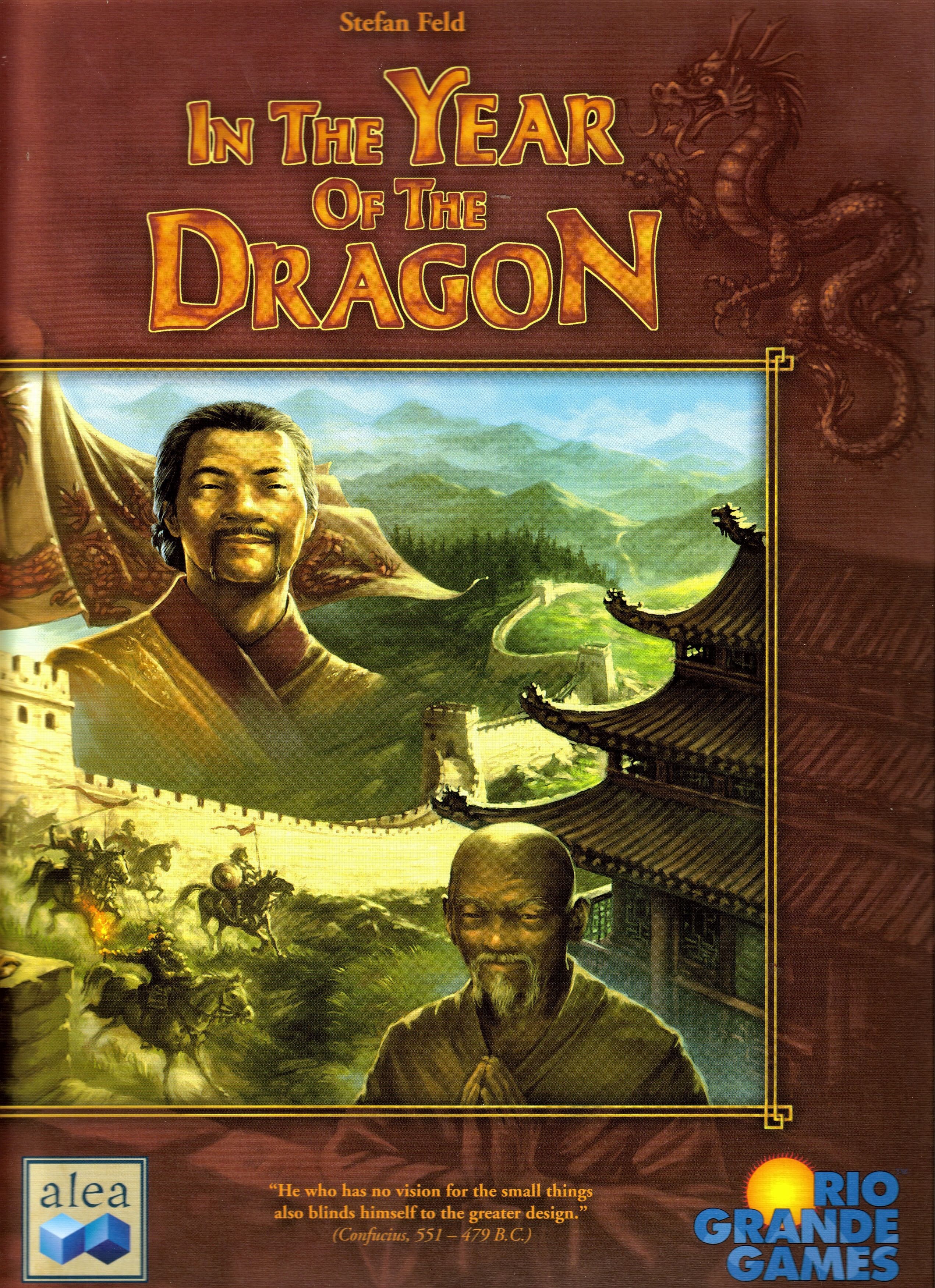
In In the Year of the Dragon: 10th Anniversary, you take on the role of Chinese nobles in 1000 A.D., seeking to maximize the prosperity and prestige of your provinces. To do this, you must rely on the talents of your courtiers, ranging from scholars and monks to warriors and artisans. These loyal subjects use their expertise to protect their rulers from the disastrous consequences and misfortunes that plague the populace month by month.
Whether it's drought, disease, or Mongol invasion, only foresight and planning can spare the nobles and their subjects from an unhappy end. The more players withstand the dangerous events, the more honor and victory points they will receive in the end. The player who best survives these difficult times will receive the most victory points and win the game.
Setup
Before the first game, carefully remove the tiles from their frames and place the dragons in their stands. Place the game board in the center of the table. Arrange the rest of the pieces as shown in the diagram.
Starting Components per Player:
- 1 personal marker (round), placing it on space 0 of the people track (the inner track in the middle of the board).
- 1 scoring marker (8-sided), placing it on space 0 of the scoring track (track on the edge of the board).
- 1 dragon (in a stand), placing it in each player's play area.
- 11 personal cards (of the player's chosen color), forming the player's hand. (Extra cards are only used to replace lost or damaged cards and otherwise remain in the game box.)
- 1 game summary.
- 4 palace floors, used to build 2 palaces with 2 floors each.
- 6 yuan (3 silver and 1 gold). Place the money next to the palaces for all to see. Players can exchange 1 gold coin for 3 silver coins from the supply at any time during the game.
Board and General Pieces Setup:
- People Pieces: First, separate these pieces by color, then sort them by "experience" level. Of the 9 types of pieces, 6 are divided by experience. For pieces divided this way, there will be 6 less experienced people (younger, with fewer symbols and higher values) and 4 more experienced people (with more symbols and a lower value). Place the older people in the first row (which contains two sections, each with space for 3 types of pieces). Then, place the corresponding pieces, with the younger people, below in the second row. The artisans (beige), court ladies (orange), and tax collectors (yellow) only come in the younger version; sort them into stacks by type and place them in the three middle spaces in the second row.
- Note for number of players: Only in a 5-player game will you place all 10 pieces of each type of person on the display. With fewer players, return 2 tokens of each type per player out of the game to the box (1 younger and 1 older for the tiles divided into these groups; and 2 younger for the others, i.e., artisans, court ladies, and tax collectors).
- Event Pieces: Locate the 2 peace pieces and place them face up in the first two spaces of the event track at the bottom of the board (containing 12 light-colored spaces). Shuffle the remaining 10 pieces face down, then randomly draw one at a time, placing them face up from left to right in the other 10 spaces on the event track. With the exception of the 2 peace pieces, there may not be 2 identical event pieces next to each other, so if you draw 2 of the same type in sequence, slide the second one to the next free space.
- The 7 Action Cards: Shuffle the 7 action cards and place them in a face-down pile in the middle of the board.
- General Supply: Sort the remaining coins, along with all other pieces (palace floors, rice tiles, fireworks tiles, privilege tiles) into a general supply above the board.
Start of Game - Initial People Summoning:
Before the game begins, all players must summon the first two people to court. The oldest player starts by taking 2 different pieces from the second row (i.e., the younger people). Clockwise, all other players choose their first 2 people pieces, following the same restrictions.
- Restrictions: Only younger people. Never 2 of the same type. No identical combination of 2 people can be chosen by more than one player.
- Place each person below any of your palaces. A 1-story palace can hold only 1 person; a 2-story palace can hold up to 2 people; and a 3-story palace can hold up to 3 people. A palace can never have more than 3 stories.
- Every time a player takes a new person and places them below a palace, the player must also immediately move their person marker forward on the person track the total number of spaces shown on the newly assigned person piece (values 1 to 6). If the marker lands on the same space as another player's, it is placed on top of that player's marker.
Game Flow
The game consists of exactly 12 rounds, representing the 12 months of the Year of the Dragon. Each round consists of the following 4 phases, in order:
- 1st Phase: Action
- 2nd Phase: Person
- 3rd Phase: Event
- 4th Phase: Scoring
1st Phase: Action
Shuffle the 7 action cards face down at the beginning of this phase. Then, place them, still face down, in the large central space of the board, in as many groups as there are players (e.g., if there are two players, they will be divided into two groups; if there are three players, three groups, etc.). The cards should be divided as evenly as possible. Then, flip the cards face up, making sure they are visible to everyone.
The player whose person marker is furthest ahead on the person track selects 1 group, places their dragon on it, and performs exactly 1 of the actions in the chosen group. Then, the player whose marker is second furthest on the person track does the same, and so on. This means that the player order is not determined by how players are seated, but rather governed throughout the game by the players' positions on the person track. If multiple person markers share a space, players alternate in top-to-bottom order.
- In player order, the other players take turns choosing a group of cards (a player can select a group that has already been chosen by a previous player), placing their dragons on them, and performing the action shown on any card in the chosen group (including an action taken by a previous player).
- Cost of Already Chosen Group: A player who chooses a group of cards already chosen by at least 1 other player in that round (i.e., there is at least 1 dragon on it) must pay 3 yuan (returning the appropriate coins to the general supply). If the player cannot pay 3 yuan, the player cannot place their dragon on that group.
- Alternative to Action: Instead of placing a dragon on one of the card groups and performing a corresponding action, a player can skip the first phase completely and instead take yuan from the supply until they have a total of 3 yuan.
- When all players have performed an action, players take back their dragons and place the action cards in a face-down pile in the intermediate space of the board.
2nd Phase: Person
After all players have performed an action or replenished their supply of yuan to 3, each player, in the order shown on the person track (which may have changed through the "Military Parade" action), plays 1 person card from their hand onto the common discard pile on the board. The player then takes the corresponding person piece from the board and places it below any of their palaces.
- If all palaces are full, the player can replace 1 of their existing person pieces. The displaced courtier is then "released from royal service." All people released in this way are removed from the game (meaning they are not placed in their pile on the board again!).
- Then, the player moves the person marker forward on the person track, the number of spaces equal to the value on the new person's piece.
- Notes:
- Person markers are never moved backward when a person is released (due to replacement or an event).
- Acquiring new person pieces does not entitle the player to immediately receive new rice pieces, fireworks pieces, money, victory points, etc. Instead, the pieces generate resources only through corresponding actions chosen in later action phases.
- A player who plays a card with a question mark can choose any piece from the board.
- If players have space in their palaces, they must summon new people to their court. If all palaces are full, and a player does not want to replace an existing courtier, the player can release the new person by removing the piece from the game. However, in this case, the player cannot move the marker forward on the person track.
- If a player plays a card showing a courtier whose piece is no longer available on the board, then that player receives nothing (i.e., does not receive a substitute person).
- In the 12th round, players skip the second phase because they will not have any person cards in their hands at that time.
3rd Phase: Event
After each player plays a person card, a monthly event occurs. In the first two rounds, the event is "Peace." In subsequent rounds, each month's event is dictated by the next event piece on the event track, from left to right. After the event concludes, flip the corresponding event piece face down.
There are 6 different types of events: Peace, Imperial Tribute, Drought, Mongol Invasion, Dragon Festival, and Disease.
- Peace: Nothing happens.
- Imperial Tribute: Each player must pay 4 yuan in honor of the emperor (placing the coins in the general supply). If a player does not have enough money, the player releases 1 person from any palace for each missing yuan.
- Note: Players cannot voluntarily release a person in an effort to save their money. Also, the coins depicted on players' tax collectors do not count for anything when paying tribute.
- Drought: Each player must return 1 rice piece to the supply for each of their palaces that has at least 1 person. If a player does not have enough rice pieces, the player must release 1 person from each palace that cannot be supplied (the affected player chooses which palace(s) will be unsupplied).
- Note: Players cannot voluntarily release a person in an effort to save rice pieces. Also, the rice depicted on farmers does not count for anything during a drought.
- Dragon Festival: The player or players with the most fireworks pieces receive 6 victory points, and the players with the second most receive 3 victory points. Then, scoring players must return half of their fireworks to the supply (rounding up when necessary).
- Note: If multiple players tie for first, they all receive 6 points, and second-place players still receive their points. Players who do not have fireworks pieces cannot score points. The rockets depicted on pyrotechnicians do not count for anything during dragon festival scoring.
- Mongol Invasion: Players move their marker on the scoring track a number equal to the total helmets of the warriors in their palaces. Additionally, the player or players with the fewest helmets must release 1 person from any of their palaces. (It can even be a warrior who was just counted.)
- Note: If all players have an equal number of helmets (including, for example, none), each must release one person from service.
- Disease: Each player must release 3 people of their choice from their palaces. Players can protect their provinces from the spread of disease through the services of their healers (blue). For each mortar represented on a player's healers, the player releases one fewer person.
General Rule for Releases: If multiple players are required to release courtiers from service at once, releases occur in player order as shown on the person track.
Decay: After an event occurs, players must check if they have uninhabited palaces. If so, each uninhabited palace must be reduced by one floor (returning the lost palace floors to the supply). Note that this can lead to the complete disappearance of an uninhabited one-story palace.
- Note: Because of this rule, there is no point in a player choosing the "Build" action to create a one-story palace without assigning a person to it in the next person phase!
4th Phase: Scoring
After the current event ends, and any uninhabited palaces have fallen into decay, players move their scoring markers forward on the scoring track, gaining 1 point for:
- each palace (regardless of whether they are inhabited or how many floors they have)
- each dragon on the fans of the court ladies (orange) and
- each dragon on the privileges.
The round is over and a new one begins.
Actions and How to Play
During the 1st Phase: Action, players choose a group of action cards and perform one of the available actions. The individual actions are:
Rules manual
Official PDF file
Frequently Asked Questions
Quick answers about the rules
What is the objective of In the Year of the Dragon: 10th Anniversary?
How do you set up In the Year of the Dragon: 10th Anniversary?
How do you play In the Year of the Dragon: 10th Anniversary?
Other Games You'll Like
Based on mechanics and theme