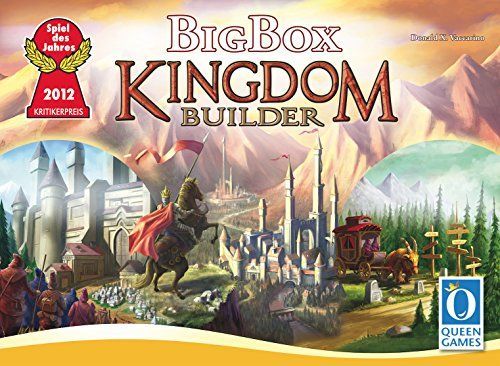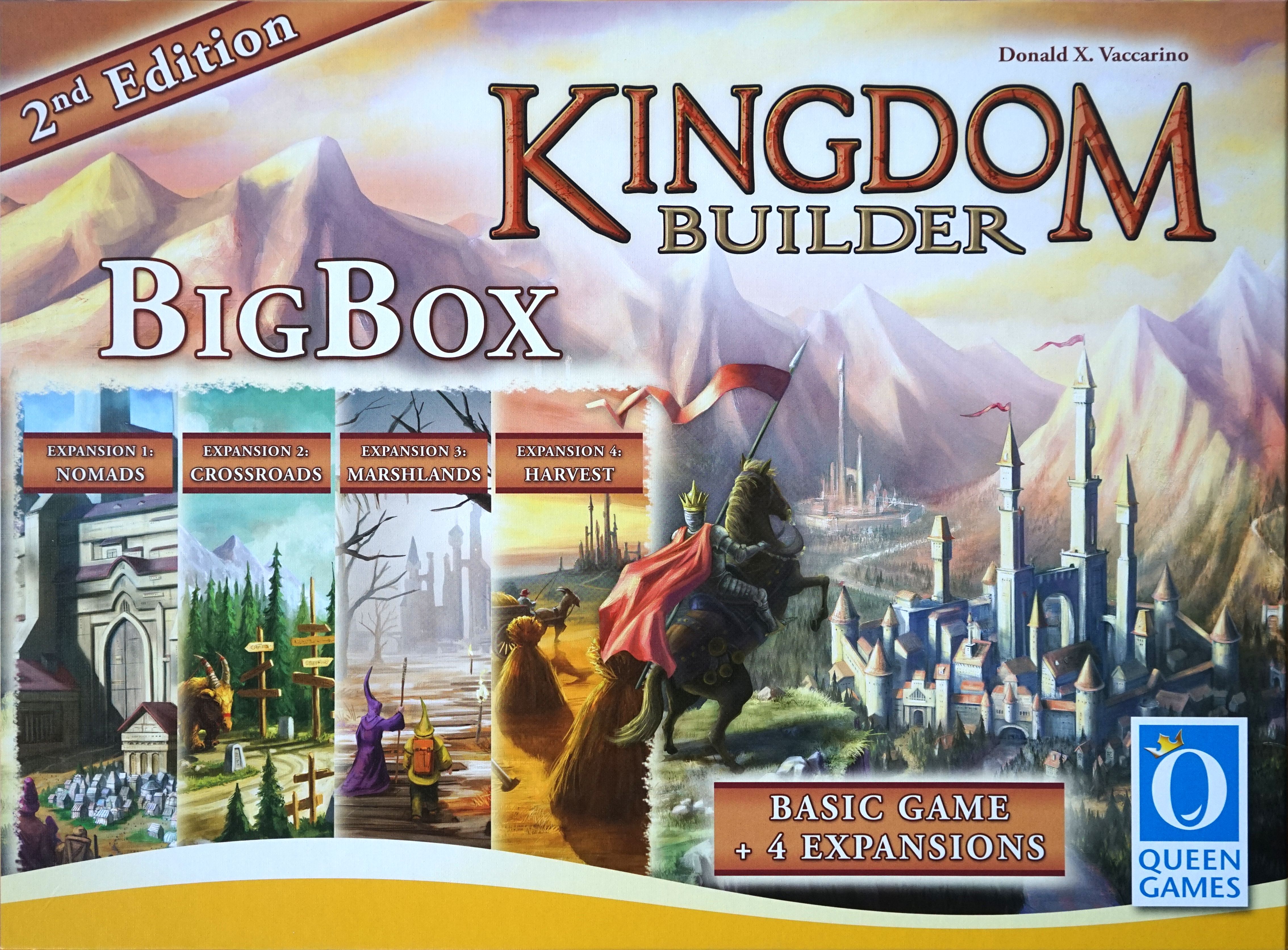
How to Play Kingdom Builder: Big Box (Second Edition)
Queen Games, Calamity Games · Board game · 2017What do you want to do now
Ask anything about Kingdom Builder: Big Box (Second Edition): rules, setup, components, complexity, price, or whether it fits your group.
Step by step
Game Objective
In Kingdom Builder, players aim to efficiently build their own kingdoms by establishing settlements. The main objective is to accumulate the most gold at the end of the game. The specific conditions for earning gold are determined by the 3 Kingdom Builder cards used in each game.
Setup
Game setup follows these steps:
- Board sections: Choose 4 of the 8 available board sections and connect them to form a rectangular board. For the first game, the suggested setup on page 7 of the manual is recommended, which uses the sections with the tavern, corral, oasis, and farm.
- Location tile summaries: Place 4 location tile summaries next to the board sections that correspond to the location hexes.
- Location tiles: Place 2 corresponding location tiles on each location hex.
- Terrain cards: Shuffle all terrain cards and form a face-down pile, within everyone's reach.
- Kingdom Builder cards: Shuffle the Kingdom Builder cards and randomly choose 3. Place them face-up next to the board. For the first game, the suggested cards are Fishermen, Knights, and Merchants.
- Gold point track: Flip over one of the unused board sections and place it next to the board. This will be the gold point track for final scoring.
- Player component distribution:
- Each player chooses a color and receives all 40 settlements of that color, which form their personal supply.
- Each player receives 1 gold marker and places it on the black space of the gold point track.
- Each player draws one terrain card from the pile and keeps it hidden in their hand.
- First player: Give the 1st player token to the oldest player.
- Unused components: Place unused components back in the box.
Game Flow
Players take their turns clockwise, starting with the 1st player. The game lasts several rounds, and each player takes their turn as follows:
- The current player plays their terrain card face-up for everyone to see.
- Then, the player performs their mandatory action of building settlements.
- The player may perform extra actions, if they have location tiles.
- After performing the actions, the player places their terrain card on the discard pile and draws a new terrain card from the deck, keeping it hidden in their hand.
The game continues until a player builds the last settlement from their personal supply. The current round must be completed, with the player to the right of the 1st player being the last to play.
Actions and How to Play
Mandatory Action
During their turn, the player must build 3 settlements from their personal supply on unoccupied hexes of the same terrain type as the terrain card they played. The building rules must be strictly obeyed.
- The 3 settlements must be built successively.
- Building rules:
- Only one settlement can be built on any appropriate terrain space.
- Settlements can only be built on hexes of the terrain types: grassland, canyon, desert, flower field, and forest.
- A player must always build each new settlement adjacent to at least one of their own already existing settlements, if possible. If not possible, the player must choose a new unoccupied hex where they can build their settlement.
- Terrain card exception: If there are no appropriate hexes (of the same terrain type as the played terrain card) for building settlements, the player immediately draws a new terrain card. The unused terrain card is removed from the game. If necessary, the player draws cards until an appropriate one is found.
- Swamp terrain cards (Swamps Expansion): If a player's terrain card shows a swamp and another appropriate terrain type for building, the player must choose between building 2 settlements on empty swamp hexes or 3 settlements on unoccupied hexes of the other terrain type shown. Normal building rules apply.
Extra Actions
During the game, players can accumulate location tiles. Location tiles grant extra actions, and players can perform each extra action once during their turn, before or after the mandatory action. Extra actions allow building additional settlements or even moving already built settlements.
- How to get location tiles: When a player builds a settlement next to a location hex, they immediately take one of these location tiles, if available. They place this tile in front of them, image side up, and can use this extra action starting from their next turn.
- A player can only take one location tile from a given location.
- The player keeps the location tile as long as at least one of their settlements is adjacent to the corresponding location. If they move their last settlement away from that location using an extra action, they must discard that location tile and remove it from the game.
- To indicate that the player has performed an extra action, they flip the corresponding location tile to the image side. After finishing their turn, they flip the tile back to the pictogram side.
- Types of extra actions (examples of location tiles):
- Oracle: Build a settlement on a hex of the same terrain type as the terrain card that was played. Build adjacent to another of your settlements, if possible.
- Farm: Build a settlement on a grassland hex. Build adjacent to another of your settlements, if possible. Skip this action if there are no unoccupied grassland hexes on the board.
- Oasis: Build a settlement on a desert hex. Build adjacent to one of your settlements, if possible. Skip this action if there are no unoccupied desert hexes on the board.
- Tavern: Build a settlement at the end of a line of at least 3 of your settlements. The direction of the line does not matter (horizontal or diagonal). The chosen hex must be appropriate for building.
- Tower: Build a settlement on the edge of the board. Choose any of the 5 appropriate terrain types. Build adjacent to one of your settlements, if possible.
- Barn: Move any of your already built settlements to a hex of the same terrain type as the played terrain card. Build adjacent to one of your settlements, if possible.
- Corral: Move any 1 of your already existing settlements 2 hexes in a straight line, in any direction (horizontal or diagonal) to an available hex. You can skip hexes of any terrain type, even water, mountain, castle, location hexes and/or your or other players' settlements. The destination hex does not necessarily need to be adjacent to one of your settlements (building rule #3 does not apply).
- Port: Move any of your already built settlements to a water hex. Build adjacent to one of your settlements, if possible. This is the only way to build settlements on water hexes.
- Quarry (Nomads Expansion): Build 1 or 2 stone walls on empty terrain spaces of the same type as the played terrain card. The walls must be adjacent to at least one of your settlements on the board. Stone walls block the space they are on for the rest of the game.
- Garden (Nomads Expansion): Build an additional settlement on a flower field space. You must build this settlement adjacent to one of your settlements, if possible.
- Caravan (Nomads Expansion): Move one of your previously built settlements in a straight line, horizontally or diagonally, until you are blocked by an obstacle. Place this settlement on an empty space appropriate for building directly in front of the obstacle.
- City (Nomads Expansion): Build an additional settlement on an empty space appropriate for building that is adjacent to at least 3 of your settlements.
- Forest Cabin (Crossroads Expansion): Build a settlement on an empty forest space. You must build this settlement adjacent to one of your settlements, if possible.
- Crossroads (Crossroads Expansion): Draw an additional terrain card at the end of each of your turns. During your turn, you choose which of your terrain cards you will use for your mandatory action and for your extra actions. Discard both terrain cards after you have finished your actions.
- Town Hall (Crossroads Expansion): During your turn, you can place your town hall token on the board. It must be placed adjacent to one of your settlements on 7 empty spaces appropriate for building. The town hall token counts as 7 settlements for Kingdom Builder cards and task cards.
- Monastery (Crossroads Expansion): Build a settlement on an empty canyon space. You must build this settlement adjacent to one of your settlements.
- Fort (Crossroads Expansion): Draw a terrain card and build a settlement on an empty space of the card's terrain type. You must build this settlement adjacent to one of your settlements, if possible.
- Lighthouse (Crossroads Expansion): Allows you to place, move, or remove your boat on water spaces. Boats are worth gold at the end of the game.
- Wagon (Crossroads Expansion): Allows you to place, move, or remove your wagon on spaces appropriate for building or mountain. Wagons are worth gold at the end of the game.
- Barracks (Crossroads Expansion): Allows you to place or remove one of your warriors on spaces appropriate for building. Warriors prevent building actions on adjacent spaces and are worth gold at the end of the game.
- Refuge (Swamps Expansion): Reallocate one of your previously built settlements to an adjacent unoccupied space appropriate for building; this hex does not need to be adjacent to an already built settlement.
- Spring (Swamps Expansion): Build a settlement next to exactly one of your settlements and next to no other opponent's settlements on any unoccupied space appropriate for building.
- Temple (Swamps Expansion): Remove one of your settlements from the board; you must rebuild this settlement during your mandatory action on your next turn in addition to the other required constructions.
- Canoe (Swamps Expansion): Build a settlement on an unoccupied swamp or water hex, building adjacent to one of your already existing settlements, if possible. However, this action can only be performed after any other player takes the last location tile from a board space.
- Bazaar (Harvest Expansion): The player can repeat any other extra action during their turn. Cannot repeat the farm action.
- Mountain Post (Harvest Expansion): Build a settlement on an appropriate terrain adjacent to a mountain space. The settlement must be adjacent to an already built settlement of the player, if possible.
- Water Mill (Harvest Expansion): Build a settlement on an appropriate terrain adjacent to a water space. The settlement must be adjacent to an already built settlement of the player, if possible.
- Sentry Post (Harvest Expansion): The player can place the 2 sentry tokens on any appropriate terrain or water or mountain spaces on the board, connected to their settlements. They count as settlements during the player's turn, and the player can build new settlements connected to them. They are removed at the end of the turn.
- Cathedral (Harvest Expansion): The player can take 1 numbered settlement token or return any number of numbered settlement tokens to build the same number of settlements on appropriate terrain spaces, according to the drawn terrain card.
- Watchtower (Harvest Expansion): Build a settlement on an appropriate terrain space next to another player's settlement. It must be adjacent to one of your settlements, if possible.
- University (Harvest Expansion): Build a settlement on an appropriate terrain space next to a location (including castles, nomad spaces, palaces, and silos). It must be adjacent to one of your settlements, if possible.
- Palisade (Harvest Expansion): Move a settlement to an appropriate terrain space connected to the same settlement area.
- Tree House (Queenie 3: Island): Move
Rules manual
Official PDF file
Frequently Asked Questions
Quick answers about the rules
What is the objective of Kingdom Builder: Big Box (Second Edition)?
How do you set up Kingdom Builder: Big Box (Second Edition)?
How do you play Kingdom Builder: Big Box (Second Edition)?
Other Games You'll Like
Based on mechanics and theme