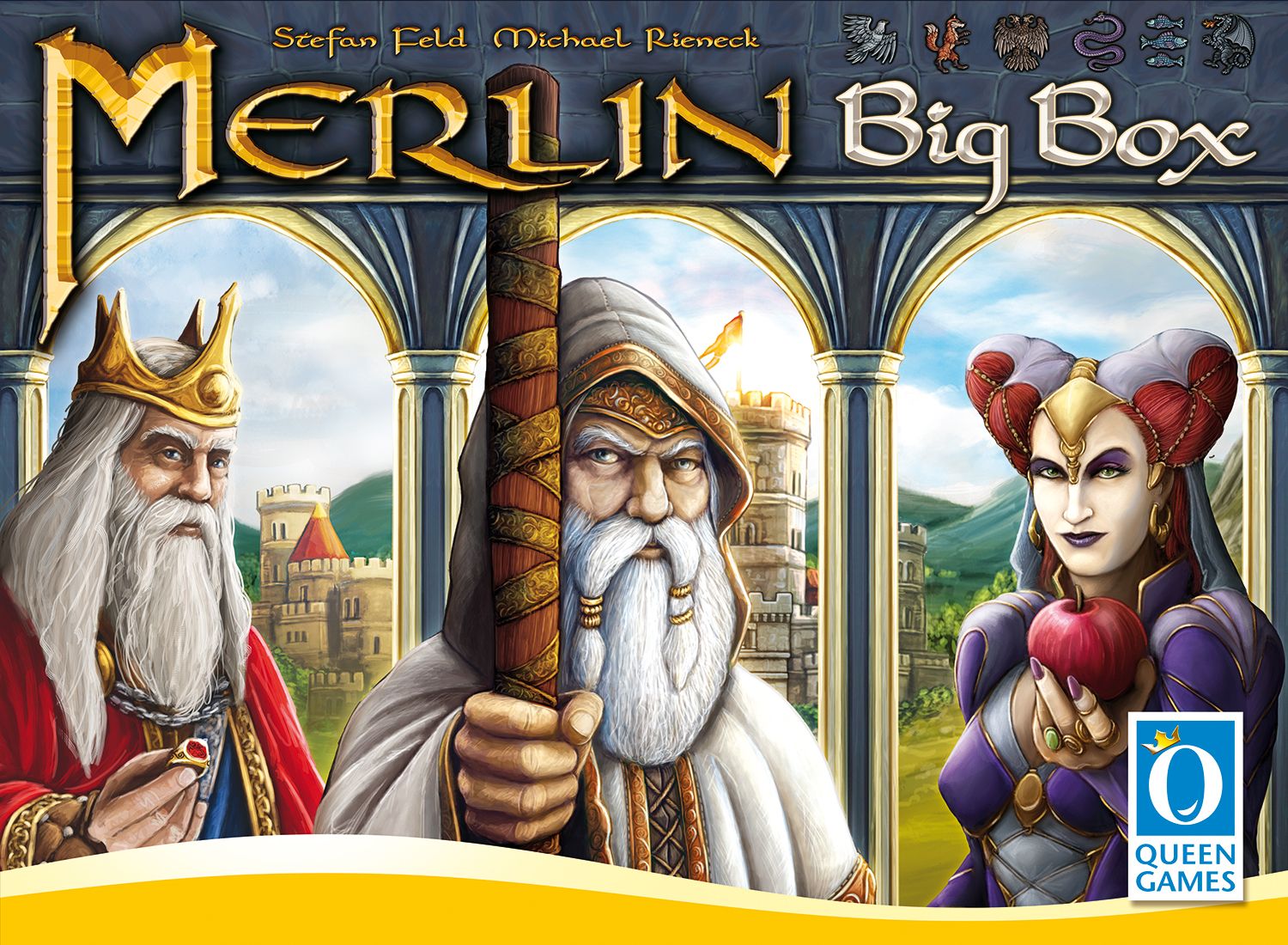
How to Play Merlin: Big Box
Queen Games · Board game · 2020What do you want to do now
Ask anything about Merlin: Big Box: rules, setup, components, complexity, price, or whether it fits your group.
Step by step
Game Objective
In Merlin: Big Box, players take on the role of knights of the round table, seeking to become the worthy successor to King Arthur's throne. Together with Merlin, they compete to earn King Arthur's favor, accumulating the most victory points by the end of six rounds. Players use their dice to move Merlin or their own knight on the action medallion, performing the actions of the spaces where they end their movements. The game involves repelling traitors, building manors in the outskirts, exerting influence in the principalities, positioning vassals on the board, and completing missions. The player who accumulates the most victory points after the final scoring of the sixth round will be King Arthur's successor.
Setup
- Place the game board in the center of the table.
- Place the round marker on the first space of the round track.
- Merlin starts on the Dragon Principality (black) space on the medallion.
- Assemble the Grail and Excalibur and place them in their corresponding spaces.
- Separate the banners, building materials, and shields, and place them in their corresponding principalities.
- Place the apples in their corresponding space.
- Shuffle the mission cards and form a face-down deck on the board. Reveal the top three cards from this deck and place them face-up on the card display next to the board.
- Shuffle the traitors face-down and place them in their corresponding spaces, in three separate piles.
- Build the outskirts next to the board: shuffle all terrain tiles, then place 6 tiles in a row, face-up, below the upper terrain border. Continue creating rows below until all tiles are placed. Then, close the outskirts with the lower terrain border.
- Note: In a 2 or 3 player game, before shuffling the terrain tiles, remove 1 mountain, forest, and lake tile, with and without a tower (totaling 6 tiles) and return them to the game box.
- Randomly determine the first player and give them the first player marker.
- Each player chooses a color and receives the following components in that color: 1 castle board, 1 knight, 4 vassals, 6 influence markers, 3 Merlin's staffs, 7 manors, 1 scoring marker, 1 100-point marker, 3 dice in their color, 1 white Merlin die, and 1 apple.
- All players place their scoring marker on the "0/100" space of the score track, and place their manors next to the outskirts.
- The remaining components are placed on each player's castle board as shown in the image next to it. For now, each player should keep their knight near their castle board and place the 100-point marker next to the board.
- Shuffle the starting tiles and give one to each player. Then, each player places their knight on the designated principality space on the action medallion. Each player takes the banner, shield, and building material from the indicated principality from the board, placing them on their own castle board. Each player places one of their influence markers on the indicated principality. Return the starting tiles to the game box.
- Now, each player takes 3 traitors from the board and places them in the spaces on their castle board, above their corresponding shield. Traitors with identical shields are stacked. Each player forms a hand of 4 mission cards from the deck.
- Finally, each player rolls their 4 dice and places them on their castle board. If a player rolls 3 or 4 identical values, they must re-roll all their dice, repeatedly, until the result shows at least 3 different numbers.
Game Flow
A game of Merlin is played over 6 rounds. Each round begins with the first player's turn, followed by the other players clockwise.
Round Details:
- Player's Turn: During their turn, the active player chooses one of their dice and moves their knight, or Merlin, a number of spaces on the action medallion equal to the die's value, and then performs the action of the space where the movement ended.
- End of Turn: After the active player has completed their action (or chosen not to), their turn ends, and the next player takes their turn.
- End of Round: The round ends when all players have used all their dice (4 turns per player in the base game).
- Scoring: Scoring occurs after the second, fourth, and sixth rounds.
- Preparing for the Next Round:
- Each player rolls their 3 personal dice and 1 Merlin die. If a player gets 3 or 4 identical values on the dice, they must re-roll all dice, repeatedly, if necessary, until the result shows no more than 2 times the same value. After rolling, players place their dice on their castle boards, being careful not to change their faces.
- Move the round marker to the next space on the round track.
- The first player marker is passed to the next player to the left, who will be the first player in the next round.
Actions and How to Play
During their turn, the player chooses a die from their castle board and places it in the center of the board without changing its value. Depending on the chosen die, they proceed as follows:
- One of the player's personal dice: The player advances their knight, clockwise, on the action medallion, a number of spaces equal to the die's value.
- Merlin's white die: The player advances Merlin, clockwise or counter-clockwise, on the action medallion, a number of spaces equal to the die's value.
Then, the player performs the action of the space where their movement ended. A player cannot skip their turn; they must choose a die, place it in the center of the board, and move the knight or Merlin, accordingly. However, they may choose not to perform the action of the space.
Action Medallion Actions:
- Principality spaces (x6): The player chooses one of their four vassals from their castle board, or from any of the other 5 principalities, and places it in the space corresponding to the principality where they ended their movement. If this space is occupied by a vassal (of the same type) of another player, that player's piece is returned to its owner's castle board. Each vassal allows the player to perform a specific action:
- Builder: The player receives a building material from that principality, if available, and places it on their castle board.
- Standard Bearer: The player receives a banner from that principality, if available, and positions it next to their castle board. A player can have more than one banner of the same type.
- Squire: The player receives a shield from that principality, if available, and positions it on their castle board.
- Lady-in-Waiting: The player takes one of their influence markers from their castle board, if available, and positions it in that principality. It is added to any existing markers there.
- Victory point spaces (x4):
- Shield, banner, building material: The player gains one victory point for each shield, banner, or building material on their castle board, depending on the space.
- Influence marker: The player gains one victory point for each of their influence markers that are in the principalities (on the board).
- Vassal: The player chooses a principality in which they have at least one influence marker and sends one of their vassals there to perform its action. The vassal can come from their castle board, or from any of the other 5 principalities.
- Influence spaces (x4):
- Banner, building material, shield: Depending on the space, the player receives a shield, a banner, or a building material from any principality where they have at least one influence marker, and places it on their castle board.
- Relocate a vassal (x1): The player chooses one of their vassals from any principality and relocates it to the next principality clockwise or counter-clockwise. This vassal then performs its action.
- Exception: If all of a player's vassals are currently on their castle board, the player can choose one of them and send it to a principality of their choice where it will perform its action.
- Exchange spaces (x2): The player chooses a shield, banner, or building material from their castle board and returns it to its original principality. In exchange, they receive a shield, banner, or building material from any principality and place it on their castle board.
- Mission spaces (x2): The player can discard up to two of their mission cards and then draw the same number from the card display and/or the deck. When a card is drawn from the display, immediately replace it with a face-up card from the draw pile. If the pile is empty, shuffle the discard pile to form a new draw pile.
- Excalibur (x1): The player defeats a traitor from their castle board and places it in the discard pile. If they do not yet possess Excalibur, they take it from the board or from the player who possesses it.
- The Grail (x1): The player takes an apple from the supply and places it on their castle board. If they do not yet possess the Grail, they take it from the board or from the player who possesses it.
- Build a manor (x3): The player can build a manor in the outskirts. A manor can be built on any terrain tile that is not already occupied by a manor, provided the player has the required building material on their castle board.
- To find which materials are eligible, trace a straight line in all six directions, and where it intersects with the border (upper or lower), a possible building material will be indicated.
- The player returns one of the required materials to its original principality and places one of their manors on the terrain tile.
- If the tile shows a tower, the player can additionally take a shield or a banner from any principality, or place one of their influence markers in any principality.
- A player cannot build more than 7 manors.
Additional Actions:
- Merlin's Staffs: When a player moves Merlin, they can spend a staff to perform the chosen action twice. The first action must be completed before the second. Return the staff to the game box.
- Apples: The active player can spend an apple from their castle board (returning it to the supply) to change the face of a chosen die to any other face, from 1 to 6. They move their knight the number of spaces according to the value of the chosen face.
- Mission Cards: The active player can complete (only) one of their mission cards at any time during their turn. Each mission card describes the necessary requirements in the upper left corner of the card. If the player meets all the requirements of the card, they gain the victory points shown on a shield in the upper right corner of it, and place it in the discard pile.
- After a player has completed one of their mission cards, they draw a new card at the end of their turn. They can take a card from the display or from the deck. When the chosen card comes from the display, immediately replenish it with a face-up card from the draw pile. If the draw pile runs out, shuffle the discard pile to form a new draw pile.
- Important: The player only needs to have the necessary shields, banners, building materials, or influence markers to fulfill the requirements of a mission card. They do not need to spend them.
End of Game and Scoring
The game ends at the end of the sixth round. Players gain victory points depending on their success in the 4 categories described below. Victory points are marked on the score track with each player's marker. A marker landing on a space occupied by another marker is placed on top of it. If a player's victory points exceed the "100" space mark, that player takes a 100-point marker and places it next to their castle board. At the end of the game, that player adds 100 to their score.
Scoring Categories (after the 2nd, 4th, and 6th rounds):
- Traitors:
- First, players need to expel the traitors in front of them. A traitor is expelled
Rules manual
Official PDF file
Frequently Asked Questions
Quick answers about the rules
What is the objective of Merlin: Big Box?
How do you set up Merlin: Big Box?
How do you play Merlin: Big Box?
How does Merlin: Big Box end, and how do you score?
Other Games You'll Like
Based on mechanics and theme