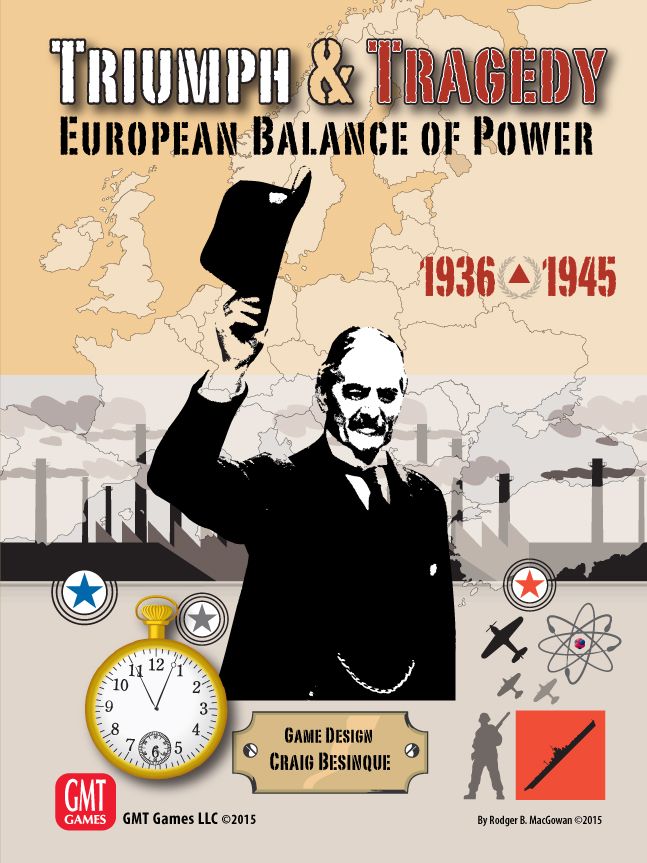
Triumph & Tragedy: European Balance of Power 1936-1945 — Prices
GMT Games · Board game · 2015
2–3 · best 3
240–360 min
Weight 3.4/5
Buy · from US$ 21.39
100.0
rating
Ludopedia
8.1
rating
BGG
Our Verdict
If you love games that blend diplomacy, economy and epic battles, Triumph & Tragedy is your next challenge.
Highlights
- Unique blend of diplomacy and warfare
- Economic dominance as a viable win
- Engaging area mechanics
Keep in mind
- High complexity, requires focus
- Long playtime (4‑6h)
Rules manual not indexed yet
Upload the PDF rulebook to ask questions about this game with AI.
About the game
What you do in a play session
Triumph & Tragedy: European Balance of Power 1936-1945 is a geopolitical strategy game that places you at the center of an arms race, diplomacy, and territorial conquest in pre‑WWII Europe. Three great powers – Capitalism (the West), Communism (the Soviet Union) and Fascism (the Axis) – vie for economic, technological or military hegemony, and each can choose a different path to victory. The 22×34 map covers Eurasia, India and even the Americas, but the action is focused on Europe. Military units are 5/8‑inch blocks, with seven types (infantry, tank, fortress, air force, transport, fleet and submarine) in seven distinct colors, allowing varied tactical compositions. Production – the minimum of controlled population, resources and industry – determines what each power can spend on units, action cards or investment cards. Action cards provide diplomacy, command and resources, while investment cards boost industry, technology and unit abilities. Victory can come in three ways: economic hegemony (production + peace dividends + atomic research), technological supremacy (building the atomic bomb) or military victory (capturing two enemy capitals). Diplomacy can be used to win over smaller nations and control resources, but the game also allows naval blockades, strategic bombing and ground invasions. Combat occurs when units occupy the same area, with shots and dice deciding the outcome. The “area movement” and “movement points” mechanics keep each turn fast and strategic. Additionally, “area majority” and “influence” mechanics make territorial control decisive. The game lasts 4‑6 hours, with high complexity demanding constant attention and long‑term planning. If you enjoy games that blend diplomacy, economy and large‑scale combat, Triumph & Tragedy delivers a deep, immersive experience full of twists and replayability.
Gallery
Box and component photos
Tap any photo to open fullscreen. Photos submitted by the community or publisher.
Rules videos
Learn by watching before you open the box
In English
-
 Extended Example of Play (1 of 2)
-
 Extended Example of Play (Part 2 of 2)
-
 T&T - intro
-
 How to Play Triumph & Tragedy, Part 1 - Map, Units, Diplomacy (Greek Subbed)
-
 How to Play Triumph & Tragedy, Part 3 - Combat, Blockade, Victory (Greek Subbed)
-
 How to Play Triumph & Tragedy, Part 2 - Movement, Supply (Greek Subbed)
-
 How to Play Triumph & Tragedy, Part 4 - Beginners' Tips and German Strategy (Greek Subbed)
-
 How to Play Triumph & Tragedy, Part 5 - Soviet Strategy (Greek Subbed)
-
 How to Play Triumph & Tragedy, Part 6 - West Strategy (Greek Subbed)
Best player count
BGG community vote
2
OK
3
BEST
Soundtrack
Ambience suggested by Melodice
Loading playlist...
Where to Buy
Prices monitored daily
Finding best prices...
Prices unavailable at this time.
Price history — last 6 months (lowest new offer)
Alert enabled!
Join the BoardGamesBot deals group
Get the best board game deals every day — without message spam.
Join the WhatsApp groupGame details
Mechanics, categories, families and credits
Mechanics
Categories
Families
Publisher
GMT Games
Designer
Craig Besinque
Artist
Charles Kibler, Rodger B. MacGowan
Community
Data from BoardGameGeek
4,028owners
1,590wishlist
261want to play
Frequently Asked Questions
Quick answers before you buy
What is the average game length?
Between 4 and 6 hours, depending on how much diplomacy and combat play out.
How many players can join?
It works well with 2 or 3 players, but the three‑way dynamic creates a unique tension.
What are the main components?
Unit blocks, 55 action cards, 55 investment cards, 30 peace dividend chips, 110 markers and a 22×34 map.
Is the game more strategic or tactical?
It’s a mix of both: macro‑economic strategy and area‑level combat tactics.
Who is this game best suited for?
Fans of war, diplomacy and economics who enjoy long, complex sessions.
How does economic victory work?
By adding production, peace dividends and atomic research; if it reaches 25 or is the highest in 1945, you win.
Which cards are essential?
Action cards (for diplomacy and command) and investment cards (for industry and tech).
Other Games You'll Like
Based on mechanics and theme