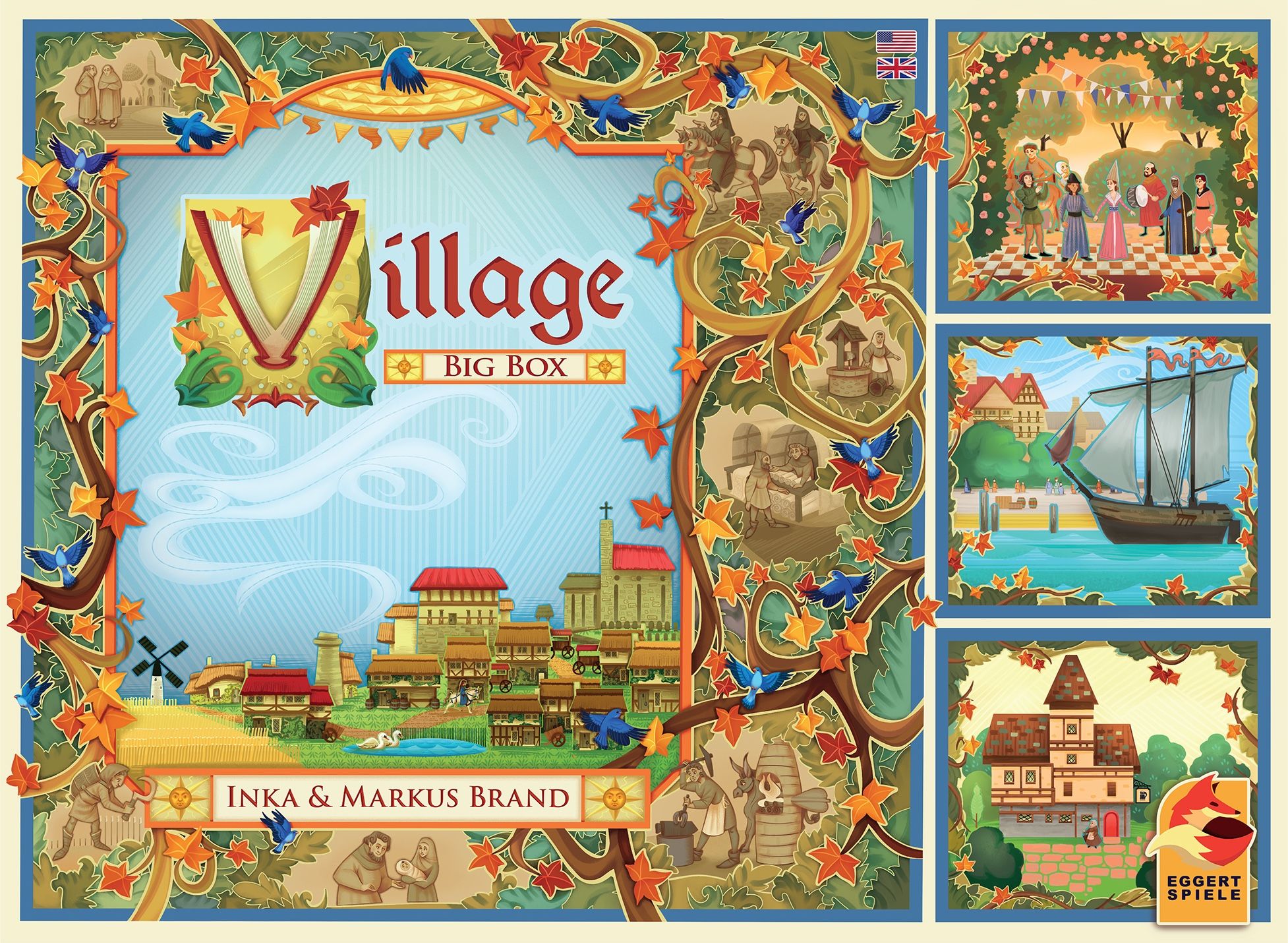
How to Play Village: Big Box
eggertspiele, Delta Vision Publishing, GoKids 玩樂小子 · Board game · 2023What do you want to do now
Ask anything about Village: Big Box: rules, setup, components, complexity, price, or whether it fits your group.
Video: How to Play
Start here, then follow the written guide
Step by step
Objective of the Game
Life in this village is tough, but it offers a lot of room for development! Each player represents the head of a family aiming to rise to prominence. The most important thing to remember is that time cannot be stopped, and eventually, family members pass away. Players must work hard to increase their family’s fame and gain prestige points. The game ends when a specific trigger occurs, and the player with the most prestige points wins the game and is immortalized in the village chronicle.
Preparation (Setup)
- Place the game board with the 4 suns (in the corners) in the middle of the table. It shows the village with its various areas and the prestige track on the right.
- Each player chooses a color. Take the farmyard of your color and place it in front of you. Your farmyard is home to your family members, and you may also store as many influence cubes, coins, and goods tiles as you like on it. Each farmyard can only store a maximum of 5 bags of grain. Furthermore, the life time track of your family can be found in the upper right of your farmyard.
- Take the 11 family members (4x “1”, 3x “2”, 2x “3”, 2x “4”), the 6 disc markers, the life time track token, and the point track token of your chosen color. Put your 4 family members with a “1” onto your farmyard. This is the first generation of your family. The 7 remaining family members are future generations; set them aside in a general supply for now.
- Put your life time track token on the life time track of your farmyard, into the space to the right of the quill. Put your point track token onto the sun (which is space “0” of the prestige track) in the lower right corner of the game board.
- Give each player 1 coin, to place onto their farmyard. Place the remaining coins in a general supply next to the game board.
- Shuffle the customer tiles face down and place them next to the market as a face down pile. Depending on the number of players, turn a certain number of tiles face up and add them to the market:
- in a 5- or 4-player game: put a tile on each of the 10 spaces
- in a 3-player game: the space labeled “4-5” remains empty
- in a 2-player game: the spaces labeled “3-5” and “4-5” remain empty.
- Place the village chronicle nearby the graveyard next to the game board. If you play with less than 5 players, use family members of an unclaimed color to reduce the number of available spaces in the chronicle and the graveyard.
- in a 4-player game: put an unused family member on each space and grave labeled “5”
- in a 3-player game: put an unused family member on each space and grave labeled “4-5” or “5”
- in a 2-player game: put an unused family member on each space and grave labeled “3-5”, “4-5” or “5”
- in addition, if you do not play with the expansion Marriage the two spaces in the chronicle with the marriage icon are always covered with family members of an unclaimed color (or use the two pink family members from the Marriage expansion).
- Place the next starting player marker on its designated space of the council chamber.
- Place the 60 goods tiles (horses, oxen, wagons, plows, and scrolls) next to the game board as a general supply.
- Place the 25 bags of grain, the influence cubes, and the 6 plague cubes next to the game board as a general supply. Also place the green bag nearby.
- Put the 4 monks into the black bag and place it near the church.
- Take the base game setup card (with the sun) that matches the number of players and place it nearby. Return the remaining setup cards to the game box. Also place the mass overview card near the game board.
- The oldest player becomes the starting player and receives the starting player marker.
- The following starting compensations are recommended:
- 1st player: Starting player marker
- 2nd player: 1 bag of grain
- 3rd player: 1 influence cube randomly determined (e.g., rolling the die)
- 4th player: 1 influence cube selected from the supply
- 5th player: 1 (additional) coin
Flow of the Game
The game is played over several rounds, during which you control the fate of your family members by placing them wisely in the village. They may give you prestige, influence, goods, or money depending on which profession you choose for them. The different areas in the village allow for a variety of options. Each area has an associated action space where you can gain different types of influence and trigger certain actions. In addition, many of these actions cost time. And just like in real life, the oldest family members eventually pass away.
Phase 1 - Seeding the action spaces
At the beginning of each round, seed the action spaces with influence cubes and plague cubes. The setup card shows how many different influence cubes you must take from the supply and add to the green bag at the beginning of a round. In addition, you must add all (6) available plague cubes to the bag. Once the cubes are in the bag, mix them thoroughly. Then distribute a certain number of randomly drawn cubes onto each action space on the game board. The number of cubes per action space is also shown on the setup card.
Phase 2 - Take a cube and perform the action
Beginning with the starting player, players take turns carrying out actions:
- Step 1: Take a cube from an action space
On your turn, you must take one influence or plague cube from an action space of your choice.
Exception: You perform the substitute action (see "Well" below).
If it is an influence cube, put it on your farmyard. (You may store any number of influence cubes on your farmyard.)
If it is a plague cube, immediately return it to the supply and lose 2 time. This means you must move your life time track token 2 spaces forward in clockwise direction. - Step 2: Perform the action of the action space
You may then perform the action of the action space from which you took the influence or plague cube. You are allowed to only take the cube and not carry out the action.
Exception: If the cube is taken from the market space, a market day must be held.
Then, repeat steps 1 and 2 with the next player in clockwise order until there are no more cubes on the action spaces.
Phase 3 - End of a round
When a player takes the last cube from the game board (i.e., all action spaces are empty), they first may carry out their action as usual. The current round is then finished and a mass is held. The new round starts again by filling the green bag with cubes and seeding the action spaces.
Actions and How to Play
The different areas in the village allow for a variety of options. Each area has an associated action space where you can gain different types of influence and trigger certain actions. Many of these actions cost time.
The "currency" time
Whenever you perform an action that costs time (every hourglass represents one unit of time), you must move your token on your life time track forward (clockwise) the appropriate number of spaces. In addition, you lose 2 time whenever you take a plague cube. As soon as your marker passes the quill, one of your oldest family members passes away.
A family member passes away
During the game, you must often pay for actions with time by moving the token on your life time track forward in clockwise direction. Once you move the token past the quill, one of your oldest family members passes away. First finish your chosen action and then at the end of your turn, decide which of your oldest family members dies. Exception: Anyone who moves their life time track token past the quill during a market day must immediately choose which of their family members dies. Of your family members, it is always the one with the lowest number that has to die. If you have several family members with the lowest number, you can choose one of them. A dying family member must be visible at the time of their death. This means that they must be either on the game board or on your farmyard, otherwise you do not lose a family member. Family members still in the black bag cannot die, nor can ones that have not yet entered play (from the supply).
For a dying family member, there is always one of two possibilities:
- There is still a free space in the village chronicle
The village chronicle records the stories of the great residents and their deeds. It has a few spaces open for each professional category. Depending on where the family member “worked” at the time of their death, they are added to one of the following empty spaces. - There is no proper space left in the village chronicle
In this case, the family member is placed onto one of the graves next to the church. Here they can rest in peace, but are not worth any prestige points.
Influence Cubes
Influence cubes are required for performing certain actions in the village. The following types of influence are available:
- Orange: Represents Skill, required for crafts, travel.
- Green: Represents Persuasiveness, required for market, council chamber.
- Brown: Represents Faith, required for church, travel.
- Pink: Represents Knowledge, required for crafts, travel.
- Black: The black cubes are not a type of influence. They are plague cubes that reduce the life span of your family members.
The Coins
You get coins at the mill or while traveling. There are 3 possible ways to use coins:
- To buy prestige points in the council chamber (at the 4th stage).
- To ensure your family members are chosen from the black bag during a mass.
- As a SUBSTITUTE for any one influence cube.
Grain Harvest Action
If you have one or more family members on your farmyard, then you may perform a harvest action. Immediately take 2 bags of grain from the supply and place them onto the appropriate spaces of your farmyard. If you do not have any family members on your farmyard, then you cannot perform this action!
- Take 3 bags of grain, if you own a horse and a plow in addition to your farming family members.
- Take 4 bags of grain, if you own an ox and a plow in addition to your farming family members.
You may never use more than one combination (i.e., several family members, plows, oxen, or horses are of no additional use during a harvest). Thus 4 bags of grain is the maximum you can take with a grain harvest action. Your goods are not used up during the harvest. Your family members remain on your farmyard as well.
Family Action
This action represents a new family member being born. Immediately take one family member of your color from the general supply and add it to your farmyard. You must always take the family member with the lowest available number from your supply. Important: Instead of taking a new family member from the supply, you may use this action to instead return one of your family members (not yet deceased) from the game board to your farmyard.
Crafts Action
This action allows you to produce 1 good in one of the five craft buildings. (Take the corresponding goods tile and put it on your farmyard.) Exception: At the mill, you get 2 coins instead. There are two ways of producing a good. At each craft building (except the mill), you may choose:
a) to pay for the produced good with time (for this you also need a family member in the craft building); OR
b) to pay for the produced good with influence cubes (or bags of grain, depending on the good).
a) Acquire goods by spending time
If you want to pay for a good with time, you first need to train a family member at the appropriate craft building. Place a family member from your farmyard below the craft building that you want to use. This costs you a certain amount of time: the number of hourglasses illustrated on the tree next to it. You may then immediately produce the corresponding good by paying as much time as indicated on the left of each craft building. Your family member will remain below the same craft building for the rest of the game (unless they die or return to the farmyard by means of the “family” action). As long as they remain below the craft building, you may produce a good again by means of the “crafts” action. In doing so, you now only pay as much time as indicated on the left of the respective craft building (since your family member is already trained).
- Wainwright:
- a) Spend 2 time with a trained family member to gain a wagon.
- b) Pay 1 orange and 1 pink influence cubes to gain a wagon.
- Stables:
- a) Spend 3 time with a trained family member to gain a horse or an ox.
- b) Pay 3 bags of grain to gain a horse or an ox.
- Office:
- a) Spend 2 time with a trained family member to gain a scroll.
- b) Pay 1 pink influence cube to gain a scroll.
- Smithy:
- a) Spend 3 time with a trained family member to gain a plow.
- b) Pay 1 orange and 1 pink influence cubes to gain a plow.
Rules manual
Official PDF file
Frequently Asked Questions
Quick answers about the rules
What is the objective of Village: Big Box?
How do you set up Village: Big Box?
How do you play Village: Big Box?
Other Games You'll Like
Based on mechanics and theme